In Kelowna, a first ADHD counselling session usually lasts 50 to 60 minutes and follows a structured intake process that includes forms, questions about your history, and a conversation about how ADHD is affecting daily life. In BC, that first meeting also commonly begins with a 5 to 10 minute discussion of consent and confidentiality, so you know what to expect before you start sharing personal information. For more information, see our Kelowna counselling.
'Your first Kelowna ADHD counselling session is a structured, 50-minute conversation in a safe space, where your counsellor gets to know you, understands your challenges, and collaboratively outlines initial goals for managing your ADHD.'
If you're reading this, you might be in a very familiar place. Maybe you've opened a booking page three times and closed it three times. Maybe you're wondering whether you'll forget what you meant to say, talk too much, freeze completely, or leave feeling exposed and misunderstood.
Those worries make sense. Many people seeking kelowna adhd counselling: what to expect from your first session aren't just asking about therapy. They're asking, "Will this feel manageable for my brain?" That's an important question, because a neurodiversity-affirming first session doesn't only talk about ADHD. It adapts the session itself to support attention, memory, pacing, and emotional safety.
For some families, part of the bigger picture also includes assessment questions. If you're still sorting out whether formal diagnosis is part of your path, this overview of a professional ADHD evaluation for families can help you understand how counselling and assessment may fit together.
Taking the First Step Towards ADHD Counselling
A first appointment often begins long before the session itself. It starts when someone says, "I can't keep doing this the hard way." For one person, that might mean work deadlines keep slipping because time seems to disappear. For another, it might mean parenting feels harder than it "should," or relationships keep getting strained by forgetfulness, overwhelm, or impulsive reactions.
Many people arrive carrying shame. They've been told they're lazy, inconsistent, dramatic, scattered, careless, or not trying hard enough. By the time they consider counselling, they're often exhausted from compensating.
A good first session doesn't treat that exhaustion as a character flaw. It treats it as information.
Why the first step can feel so hard
ADHD can affect planning, remembering, transitioning, organising thoughts, and starting tasks. That means even booking therapy can take real effort. You might want support and still procrastinate. You might care very much and still miss an email. That doesn't mean you're not ready. It means your brain may need a process that's clear, structured, and gentle.
You do not need to arrive polished, perfectly organised, or able to explain your whole life story in order.
In Kelowna, ADHD affects approximately 5 to 7% of children and 2.5 to 4% of adults, aligning with Canadian prevalence rates reported by the Public Health Agency of Canada. If you're struggling, you're not alone, and it makes sense that many people want clearer guidance about what that first hour will feel like.
What most people need to hear first
Your first session is not a test. You're not expected to prove you have ADHD, defend your struggles, or perform insight on command. You also don't need to tell everything in order.
What matters most is starting somewhere real.
That might sound like:
- "I lose track of time constantly." You don't need a polished explanation.
- "I can do well in bursts, then everything falls apart." That's useful clinical information.
- "I don't know if it's ADHD, anxiety, burnout, or all three." That's okay too.
Counselling works best when the room feels safe enough for honesty, not perfection.
The Intake Process and Your Initial Assessment

You log in a minute late, forget what you meant to mention, and worry that you have already started badly. A good ADHD-informed intake is built for moments like that.
The first session usually has more structure than a regular conversation, but the structure is there to reduce pressure, not create it. In many Kelowna counselling practices, the opening appointment includes some intake paperwork and a guided assessment conversation that helps the therapist understand your history, your current struggles, and what kind of support may fit best.
A useful comparison is a map with highlighted landmarks. Your counsellor has a few places they need to visit, but there is still room to pause, back up, or take a different route if your mind jumps ahead. If you lose your train of thought, that is not an interruption to the assessment. It is part of the information.
What happens before the conversation starts
Many therapists send forms before the session. Some clients like that because it gives them time to reflect. Others open the form, feel overwhelmed, and close the tab.
Both responses make sense.
An ADHD-affirming therapist does not treat difficulty with forms as resistance or laziness. They understand that planning, sequencing, time estimation, and working memory can all affect how intake gets done. You may be offered a shorter form, the option to complete part of it together, or reminders that break the task into smaller steps.
The paperwork often asks about:
- Basic background information, such as contact details, health history, and important family or relationship context
- Current concerns, such as distractibility, missed deadlines, emotional overload, chronic procrastination, or conflict at home or work
- What you want help with, even if your answer is still rough or uncertain
- Practical needs, such as online versus in-person sessions, scheduling preferences, sensory considerations, or communication supports
That flexibility matters. The intake process itself can show a therapist how your brain manages demands in real time.
What the counsellor is listening for
During the assessment, the therapist is usually trying to understand patterns, not collect perfect answers. They are listening for how attention, impulsivity, organisation, motivation, and emotional regulation show up in daily life.
A question about lateness, for example, is rarely just about lateness. It may be exploring time blindness, transitions, shame, or the amount of invisible effort it takes you to get out the door. A question about unfinished tasks may be examining initiation, overwhelm, perfectionism, or mental fatigue.
You might hear questions like these:
| Area | What you might be asked |
|---|---|
| Attention | Do you drift off during conversations, reading, or meetings even when you care about the topic? |
| Organisation | Is it hard to start, estimate, sequence, or complete tasks? |
| Emotions | Do frustration, shame, or irritability rise quickly and linger? |
| Relationships | Do other people misread forgetfulness or inconsistency as a lack of caring? |
| History | Have these patterns been present for a long time, or did they become more noticeable during stress, burnout, or major life changes? |
If your answer is, "I know this happens, but I can't think of an example right now," that is still useful. Working memory gaps often show up under pressure, and a skilled therapist will help you slow the moment down instead of pushing harder.
ADHD-informed intake looks different
A neurodiversity-affirming therapist adapts the intake process to fit the person in front of them. They may ask one question at a time, summarise what they heard, offer choices instead of open-ended prompts, or gently keep track of the thread when your thoughts branch in five directions at once.
That can sound like:
- "Let's stay with mornings for a minute."
- "Would it help if I gave a few examples?"
- "I want to check that I understood you correctly."
- "We can write that down and return to it."
- "You do not have to remember everything right now."
Many adults with ADHD have spent years in conversations where they were corrected, rushed, or told they were not trying hard enough. A good first session feels different. It helps you tell the truth with less strain.
Your initial assessment should leave you feeling more understood, not more scattered. Even if you do not cover everything in one hour, the process should feel clear enough that your nervous system can settle and your story can start to take shape.
Building the Therapeutic Alliance and Understanding Confidentiality
The most important part of a first session is not the paperwork. It's the relationship taking shape in the room.
Therapy tends to help when you feel respected, understood, and safe enough to be honest. That doesn't mean instant comfort. Many people feel awkward at first. What matters is whether the counsellor responds in a way that creates steadiness rather than pressure.
In BC, first ADHD counselling sessions typically begin with a 5 to 10 minute briefing on consent and confidentiality, as required under BC's Health Professions Act and described in this explanation of first therapy sessions in BC. That early conversation matters because trust grows when you know the rules of the space.
What confidentiality really means
Confidentiality means what you share in counselling is private within the professional limits your counsellor explains to you. They should tell you, in plain language, what stays private and what exceptions apply.
People often worry they'll say the wrong thing and lose control of the conversation. Clear consent helps reduce that fear. You deserve to know what your rights are before getting into vulnerable material.
A counsellor will usually explain:
- How your information is protected
- What records are kept
- When privacy has legal limits, such as serious safety concerns
- How you can ask questions or clarify anything you don't understand
If you've had experiences where your words were dismissed, used against you, or misunderstood, this part can feel surprisingly emotional. That's normal.
You're also assessing the counsellor
The first session isn't only for the therapist to learn about you. It's also your chance to notice how the interaction feels.
Ask yourself:
- Do I feel talked down to, or spoken with respect?
- Does this person seem to understand ADHD beyond stereotypes?
- Can they hold structure without becoming rigid?
- Do I feel safer by the end than I did at the beginning?
A strong therapeutic alliance often begins with small moments. A counsellor remembers what you said, notices when you're overwhelmed, and adjusts without making you feel like a problem.
What neurodiversity-affirming trust can look like
In an ADHD-affirming first session, the counsellor doesn't interpret fidgeting, tangents, lateness, forgetfulness, or emotional intensity as a lack of effort. They treat those responses as meaningful parts of your experience.
That doesn't mean there are no boundaries. It means the boundaries are humane.
For example, if you lose your place mid-sentence, a supportive therapist may help you return without embarrassment. If you start apologising for rambling, they may reframe that by saying your thinking style makes sense and they're following with you. Those moments build trust far more than polished clinical language ever could.
How to Prepare for Your First ADHD Counselling Session

It is 10 minutes before your first appointment. You know the session matters, but now your brain is asking seven questions at once. Should you bring notes? What if you forget the important part? What if you talk too much, or freeze and say almost nothing?
That kind of scramble is common with ADHD. Preparation helps most when it lowers pressure instead of adding another task to manage. A good first session is not a test of how organised you can be. It works more like setting a few trail markers before a walk, so you do not have to rely on memory alone once you begin.
In our experience, structured intake supports can make the process feel more manageable for clients. In neurodiversity-affirming ADHD counselling, that support often begins before the conversation starts. The therapist may send a form ahead of time, offer reminders, provide a clear agenda, or welcome point-form notes during session. Those choices matter because they adapt the process to ADHD traits like time blindness, working memory lapses, and difficulty shifting between tasks.
For adults
Keep your prep light and usable. A few bullet points on your phone, a sticky note, or a voice memo is enough.
You might capture:
- Three places ADHD shows up most, such as work, parenting, school, home, or relationships
- One recent example, like missing a deadline, forgetting an appointment, or getting flooded during conflict
- What you want help with first, even if it is "I want daily life to feel less chaotic"
If focusing is easier when your hands are busy, bring a small object to hold. A ring, textured item, putty, or fidget can help your nervous system settle. In an ADHD-affirming session, using tools like that is usually treated the same way glasses are treated in an eye exam. It is support, not a problem.
Virtual sessions often go better with less friction beforehand. You can open the link early, charge your device, keep water nearby, and put the appointment time in more than one place. If mornings are part of the struggle, these tips for managing adhd mornings may help you create a simpler lead-in to the appointment.
For parents bringing a child
Parents often worry that they need to tell the whole story in the right order. You do not. Specific examples help more than a polished summary.
Try noting:
- What you see at home, such as transitions, homework battles, bedtime struggles, or emotional outbursts
- What teachers or caregivers have noticed
- What already helps, even a little
- What your child is sensitive about, so the counsellor can approach with care
It also helps to prepare the emotional meaning of the visit, not just the schedule. Many children feel calmer when they hear that counselling is a place to understand their brain and feelings, not a place where adults list what is wrong with them.
For children and teens
Young people often carry quiet worries into a first session. Will I get in trouble? Do I have to talk the whole time? What if I do not know the answer?
A simple script can reduce that pressure:
"You do not have to get it right. You can talk, draw, ask questions, or say you are not sure."
If your child or teen settles better with predictability, write down what helps. That might be movement before the session, a snack, a favourite object, headphones in the waiting room, or knowing the plan ahead of time.
ADHD-friendly prep that works
The best preparation supports memory, attention, and regulation at the same time.
Try this checklist:
- Use one or two reminders you already trust, such as a phone alert and a calendar note
- Give yourself more transition time than you think you need, especially if leaving the house is hard
- Bring notes without trying to make them neat, because messy notes still help
- Expect that you may remember something important later, and make a quick note for next time
- Ask for structure during the session, with phrases like "Can you help me stay on track?" or "Can we slow this down?"
Many clients feel relieved when they learn this. You are not supposed to overcome your ADHD in order to start ADHD counselling. The intake process itself can be adjusted to fit how your brain works.
Exploring Pathways and Setting Collaborative Goals
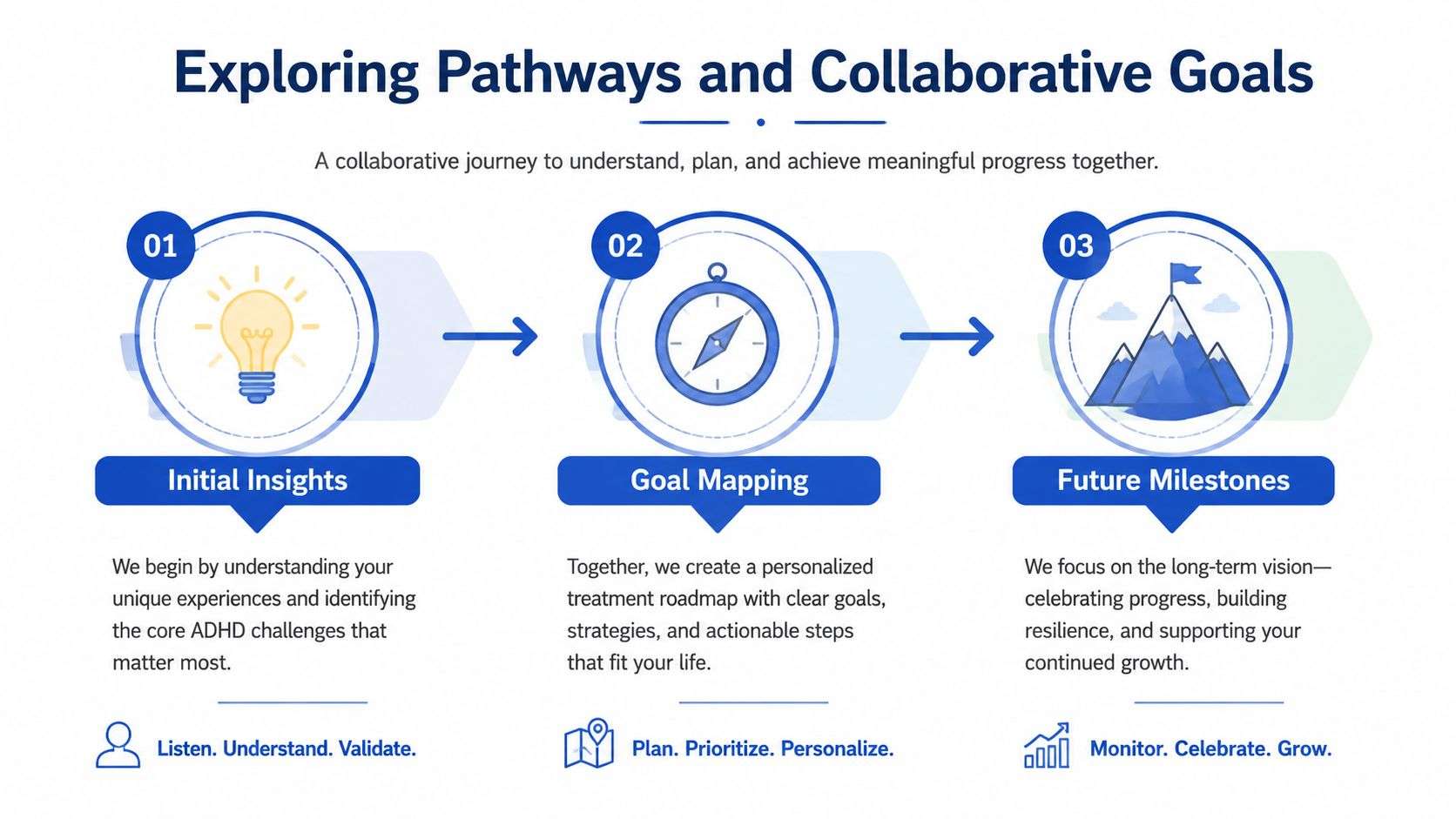
By the end of a strong first session, you don't need a full treatment plan for the rest of your life. You do need a clearer sense of direction.
One key outcome of a first ADHD session is the creation of SMART goals, meaning specific, measurable, achievable, relevant, and time-bound. This process may be informed by tools such as the Conners' Adult ADHD Rating Scales, and this overview of first counselling sessions notes that 70% of Kelowna clients report executive function gains after intake planning.
What collaborative goals actually sound like
SMART goals sound formal, but in therapy they often begin with ordinary language. A counsellor helps shape broad hopes into goals that are clear enough to guide treatment.
For example:
| Broad hope | Collaborative early goal |
|---|---|
| "I want to be less overwhelmed" | Notice the top two situations each week that trigger overload |
| "I keep dropping the ball at work" | Build one repeatable system for tracking deadlines |
| "Mornings are chaos" | Test one simpler morning routine and review what got in the way |
| "My teen shuts down fast" | Identify early signs of escalation and one co-regulation strategy |
These goals don't need to be dramatic. They need to be usable.
A practical example is mornings. If ADHD affects transitions, sequencing, and task initiation, the first goal may not be "become organised." It may be "create a predictable first 20 minutes after waking." If that area is especially difficult in your household, these tips for managing adhd mornings can offer simple ideas to discuss with your counsellor.
Possible pathways after the first session
Different people need different kinds of support. Your counsellor may suggest one or more of the following directions based on what came up in intake.
- Psychoeducation helps you understand how ADHD affects attention, emotion, behaviour, and self-image.
- Cognitive Behavioural Therapy can help identify unhelpful thought loops, especially shame-based patterns such as "I always mess things up."
- Executive function support focuses on routines, planning systems, transitions, and task follow-through.
- Family or parenting work may help if ADHD affects communication, conflict, or household rhythms.
- Trauma-informed support may matter if stress responses are complicating focus, regulation, or trust.
The first goal isn't to force yourself into someone else's system. It's to build support that fits how your brain actually works.
Your input matters more than many people realise
Some clients assume the therapist will decide everything. In good therapy, your experience shapes the plan. If a strategy feels unrealistic, say so. If visual reminders work better than verbal ones, say that too. If you need the therapist to be more direct, or gentler, or more structured, that information is useful.
Therapy is not something done to you. It works best as something built with you.
Session Logistics and Planning Your Next Steps

The last few minutes of a first session often feel strangely important. You've shared a lot, you're trying to remember what was said, and part of you may already be mentally leaving the room. Clear wrap-up matters.
Most first ADHD sessions in Kelowna are about one hour, and many therapists will use the end of that time to reflect back themes they noticed, suggest possible next steps, and ask how the session felt for you. You may be offered options for in-person, phone, or secure virtual follow-up depending on what fits your life best.
What usually happens at the end
The close of session is often simple and practical. Your counsellor may:
- Summarise what stood out from your story
- Name a starting focus for future work
- Suggest a follow-up rhythm that feels manageable
- Invite questions about fit, process, or logistics
Sometimes there is "homework," but it is rarely homework in the school sense. It may be as simple as noticing when your attention drops, tracking one stress point, or observing what happens before a shutdown or conflict. If executive function is a major theme, this short explanation can help you understand your brain's command center in clearer everyday language.
It is okay to need time
You do not have to leave the first session with certainty. Some people feel relief immediately. Others need a day or two to notice how their body felt with the counsellor.
If you are deciding whether to continue, reflect on questions like:
- Did I feel safe enough to be honest?
- Did the therapist seem to understand ADHD in a practical way?
- Did the structure help me, or overwhelm me?
- Can I imagine returning without dreading it?
A good next step should feel supportive, not pressured.
Frequently Asked Questions About ADHD Counselling
A lot of people reach this part with one quiet fear. "What if my ADHD shows up in the room before I can explain it?" That concern makes sense. In a neurodiversity-affirming counselling space, the first session is not a test of how organized, focused, or articulate you can be. The session itself should adapt to your brain, not ask you to mask it.
What if I forget everything I wanted to say?
That is very common.
Stress can make working memory feel like a whiteboard that gets wiped clean the moment you need it most. A good counsellor knows this and will not expect you to deliver a neat summary on command. They may slow the pace, ask one question at a time, repeat key points, or help you circle back if something slips away.
You can also make the session easier on yourself. Bring a few bullet points in your phone, a screenshot of notes you wrote at 1 a.m., or even one sentence like, "I lose track of what I mean when I feel put on the spot." That is enough to begin.
What if I talk too much or go off on tangents?
Many people with ADHD worry about this, especially if they have been criticized for it before. In therapy, a tangent is often useful information. It can show how your thoughts connect, where emotion rises, what your mind grabs first, and what feels hard to organize in real time.
A skilled therapist will help shape the conversation without shaming you. That might look like gently pausing, reflecting a pattern, or helping you choose which thread to follow first. The goal is not to make you sound more polished. The goal is to understand how your mind works and create enough structure that you feel heard.
Will the first session diagnose me?
Usually, no. A first counselling session is more often a starting map than a final answer.
Counselling can help clarify patterns, daily impairments, emotional stress, and the supports that may fit best. If a formal ADHD assessment seems relevant, your therapist can explain what that process involves, who can diagnose, and how counselling can still help whether you are diagnosed, self-questioning, or newly identified.
You do not need to prove that your struggle is serious enough before you book. Uncertainty belongs in the room too.
What if I can't get in quickly?
Waiting is hard, especially when booking the appointment took effort in the first place. If there is a delay, try to keep the thread alive in a low-pressure way. Jot down examples in your notes app, save voice memos, or write a few words when something difficult happens, like "missed deadline," "couldn't start," or "lost track of time again."
Those scraps can help later because ADHD challenges are often easier to notice in the moment than to reconstruct weeks afterward. You do not need a polished timeline. A few real-life examples are often more helpful than a perfect summary.
Is virtual counselling okay for ADHD?
For many people, yes. For others, in-person feels easier. The better format is the one that lowers friction and helps you stay present.
Virtual sessions can work well because they remove commuting, parking, and transition stress. They can also be harder if screens already drain your attention or if your space is full of interruptions. A neurodiversity-affirming therapist will help you sort that out practically, not treat one format as the "right" one.
If you choose virtual, small adjustments can help. Keep only one tab open. Silence notifications. Use headphones. Put a drink, tissue, notebook, or fidget nearby so you do not have to keep getting up. These are not extras. They are part of building a session around how your nervous system and attention work.
If you're looking for a warm, structured place to begin, Interactive Counselling offers evidence-informed support for children, youth, adults, couples, and families in a safe, inclusive, non-judgmental environment. You can learn more about their counselling approach, including in-person, phone, and secure virtual options, and decide whether it feels like the right fit for your next step.
Clinically Reviewed By
Amy Mosset, MCP, RCC-S
Amy Mosset is a Master Practitioner in Clinical Counselling, Clinical Supervisor, and the owner of Interactive Counselling. She provides trauma-informed, evidence-based care and clinical supervision to registered therapists, with a focus on ethical practice, client safety, and high-quality therapeutic outcomes.