Summer in Penticton can strain relationships because local life often gets squeezed by seasonal work, heat, crowds, and social pressure all at once. In one spring month alone, 12 documented ER visits in April 2026 were linked to casual relationship anxiety during the lead-up to summer activity around the SOEC reopening, which gives a concrete glimpse of how intense this season can become for some people. For more information, see our Penticton couples counselling.
If you live here, you might know the feeling already. The weather turns beautiful, the city gets busy, everyone seems to be out doing something, and yet at home things can start to feel tighter, touchier, and more exhausting. You may love Penticton in summer and still find yourself snapping at your partner over dishes, schedules, money, or who forgot to pick something up before the store got packed again. That doesn't make you ungrateful. It makes you human. For more information, see our counselling in Penticton.
"The combination of intense heat, a massive influx of tourists, demanding seasonal work schedules, and high social expectations creates a pressure-cooker environment that can exhaust partners and erode communication." For more information, see our couples counselling.
Introduction
A lot of couples feel confused by this time of year. Summer is supposed to be fun. It's supposed to be the easy season. So when you and your partner start feeling more distant, more irritable, or more like co-managers than a couple, it can be hard to make sense of.
In Penticton, that confusion makes sense. The same things that make summer attractive here also create pressure for the people who live and work here. Longer shifts, crowded errands, hot homes, packed event calendars, child care changes, and the sense that you should be enjoying every minute can leave very little room to rest and reconnect.
This is part of why why penticton summers can put stress on relationships is such a common local question. The stress usually isn't coming from one dramatic problem. More often, it builds through many small pressures that pile up until patience gets thin and connection starts to fray.
A helpful reframe: If summer tension has shown up in your relationship, that doesn't automatically mean the relationship is failing. It may mean your systems, routines, and expectations need adjusting for a very demanding season.
Penticton's Unique Summer Pressure Cooker
Penticton's summer stress isn't only about being busy. It's about how several local realities collide at the same time. Tourism ramps up. Service work gets heavier. Roads, shops, and public spaces feel fuller. Daily life takes more effort than it does in quieter months.
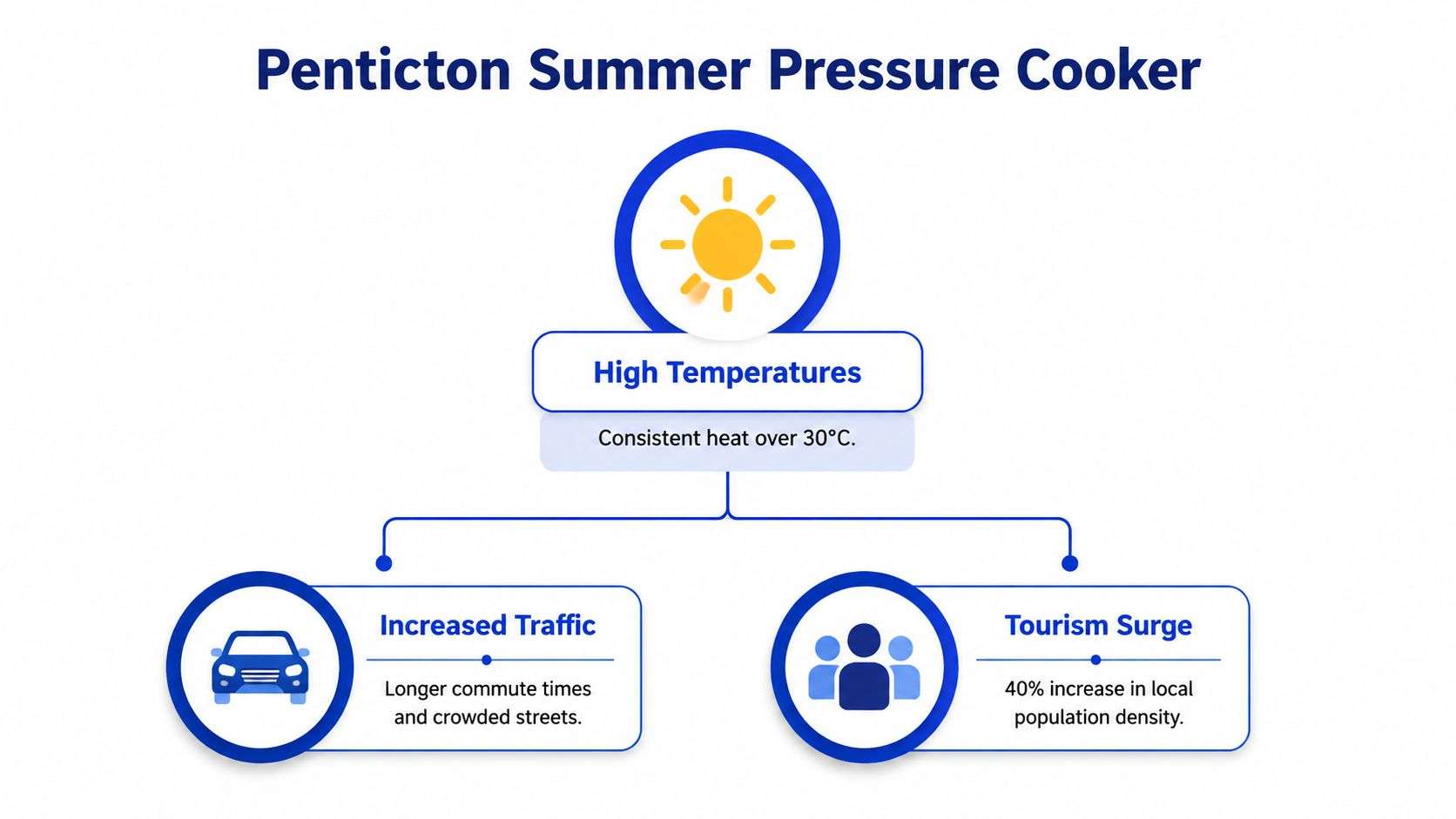
Local counselling guidance notes that Penticton's summer tourism boom can significantly worsen work-life balance through extended hours, physical exhaustion, and disrupted family time. It also notes that partners can start feeling like “roommates” as quality time erodes, especially in hospitality, retail, and service roles, as described in managing life balance in Penticton.
Why ordinary tasks start taking more out of you
When a city gets busier, stress doesn't stay at work. It follows people home.
A quick grocery run can feel draining. Getting across town can take more planning. If one partner is working late and the other is trying to manage meals, kids, errands, or housework alone, resentment can build fast. Often the argument isn't really about the groceries or the traffic. It's about depletion.
Some common ways this shows up include:
- Mismatched schedules: One partner works evenings or weekends while the other is on a different routine.
- Less recovery time: People finish the day physically tired and emotionally flat.
- More invisible labour: Someone usually absorbs the extra planning, cleaning, and remembering.
- Crowding stress: Even simple outings can feel overstimulating.
Why couples start feeling like roommates
Many people expect relationship trouble to come from obvious conflict. In summer, it often comes from simple disconnection. You pass each other in the kitchen. You talk logistics. You collapse into bed. Days go by without real eye contact, affection, or a calm conversation.
That “roommates” feeling can be especially upsetting because it often sneaks in. Nobody chose distance. The season created conditions where connection became harder to protect.
When a couple loses regular moments of warmth, the relationship can start to feel colder even if love is still there.
A local suggestion from the same counselling source is simple but useful. Even 15 minutes of daily distraction-free check-ins can help couples stay more connected during intense periods. That won't solve every structural problem, but it can reduce the feeling that you're living separate lives under the same roof.
When the Heat is On Inside and Out
Heat affects more than comfort. It can affect sleep, patience, focus, and emotional regulation. When people are already stretched thin, the body's stress response has less room to absorb one more frustration.

One less visible reason this season can feel hard is reverse SAD., nearly 10% of people experience reverse SAD in spring and summer. For them, more sunlight and heat can trigger depression and anxiety rather than improve mood. The same source also notes that hormonal shifts, including increases in testosterone with warmth, may intensify mood dysregulation and relationship friction.
What reverse SAD can look like in daily life
People often miss this because summer distress doesn't fit the usual story. A partner may say:
- “I should be happier right now.”
- “Everyone else seems energised, but I feel agitated.”
- “I'm tired, wired, and I don't know why.”
That can create a painful mismatch in couples. One person wants patios, beaches, and packed weekends. The other wants darkness, quiet, and fewer demands. Without context, both people can start misreading each other. One feels rejected. The other feels pushed.
The pressure of forced fun
Summer also carries a subtle emotional rule. Be outside. Be social. Make memories. Enjoy it while it lasts.
That pressure can make ordinary limits feel like personal failures. If you're too tired to go out, too irritable to host, or too anxious to be around crowds, you may feel guilt on top of fatigue. Couples then argue not only about plans, but about what those plans mean.
Practical rule: Before assuming your partner is being distant, ask whether they might be overheated, underslept, overstimulated, or struggling with a summer mood shift.
If burnout is part of the picture, it may help to look at expert advice on tourism burnout and treat the season as something that requires active coping, not just endurance.
Navigating the Social Whirlwind and Festival Culture
Summer in Penticton can feel like a long stream of invitations, events, festivals, markets, beach meetups, and last-minute plans. For some couples, that's exciting. For others, it becomes another source of strain.
The challenge isn't only deciding what to attend. It's the constant negotiation behind it. Who wants to go. Who's too tired. Who's paying. Who's staying sober. Who's managing the kids. Who's pretending to be in the mood.
Why social energy becomes relationship pressure
A busy local social scene can magnify whatever is already uncertain in a relationship. Newer couples may struggle with expectations. Long-term couples may find themselves disagreeing about boundaries, spending, alcohol, or how much togetherness feels good.
Healthcare data described in this report on casual relationship anxiety in Penticton points to a surge in casual relationship anxiety during spring and summer, with 12 documented ER visits in April 2026 alone linked to the lead-up around the reopening of the South Okanagan Events Centre. Even if that doesn't reflect your situation directly, it illustrates a broader truth. Major community events can flood the local social system and intensify emotional stress.
Common arguments hidden inside summer plans
Sometimes the fight sounds small, but the meaning underneath is bigger.
- “Do we have to go to everything?” often means “I'm overwhelmed.”
- “Why don't you want to come with me?” may mean “I miss feeling like a team.”
- “You said we'd keep things simple.” can mean “I'm worried about money, energy, or both.”
- “You're different around other people.” may point to insecurity or disconnection.
For couples in less-defined relationships, event-heavy seasons can also bring ambiguity to the surface. Are we serious? Are we exclusive? Are we just filling time because summer feels exciting? Big social seasons tend to expose questions that were easier to avoid in quieter months.
A crowded calendar doesn't create every relationship issue, but it often removes the silence that was hiding one.
The Summer Juggle for Parents and Blended Families
For parents, co-parents, and step-families, summer stress often becomes a logistics problem before it becomes a relationship problem. Once school routines disappear, many households lose the structure that was keeping conflict contained.

A key local concern is that the strain of a seasonal economy can hit co-parenting and blended families especially hard. This discussion of summer relationship stress notes that irregular summer income and asymmetrical work schedules can create unpredictability in childcare, support payments, and parenting time. That kind of unpredictability can quickly fuel resentment when families don't have clear systems for handling it.
Why blended families often feel this more sharply
Blended families usually carry more moving parts. There may be multiple homes, changing custody schedules, different parenting styles, step-parent roles that are still evolving, and children with mixed feelings about transitions.
Now add summer realities:
- One adult's work hours spike
- Another adult becomes the default child-care manager
- Plans change due to heat, camps, travel, or work demands
- Household costs feel less predictable
- Children move between homes with different rules and expectations
This doesn't mean summer is doomed. It means family stress can become uneven. One person may feel abandoned by work demands. Another may feel unappreciated for carrying the household. A step-parent may wonder how much to step in. A co-parent may feel every schedule change as a sign of disrespect rather than a practical challenge.
Small systems help more than big promises
Families often try to solve summer chaos with vague agreements like “we'll communicate better.” That usually isn't enough. What tends to help is concrete structure.
A few practical tools can reduce friction:
- Shared calendars: Put exchanges, work shifts, camps, and events in one place everyone can see.
- Written backup plans: Decide in advance what happens if someone gets called into work or a child-care plan falls through.
- Role clarity: Name who handles transport, meals, and day-to-day decisions on specific days.
- Weekly reset meetings: Keep them short and practical.
If your household needs help staying organised, some families use digital tools to simplify family life with apps, especially when several adults are coordinating children, reminders, and changing routines.
For households where step-parent tension or teen conflict rises during these shifts, some families also look into therapy for blended family teens as one support option when conversations at home keep getting stuck.
Recognizing the Warning Signs of Summer Strain
Summer relationship stress doesn't always announce itself clearly. It often arrives as a series of small changes in tone, patience, and closeness. Recognising those changes early can help you respond before everything turns into a fight.
Here's a simple way to sort what you're noticing.
| Warning Sign | Potential Underlying Summer Stressor |
|---|---|
| Constant small arguments | Physical exhaustion, heat, overstimulation |
| Feeling like roommates | Opposite schedules, little quality time |
| One partner withdrawing | Burnout, social overload, low mood |
| Conflict about plans every weekend | Different energy levels, different expectations about summer |
| Resentment about chores or kids | Uneven workload, invisible labour, changing routines |
| Tension around spending | Seasonal income stress, event pressure, child-care costs |
| Increased jealousy or insecurity | More social exposure, less reassurance, unclear boundaries |
| Trouble making decisions | Mental fatigue and too many moving parts |
| Snapping over minor inconveniences | Poor sleep, heat discomfort, lack of recovery time |
| Feeling hopeless about reconnecting | Stress has shifted from situational to relational |
What to remember when you see these signs
These patterns don't automatically mean your relationship is unhealthy or beyond repair. They may be signs that your coping capacity is lower than usual and your current routines aren't protecting the relationship well enough.
Try to treat the sign as information, not proof that your partner doesn't care.
That shift matters. It moves the conversation away from blame and toward problem-solving.
Practical Strategies to Protect Your Connection
When a season is demanding, couples usually need smaller, more repeatable habits rather than grand solutions. The goal isn't to create a perfect summer. It's to reduce friction and preserve connection.

Protect short daily check-ins
If your schedules are full, don't wait for a long romantic evening. Build in a brief touchpoint instead.
Useful prompts include:
- “What's your stress level today?”
- “What do you need from me tonight?”
- “Is there anything we should solve before it turns into a bigger issue?”
Keep it short and distraction-free. No phones. No multitasking. The point is to stay emotionally updated.
Redefine quality time
During high-pressure months, quality time may need to get smaller and simpler.
That might look like:
- A cold drink together after work
- A walk after sunset when it's quieter
- Ten minutes on the porch before bed
- A quick coffee check-in before the house wakes up
These moments matter because they interrupt the “roommates” pattern. They remind both people that the relationship still exists underneath the logistics.
Set boundaries around social energy
Not every invitation deserves a yes. Not every sunny day has to be maximised.
Try language like:
- “I want to see people, but I need one quiet evening first.”
- “Let's pick one event this weekend, not three.”
- “I can come for a short time, but I need an early night.”
A boundary isn't rejection. It's a way of protecting the part of you that still needs rest.
Make the invisible workload visible
Many summer fights are really fights about uneven mental load. Write things down. Put tasks in a shared note or calendar. Name who is carrying what.
Sometimes couples need help learning how to talk through this without defensiveness. Resources like 8 couples communication techniques can give you structured ways to slow down conflict and speak more clearly.
Use local de-stressing choices that match your real capacity
You don't have to bond by doing the most popular thing in town. Often the best repair comes from lower-demand choices.
Examples might include:
- Going out earlier or later to avoid peak crowds
- Choosing shade and quiet over packed attractions
- Eating something simple at home before deciding whether to go out
- Taking separate downtime before meeting up as a couple
“Connection often returns faster when couples stop trying to perform summer and start responding honestly to their energy.”
If the same arguments keep repeating, one option is professional support. Interactive Counselling offers relationship-focused therapy for communication, conflict, and reconnection, which some couples use alongside practical changes at home.
When to Seek Professional Support
Sometimes summer stress is temporary. Sometimes it exposes a deeper pattern that was already there. The difference usually shows up in how hard it is to recover after conflict.
It may be time to look for added support if:
- You can't talk without it becoming hostile
- One or both of you feels emotionally checked out most of the time
- Arguments about summer pressures trigger older unresolved wounds
- Co-parenting tension is affecting children or household stability
- You've tried practical fixes, but the same cycle keeps repeating
- There's a growing sense of hopelessness rather than occasional strain
Seeking support doesn't mean you've failed. It often means you're paying attention before more damage is done. If you want to explore options, Interactive Counselling for Penticton support provides information about local counselling services for individuals, couples, and families.
Frequently Asked Questions
Is it normal if one partner loves summer and the other struggles?
Yes. That mismatch is more common than many couples expect. If one partner feels energised and the other feels depleted, try not to frame it as attitude versus negativity. Treat it as a difference in nervous-system needs. Build plans that include both activity and recovery.
Can summer really affect mood that much?
For some people, yes. Reverse SAD is one example of how heat and long days can increase anxiety or low mood for a portion of people. Even without that pattern, poor sleep, overstimulation, and social pressure can make anyone more reactive.
How can we stay connected if money feels tight in summer?
Focus on low-cost rituals instead of expensive outings. A walk, a lakefront sit, a simple meal at home, or a short evening check-in can do more for connection than a packed day that leaves both of you drained and resentful.
Should we just wait until autumn and hope things calm down?
Waiting can help if the stress is clearly seasonal and both of you are handling it with care. But if you're getting stuck in harsh communication, deep resentment, or emotional shutdown, it's better to respond now. Repeated strain can harden into habit.
How do we talk to kids when the adults are stressed?
Keep it simple and age-appropriate. Children don't need adult details. They do need reassurance. You can say that the family is having a busy, tiring time and that the adults are working on better ways to handle stress. Let them know the stress isn't their fault.
Conclusion
Penticton summers can be beautiful and hard at the same time. That's the experience many couples, parents, and families live with here. When work intensifies, heat lingers, calendars fill up, and routines fall apart, relationships often feel the strain.
The good news is that strain isn't the same as failure. With clearer expectations, smaller moments of connection, better boundaries, and support when needed, couples can move through this season with more steadiness and a lot less self-blame.
If this article felt familiar, you can learn more about relationship, family, and mental health support through Interactive Counselling and explore approaches that fit real life in busy seasons.
Clinically Reviewed By
Amy Mosset, MCP, RCC-S
Amy Mosset is a Master Practitioner in Clinical Counselling, Clinical Supervisor, and the owner of Interactive Counselling. She provides trauma-informed, evidence-based care and clinical supervision to registered therapists, with a focus on ethical practice, client safety, and high-quality therapeutic outcomes.