
TL;DR:
- CBT thought records help examine and reframe negative automatic thoughts effectively.
- They are adaptable, with many formats tailored to individual needs and patterns.
- Regular use, especially when combined with professional guidance, can reduce symptoms of depression and anxiety.
Negative thoughts can feel less like opinions and more like facts. When your mind insists “I’m a failure” or “nothing will ever improve,” it’s hard to step back and question whether that’s actually true. CBT thought records are structured, evidence-based tools that help you do exactly that: slow down, examine the evidence, and find a more balanced view. What surprises many people is just how adaptable these tools are. Over 110 variants of thought records exist among certified therapists, coded into 55 unique combinations, which means there’s almost certainly a version that can work for you.
Table of Contents
- What are CBT thought records and why do they matter?
- How do CBT thought records work? Key steps and real examples
- Not all thought records are the same: Variability and customisation
- Making CBT thought records work for you: Tips and troubleshooting
- Our take: What most guides miss about using CBT thought records
- Take the next step to mental wellness
- Frequently asked questions
Key Takeaways
| Point | Details |
|---|---|
| Flexible tool for thinking | CBT thought records help you examine and challenge negative thoughts in many adaptable ways. |
| Evidence-based benefit | Research shows moderate improvement for anxiety and depression when thought records are used as part of CBT. |
| Customise for your needs | There is no single ‘best’ format—what matters is consistency and using a style you’ll stick with. |
| Practical tips matter | Start simple, review progress, and seek help if you’re struggling, for the best results. |
What are CBT thought records and why do they matter?
CBT stands for cognitive-behavioural therapy, one of the most widely researched and practised approaches for treating anxiety and depression. At its core, CBT is built on a simple but powerful idea: the way you think about a situation shapes how you feel and behave. Change the thought pattern, and you can change the emotional response.
A thought record is a structured worksheet used within CBT to help you identify, examine, and reframe negative automatic thoughts. Think of it like a pause button for your mind. Instead of letting a distressing thought spiral unchecked, you write it down, look at the evidence, and build a more realistic response. It’s not about forcing yourself to think positively. It’s about thinking accurately.
Thought records help you separate facts from interpretations, which is one of the most valuable skills in CBT. For example, “I didn’t get invited to the meeting” is a fact. “That means my manager thinks I’m incompetent” is an interpretation, and a very different thing. Learning to notice that gap is where the real shift happens.
Learning more about CBT exercises for anxiety can help you understand how thought records fit within a broader set of tools. They aren’t a standalone fix, but as part of a consistent CBT practice, the benefits are well-supported.
Here’s a quick look at what thought records offer:
- Perspective: You gain distance from a thought instead of being swallowed by it
- Reduced distress: Naming and examining emotions tends to lower their intensity
- Constructive self-talk: You practise building balanced inner dialogue over time
- Resilience: Repeated use builds your capacity to handle future negative thinking
- Awareness: You start to notice patterns in your thinking, including unhelpful thinking styles like catastrophising or all-or-nothing thinking
The evidence: A meta-analysis of 13 RCTs involving 1,441 participants found that CBT including thought records showed moderate effects on reducing depression (SMD of -0.24 after outlier exclusion). The results are meaningful, especially when thought records are used as part of a broader therapeutic approach.
The science supports these tools. More importantly, they’re accessible, adaptable, and can be started today.
How do CBT thought records work? Key steps and real examples
Once you understand the purpose of thought records, the next step is to see exactly how they’re used in practice, so you can start applying them to your own patterns.
Most thought records follow a sequence of six steps:
- Situation: What happened? Where were you, and what were you doing?
- Emotion: What did you feel, and how intense was it (0 to 100)?
- Automatic thought: What went through your mind at that moment?
- Evidence for the thought: What facts seem to support this thought?
- Evidence against the thought: What facts challenge or contradict it?
- Balanced thought and outcome: What’s a more realistic view, and how does your emotion change?
Seeing this in action makes it clearer. Here’s a real-life example:
| Step | Example entry |
|---|---|
| Situation | Made an error in a report at work |
| Emotion | Shame (80/100), anxiety (70/100) |
| Automatic thought | “I’m a complete failure” |
| Evidence for | I made a mistake; my manager noticed it |
| Evidence against | I have a strong track record; everyone makes mistakes; my manager didn’t say I was failing |
| Balanced thought | “I made one error. That’s human. I can correct it and continue doing good work.” |
| Outcome | Shame drops to 40/100; anxiety to 35/100 |
Notice how the emotion doesn’t disappear entirely, and that’s the point. The goal is not to erase discomfort but to bring it to a manageable level. As variability in thought records research highlights, therapists often adapt these questions to suit individual clients, and that flexibility is a strength rather than a flaw.

You can find thought journal guidance to help you get started with your own records in a structured way.
Pro Tip: When writing your automatic thought, be as specific as possible. “I’m terrible” is too vague to work with. “I’m terrible at presenting in front of groups” gives you something real to examine and challenge.
Not all thought records are the same: Variability and customisation
Seeing how a basic record is filled out reveals its value, but it’s important to realise that there’s no one-size-fits-all approach. Thought records are as varied as the people who use them.
Over 110 variants of thought records are in active clinical use, coded into 55 unique combinations. Some focus on identifying core beliefs. Others centre on daily mood tracking, trigger mapping, or behavioural experiments. This isn’t a problem. It’s a sign that skilled therapists tailor these tools to the individual, which is exactly how good therapy works.
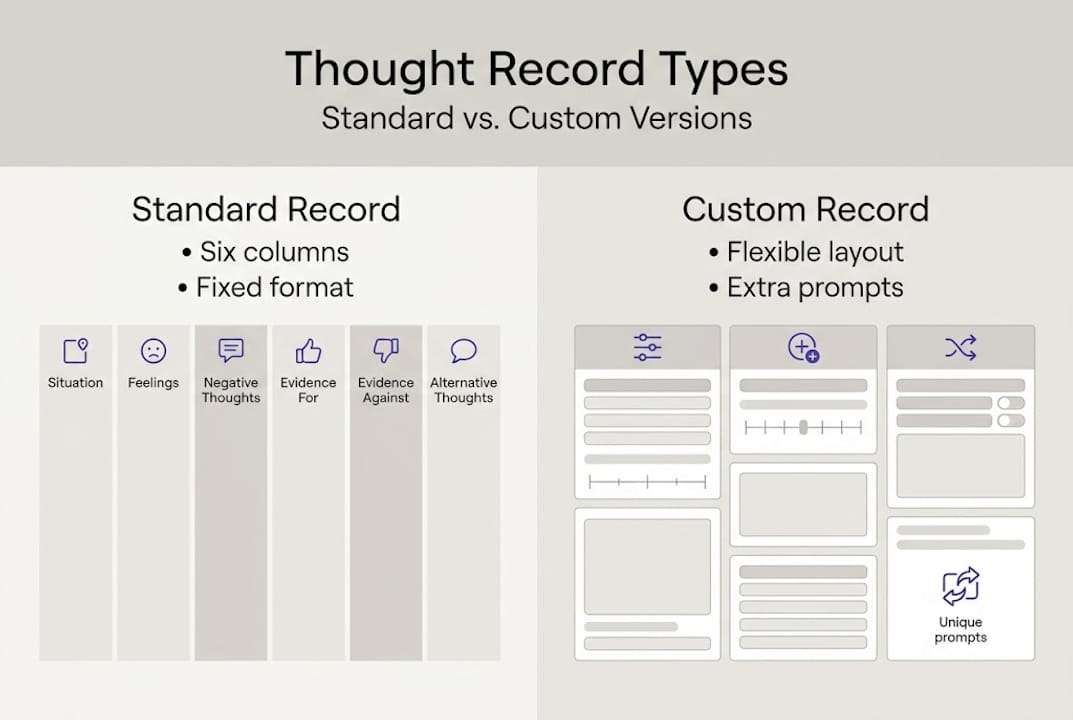
Here’s a comparison of what standard and customised thought records might look like:
| Feature | Standard thought record | Customised thought record |
|---|---|---|
| Format | Fixed six-column worksheet | Adapted columns based on client needs |
| Focus | Automatic thoughts | Core beliefs, triggers, or mood patterns |
| Frequency | As needed | Daily, weekly, or event-specific |
| Guidance | Self-directed | Therapist-guided with tailored prompts |
| Best for | General use, self-help | Complex or long-standing thought patterns |
Some formats also track how negative self-talk affects daily life, making them especially useful for people who notice the same harsh inner voice appearing across different situations.
What the research also tells us is that no single format has proven clearly superior to another. What matters more is consistency and self-awareness, not the version you choose. The best thought record is the one you’ll actually use.
“The variety of thought record formats isn’t confusion, it’s personalisation. What works for one person may not work for another, and that’s not a limitation of the tool. It’s the whole point.”
Key takeaways on customisation:
- Some formats are better for specific concerns, such as social anxiety or perfectionism
- Simpler versions are often more sustainable for beginners
- A therapist can help you choose and refine the format that fits your situation
- Trying a few versions before settling on one is completely reasonable
Making CBT thought records work for you: Tips and troubleshooting
With so many customisable options, it’s normal to feel unsure where to start. Here are practical strategies to make thought records effective and sustainable for you.
The most common mistake people make is waiting for a perfect moment to start. You don’t need a special notebook or a dedicated hour. A thought record can be three sentences scribbled on your phone during a lunch break. Starting small is still starting.
Common obstacles and how to handle them:
- Blank page anxiety: Begin with just the situation and emotion columns. You don’t have to fill everything in at once.
- Difficulty identifying thoughts: Ask yourself, “What was going through my mind right before I felt this way?” That question often unlocks the thought.
- Judging your progress: Change is gradual. A small drop in emotional intensity is a real result.
- Forgetting to use them: Set a daily reminder, or pair the habit with something you already do, like morning coffee.
- Feeling it’s not working: Check whether you’re being specific enough. Vague thoughts produce vague results.
Thought records work best as one part of a broader toolkit. Pairing them with coping strategies for depression or exploring how CBT can quiet the inner critic deepens the impact over time.
It’s also worth knowing their limits. CBT thought records are not recommended as a sole response during acute mental health crises. If you’re experiencing severe distress, professional support is essential, not optional. That said, research consistently shows that CBT interventions including thought records produce meaningful, moderate reductions in depression symptoms when used consistently.
Pro Tip: Set aside five minutes each week to review your completed records. Over time, you’ll start to notice repeating thought patterns, and recognising those patterns is half the battle.
Our take: What most guides miss about using CBT thought records
Here’s the honest truth that most step-by-step guides overlook: the format you choose matters far less than whether you show up for it on the hard days.
It’s easy to fill out a thought record when you’re feeling calm and curious. The real work happens when you’re overwhelmed, exhausted, or convinced that nothing will help. Those are exactly the moments when picking up the worksheet makes the most difference, even if it feels pointless.
Many people quit too early, expecting a dramatic shift after a few attempts. But CBT thought records work the way physical therapy does: the changes are small, incremental, and cumulative. You might not notice much after one week. After two months of consistent use, the shift in how you relate to your own thinking can be significant.
And here’s something worth sitting with: the goal is never to eliminate negative thoughts entirely. Every human mind produces them. The goal, as explored through reframing unhelpful thoughts, is to build a more skilful relationship with your thinking, so those thoughts have less power over how you feel and what you do.
Take the next step to mental wellness
CBT thought records are a genuinely powerful place to start, but the deepest and most lasting change usually happens with professional support alongside you. A skilled therapist can help you identify which format suits your needs, work through stubborn thought patterns, and build a practice that fits your life.
At Interactive Counselling, our licensed therapists offer in-person, phone, and online sessions across Kelowna, Vernon, Grande Prairie, Penticton, and beyond. Whether you’re curious about the types of counselling services available or want to learn more about the types of therapy that might suit you best, we’re here to help you find the right path forward. You don’t have to navigate this alone.
Frequently asked questions
Are CBT thought records actually effective for anxiety and depression?
Yes. CBT with thought records shows moderate, meaningful effects on reducing depression symptoms when used as part of a broader therapeutic approach, and many people also find them helpful for managing anxiety.
Do I need a therapist to use thought records, or can I do them on my own?
You can begin using basic thought records independently, but a therapist helps you personalise the format and address deeper patterns. Therapists adapt records in ways that self-help alone often cannot replicate.
Is one type of thought record better than another?
No single format has been shown to be clearly superior. The most effective version is the one you’ll use consistently and that matches your specific thinking challenges.
What if I feel overwhelmed or stuck when filling out a thought record?
Start with just two columns, the situation and the emotion, and build from there. If distress is significant or ongoing, reaching out to a mental health professional is the most important next step.
Recommended
- Your Guide to a Thought Journal for CBT in 2026 – Interactive Counselling
- Cognitive Behavioral Therapy Exercises for Anxiety – Interactive Counselling
- How to Change Unhelpful Thinking styles for Good
- Master Your Mind with a Cognitive Therapy Thought Record
- How to Calm Racing Thoughts — The Caia Journal