Many therapists in Canada reach a point where solid clinical skills still don’t fully explain why some clients stay stuck. You may be helping someone understand their anxiety, trace patterns to childhood, and practise regulation skills, yet something inside them still braces, shuts down, attacks, or flees. That’s often the moment Internal Family Systems starts to make sense, not as another technique to add on, but as a different way of understanding the mind. For more information, see our family counselling.
"Internal family systems training canada refers to the range of IFS learning pathways available to Canadian therapists, from introductory Canadian programs to the official IFS Institute route, which together help clinicians learn parts work safely, ethically, and with increasing depth."
As of April 2024, 45,764 psychotherapists on PsychologyToday.com listed IFS as a modality they use, reflecting how widely the model has spread across North America (Society for the Advancement of Psychotherapy). That doesn’t mean every therapist uses it in the same way or with the same level of training. It does mean that if you’re curious about IFS, you’re not off on a fringe path. You’re looking at a model many clinicians are actively trying to learn well.
For Canadian therapists, the challenge usually isn’t whether IFS is interesting. It’s figuring out where to begin, which training counts for what, and how to choose a path that fits your scope, your province, and your clients. If your work is grounded in trauma-informed care, IFS often feels especially relevant because it offers a respectful, non-pathologising way to approach protection, survival responses, and wounded younger states.
A New Way of Healing for You and Your Clients
Some therapy models organise people around symptoms. IFS organises people around inner relationships.
That shift matters.
A client who says, “Part of me wants closeness and part of me pushes everyone away,” isn’t being inconsistent in an IFS frame. They’re describing an internal system. One part longs for connection. Another part has learned that closeness feels risky. Both are trying to help in their own way.
Why IFS lands so deeply for many therapists
IFS often feels relieving to clinicians because it gives language to patterns you’ve probably already seen:
- A capable client who panics before every performance
- A thoughtful parent who erupts in anger and then feels ashamed
- A trauma survivor who wants to heal but avoids every doorway into pain
- A couple who repeat the same argument, even when both care immensely
IFS doesn’t ask, “What’s wrong with this person?”
It asks, “What is each part trying to do, and what is it protecting?”
That question tends to soften both therapist and client. It replaces blame with curiosity.
What makes it different
Many clinicians first encounter IFS through a short workshop, a colleague, or a client who already knows the language of “parts.” What keeps them interested is the combination of clarity and compassion.
IFS assumes that protective reactions make sense in context. A harsh inner critic may be trying to prevent humiliation. Emotional numbing may be trying to stop overwhelm. Avoidance may be trying to keep a person functioning. None of that means the strategies are ideal. It means they’re understandable.
A good IFS lens doesn’t excuse harm. It helps you understand the protective logic underneath it.
For therapists, that can transform the room. Instead of fighting defences, you learn to listen to them. Instead of trying to eliminate symptoms too quickly, you build enough safety for the system to change from the inside.
Why Canadian therapists are searching for training now
Interest in internal family systems training canada has grown because the model fits work many therapists are already doing. It can be integrated thoughtfully into trauma therapy, anxiety treatment, depression work, family counselling, and relationship repair.
Canadian clinicians also tend to ask practical questions early:
| Question | Why it matters |
|---|---|
| Will this help with complex trauma work? | Many therapists want a model that honours protection and pacing. |
| Is this official IFS Institute training or a Canadian-based certificate? | The answer affects long-term planning. |
| Can I use IFS-informed ideas before formal certification? | Ethical practice depends on clear scope and accurate representation. |
| Is the program accessible from my province? | Geography and schedule still shape what’s realistic. |
Those are wise questions. The rest of this guide is meant to answer them in plain language.
Understanding the Core of Internal Family Systems
IFS is easiest to understand if you stop thinking of the mind as one single, unified voice.
It is common to speak in parts language without realising it. “Part of me wants to go.” “Part of me is terrified.” “A part of me knows I should leave.” IFS takes that everyday experience seriously.
Your inner system is not a flaw
Think of the psyche like an inner family or committee. Different members have different jobs, fears, and styles. Some are organised. Some are reactive. Some carry old pain. They may clash with each other, but they all belong to the same person.
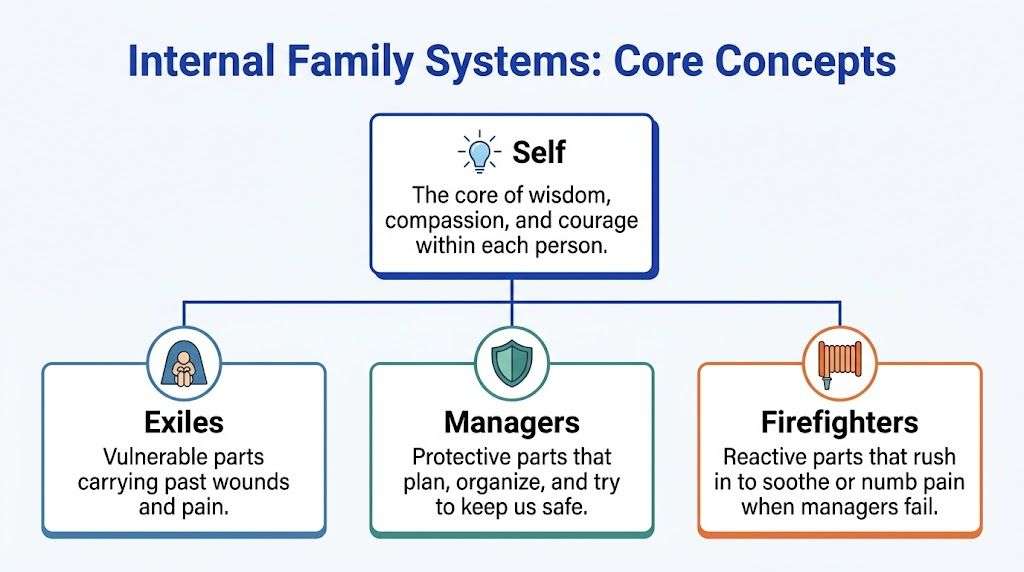
The core categories usually taught first are Managers, Firefighters, and Exiles.
Managers
Managers are proactive protectors.
They try to stay ahead of pain by controlling situations, pleasing people, overthinking, organising, striving, criticising, or staying hyper-alert. A client with a perfectionistic streak may have a manager that believes, “If we do everything right, nobody can hurt us.”
Managers often look impressive from the outside. They can also become exhausting.
Firefighters
Firefighters are reactive protectors.
They step in when pain breaks through and the system feels flooded. Their job is immediate relief. That might look like numbing, bingeing, dissociating, rage, compulsive distraction, shutting down, or impulsive behaviour.
A firefighter isn’t usually thinking long term. It’s trying to put out a fire.
Exiles
Exiles are the vulnerable parts that carry burdens from painful experiences.
They often hold shame, fear, grief, loneliness, helplessness, or the felt sense of being too much or not enough. These parts are frequently younger in tone. Protectors work hard to keep exiles out of awareness because their pain can feel overwhelming.
The role of Self
The most important idea in IFS is Self.
Self is not another part. It refers to the grounded, compassionate, steady core that can relate to all parts without becoming overwhelmed by them. When a therapist learns IFS well, one of the biggest shifts is learning to recognise when a client is speaking from a part and when there is enough Self present to lead.
Practical rule: In IFS, healing usually doesn’t come from overpowering a part. It comes from helping the person relate to that part with enough calm and curiosity that it no longer has to work so hard.
You can think of Self as the inner leader who can say:
- “I see why you’re scared.”
- “I understand why you’ve been controlling everything.”
- “You don’t have to do this alone anymore.”
That’s why IFS can feel so different from approaches that focus mainly on symptom control. It doesn’t ask clients to get rid of parts. It asks them to build a relationship with them.
Where therapists often get confused
A common misunderstanding is that parts are just metaphors.
Some clinicians use them metaphorically, and that can still be useful. In practice, though, many clients experience parts as real inner states with distinct emotions, beliefs, body sensations, and impulses. You don’t need to force that language. You need to listen for it.
Another confusion point is the inner critic. In IFS, a critic is not treated as an enemy. It’s understood as a protector. That doesn’t make its impact harmless. It means you work to understand what it fears would happen if it stopped. If you want a deeper everyday example, this piece on where your inner critic comes from connects well with the logic of parts work.
Once that clicks, IFS stops sounding abstract. It starts sounding like the clients you already see.
The Clinical Power of IFS in Modern Therapy
A model earns its place in practice by what happens in the room.
IFS can be clinically powerful because it gives therapists a way to work with internal conflict without shaming it, escalating it, or flattening it into one symptom label.

Anxiety through an IFS lens
Consider a client who says, “I can’t stop scanning for what might go wrong.”
An IFS-informed therapist might hear a manager working hard to prevent danger. Instead of trying to silence that anxious voice immediately, the therapist helps the client turn toward it with respect.
Questions become gentler and more precise:
- What is this anxious part afraid would happen if it relaxed?
- How old does it feel?
- What does it want you to know?
- What is it protecting you from?
Often, the anxiety makes more sense once the protective logic is visible.
Trauma work with more internal safety
IFS is especially compelling for trauma clinicians because it treats defensive responses as meaningful, not resistant. A dissociative shift, a collapse into shame, or sudden anger can be met as protection rather than failure.
That stance overlaps strongly with the values of trauma-informed therapy, which emphasises safety, pacing, and respect for survival responses. In IFS, the therapist doesn’t rush past protectors to get to the pain underneath. The therapist develops permission, trust, and internal consent.
When protectors believe the therapist and the client will respect their job, they often become more willing to soften.
That matters in trauma treatment. Clients who have been intruded upon, overexposed, or pushed too quickly often need a model that honours hesitation.
Relationship conflict makes more sense in parts language
IFS also offers a remarkably practical way to understand couples and family dynamics.
One partner may have a pursuing part that feels desperate for reassurance. The other may have a distancing part that feels flooded by demands. If each person only sees the other’s surface reaction, the cycle hardens. If both begin to see the vulnerable parts underneath, the tone changes.
A conversation can move from this:
- “You never care.”
- “You’re always too much.”
To this:
- “A part of me panics when I feel distance.”
- “A part of me shuts down when I think I’ll fail you.”
That’s not magic. It’s structure.
Why therapists often stay with IFS once they learn it
IFS tends to stay useful because it helps with several common clinical dilemmas at once:
| Clinical dilemma | IFS response |
|---|---|
| A client is highly ambivalent about change | Explore the protective parts on both sides of the conflict |
| A client becomes flooded when discussing trauma | Slow down and build relationship with protectors first |
| A client is harshly self-critical | Treat the critic as a protector with fears and intentions |
| A client repeats harmful relationship patterns | Map the parts involved in attachment, defence, and shame |
For many clinicians, that combination of gentleness and structure is what makes the training worth pursuing.
Navigating the Official IFS Training Pathway in Canada
Many Canadian therapists often get tangled. They hear “IFS training” used broadly, but not every training means the same thing.
If your goal is the official IFS Institute pathway, it helps to separate that route from other valuable but different Canadian learning options.
What the official pathway is trying to do
The IFS Institute route is designed to build depth over time.
The foundation is Level 1. This is the core clinical training where therapists learn the model in a structured, experiential way. According to IFS Connect, five Level 1 IFS trainings are planned for Canadian residents in 2026, and Level 1 includes 80+ hours of instruction with 3:1 guided practice sessions supported by trained assistants (IFS Connect Canada learning pathways).
That detail matters because Level 1 is not just a lecture series. It includes practice, observation, and close support while learning to apply the model.
How Levels 2 and 3 fit in
After Level 1, the pathway continues into Level 2 and Level 3.
You can think of them this way:
- Level 1 gives you the foundation. You learn the map, the stance, and the basic clinical process.
- Level 2 usually deepens application in more specialised areas.
- Level 3 is more advanced and designed for clinicians who already have substantial grounding in the model.
The exact content can vary by training focus, but the broad purpose stays the same. Depth comes in layers.
Why the Canadian expansion matters
For a long time, one of the biggest barriers for Canadian therapists was access. There weren’t many official opportunities dedicated to Canadian residents.
The planned expansion for 2026 meaningfully reshapes the training climate. It doesn’t remove every bottleneck, but it gives clinicians in Canada more reason to plan ahead instead of assuming the official route is unreachable.
Clinical planning note: If official recognition matters to you, treat timing as part of your professional development strategy, not as an afterthought.
This is often relevant for therapists who want to present themselves accurately to clients, supervisors, and employers. It also matters for those who want a clear progression rather than a patchwork of shorter trainings.
What many therapists want clarified
The phrase “certified in IFS” can create confusion.
A therapist may be:
- IFS-informed through reading, consultation, and shorter trainings
- Formally trained through substantial programs
- On the IFS Institute pathway
- Certified through that official process
Those aren’t interchangeable terms. It’s important to describe your training precisely.
That’s part of ethical practice, just like clearly explaining what a clinical counsellor is and what your role includes. Clients deserve accuracy. So do supervisees and referral partners.
A simple way to think about the official path
If you’re deciding whether to pursue the IFS Institute route, this framework can help:
| If your goal is… | The official pathway may be a strong fit because… |
|---|---|
| Deep immersion in the model | It builds skill through sustained experiential learning |
| Clear professional identity in IFS | It offers a recognised training sequence |
| Long-term commitment | It supports gradual advancement rather than a quick overview |
| Strong practice foundations | Level 1 includes substantial guided learning and practice |
For some therapists, this is the right destination from the start. For others, it’s a long-term goal and not the first step. Both are reasonable.
Exploring Canadian IFS Training Programs and Providers
You finish a full day of sessions, open your laptop at 9 p.m., and start searching for internal family systems training in Canada. Very quickly, the options blur together. One program looks official. Another is Canadian and easier to access. A third offers a university certificate, but not the same professional pathway. For many therapists, this is the point where interest turns into confusion.
Canadian clinicians often need more than a list of programs. They need help sorting training by purpose, cost, format, and real-world accessibility. If you live outside a major urban centre, work around a full caseload, or need to track whether a course offers CE value for your regulator or professional association, those details shape the decision just as much as the curriculum.
Two Canadian examples worth understanding
These two Canadian options are useful to compare because they answer different needs. Neither should be mistaken for the official IFS Institute Level 1 route. A better comparison is this: one functions more like a guided entry point, while the other resembles a longer certificate-based course of study.
IFSCA Stepping Stones
IFSCA’s Stepping Stones program is a Canadian online training for mental health professionals. According to IFSCA, the program runs over several months and includes live instruction in a small-cohort format, which can support feedback, discussion, and experiential practice.
That kind of structure often suits therapists who want time to absorb the model between sessions. It can also be a practical fit for clinicians managing work, family, and licensing demands across different time zones in Canada.
This option may appeal if you are looking for:
- A paced online format instead of a single intensive block
- Smaller-group learning with room for discussion
- Canadian scheduling
- An introductory skills-building experience before committing to a larger training path
It may be especially helpful for therapists in regions where in-person options are limited.
Wilfrid Laurier University Applied IFS Practice Certificate
The Wilfrid Laurier University Applied IFS Practice Certificate offers a more academic and extended format for helping professionals with prior experience. According to Wilfrid Laurier University Continuing Education, the certificate includes Foundations and Deeper Applications, along with live teaching, demonstrations, supervised practice groups, and self-study.
This format tends to attract clinicians who learn best through repetition, structure, and instructor feedback. If Stepping Stones is closer to a carefully guided introduction, the Laurier certificate works more like a semester-based course where ideas are revisited, practiced, and refined over time.
It may fit therapists who value:
- A university-affiliated certificate
- Supervised practice opportunities
- A substantial commitment without entering the official institute path immediately
- A program aimed at experienced helping professionals
How these compare in practical terms
For Canadian therapists, the practical questions are often the deciding ones. Can you attend consistently from your province or territory? Does the timing work with your caseload? Will the training count in a way that is meaningful for your college, association, employer, or continuing education record? Does the cost match what you need right now?
Here is a simple comparison:
| Program type | Best for | Main strength | Important consideration |
|---|---|---|---|
| Official IFS Institute Level 1 | Therapists pursuing the formal IFS pathway | Direct alignment with the institute route | Admission, timing, and cost often require advance planning |
| IFSCA Stepping Stones | Therapists who want an accessible Canadian online starting point | Smaller-group live learning over time | It is not the same as official IFS Institute Level 1 |
| Wilfrid Laurier certificate | Experienced helping professionals who want a structured certificate | Extended study with supervised practice | Review eligibility, CE value, and how it fits your longer-term plan |
What Canadian therapists often miss on a first read
Program descriptions can sound similar, but they do different jobs.
One gives you a first scaffold. Another offers a more formal academic container. The official institute route serves therapists who want direct progression within that specific training system.
That distinction matters because money, time, and professional identity are all involved. A shorter Canadian online course may be the right choice if your goal is thoughtful introduction and careful integration. A longer certificate may make more sense if you want accountability and sustained practice. If you already know that official IFS training is your destination, you will want to weigh whether an interim Canadian program is a stepping stone or a detour.
Geography matters too. A therapist in Toronto may have more in-person and consultation options than a therapist in northern BC, the Prairies, or Atlantic Canada. In that context, accessibility is not a minor convenience issue. It affects whether training can be completed and translated into clinical practice. That is also true for clinicians who balance local office work with broader Kelowna counselling services or virtual care across communities.
A good training choice is rarely the most impressive one on paper. It is the one you can attend fully, afford responsibly, integrate ethically, and build on with clarity.
How to Choose the Right IFS Program for You
Many Canadian therapists don’t need more inspiration. They need a filter.
One of the clearest gaps in the Canadian IFS training conversation is the lack of region-specific guidance on accessibility, costs, and certification pathways connected to Canadian regulatory realities (Canadian Clinical Supervision on IFS trainings in Canada). That’s why choosing well starts with the right questions, not the flashiest program description.
Start with your actual goal
Try finishing this sentence: “Right now, I want IFS training because…”
Your answer usually falls into one of a few categories:
- I want a strong introduction so I can understand the model better.
- I want clinical tools I can begin integrating carefully within my scope.
- I want a serious long-term pathway toward advanced IFS development.
- I want to support my current client population more effectively, especially in trauma, anxiety, or relational work.
Those goals point to different programs.
Use a decision lens, not just a preference list
A useful way to decide is to weigh each option against four questions.
Does this match my stage of practice
A newer therapist may benefit from foundational exposure and consultation. A more seasoned clinician may want substantial supervised practice right away.
Can I realistically complete it
A beautiful training isn’t the right training if the schedule, pacing, or delivery format doesn’t fit your life.
What can I ethically say afterwards
This question is easy to skip and important not to.
If you complete an introductory or certificate program, how will you describe that to clients? Will you say IFS-informed, trained in a Canadian certificate, or on the official pathway? Precision protects trust.
How does this fit my province and college
Continuing education expectations and professional language can vary. Before registering, check what your regulatory body expects from you in relation to CE tracking, advertising, and modality claims.
The strongest training choice is the one that fits your clients, your scope, and your next ethical step. Not the one that impresses other therapists.
A short checklist before you register
- Clarify recognition: Is this an official IFS Institute training, a Canadian certificate, or an introductory program?
- Check prerequisites: Does it require licensure, years of experience, or a specific professional background?
- Review delivery format: Live online, intensive, hybrid, or paced weekly learning all create different learning experiences.
- Ask about supervision and practice: Skills deepen faster when the program includes guided application.
- Confirm CE details directly: Don’t assume a program automatically satisfies your professional requirements.
- Plan integration carefully: Think about how you’ll use what you learn in your actual caseload.
A thoughtful choice here can support years of better practice, whether you work with adults, couples, or families seeking counselling support.
Frequently Asked Questions about IFS Training in Canada
Do I need to be fully licensed to begin IFS training
Eligibility varies by program, and this is often where Canadian therapists get mixed messages.
Some trainings welcome a wider circle of helping professionals. Others are reserved for regulated mental health clinicians, or for therapists who are already in supervised practice. A good rule is to read the admission requirements the way you would read informed consent language. Slow down, look for the exact wording, and check whether the training is speaking to your current role, your province, and your college status.
If a program description feels vague, ask directly before you register.
Does a Canadian IFS program make me IFS certified
A Canadian training can give you real skill, solid conceptual grounding, and a meaningful start with the model. It does not automatically place you on the official IFS Institute certification path.
That distinction matters. It is a little like the difference between learning a language well and holding a credential from a specific institution. Both have value, but they are not the same claim. If you complete a Canadian certificate, workshop series, or introductory training, describe it plainly. That protects clients and keeps your professional language accurate.
Can I use IFS ideas in practice before official certification
Yes, if you stay within your competence and present your training accurately.
Many therapists begin by using parts-informed language, helping clients notice inner conflicts, or supporting compassionate curiosity toward protective responses. Those practices can be clinically useful before formal certification. The caution is simple. Do not present yourself as more trained than you are, and do not use the model beyond what your education, supervision, and judgment can safely support.
For many Canadian clinicians, this is the middle stage. You are learning the map while still walking familiar clinical ground.
How do I know whether a program counts for CE requirements
Check with the provider, then check with your regulator or professional association.
That two-step process saves trouble later. A training may offer completion certificates or continuing education hours, but your college or association decides how those hours are recorded and whether they fit your requirements. This can differ across provinces and professions, which is one reason Canadian therapists need to verify details instead of relying on a colleague's experience from another jurisdiction.
Keep the paperwork. Save course outlines, attendance records, and certificates.
What if I’m interested in IFS but not ready for a major commitment
That is a thoughtful place to begin, not a sign that you are behind.
Many therapists first choose a shorter Canadian training, an introductory workshop, or a skills-focused course to see how IFS fits their clinical style. That can be especially helpful if cost, travel, waitlists, or time zone issues make larger programs harder to access. You do not need to decide your whole professional identity at the first step. You need enough experience to tell whether the model supports the way you listen, formulate, and intervene.
Good training decisions usually grow from clarity, not pressure.
Conclusion: Beginning Your Journey with Self and Parts
IFS tends to stay with therapists because it changes more than technique. It changes posture.
You stop seeing symptoms only as problems to reduce. You start recognising protectors, burdens, and the possibility of Self-led healing. That can deepen your work with clients, and it can also deepen your awareness of what happens inside you as a therapist.
Internal family systems training canada is not one single road. It presents a variety of options. Some paths are introductory. Some are formal and sequential. Some are easier to access from within Canada. The right place to begin depends on your goals, your scope, and the kind of clinical grounding you want to build.
If you approach the decision with honesty and care, you’re already working in the spirit of the model. You’re listening for what matters, noticing what’s protective, and choosing the next step with steadiness rather than pressure.
Clinically Reviewed By
Amy Mosset, MCP, RCC-S
Amy Mosset is a Master Practitioner in Clinical Counselling, Clinical Supervisor, and the owner of Interactive Counselling. She provides trauma-informed, evidence-based care and clinical supervision to registered therapists, with a focus on ethical practice, client safety, and high-quality therapeutic outcomes.
If you’d like to learn more about Interactive Counselling, you can explore their approach to evidence-informed, trauma-aware support for individuals, couples, families, children, and youth across a range of concerns.