Bringing a new baby into your life is a massive, wonderful, and often overwhelming shift. But the most important prep work you can do isn't about picking out a crib or stocking up on diapers—it's about getting on the same page as your partner. For more information, see our family counselling.
"Aligning your parenting values before you have children is the foundational work that transforms two individuals into a cohesive parenting team, allowing you to navigate future challenges with shared understanding, mutual respect, and a stronger partnership."
When you decide to start a family, it's easy to get lost in the excitement of it all. But beneath the surface of dreaming about what your baby will look like, there’s often a quiet hum of anxiety. The real, meaningful work happens when you turn toward each other to talk about what kind of parents you want to be.
This is all about aligning your parenting values before you have children. It’s the process that lays the groundwork for a home that feels stable, loving, and consistent.
Let's be clear: this isn't about carving out a rigid set of rules or trying to predict every single parenting challenge you'll face. That’s impossible. Instead, it’s about strengthening the very core of your relationship. It’s your chance to move from thinking as an “I” to operating as a solid “we,” making sure you both feel heard and valued as you step into these new roles.
Doing this work now pays off in huge ways, both right away and for years to come.
- You'll strengthen your bond. Digging into each other's hopes, fears, and deepest-held beliefs is an incredibly powerful way to connect.
- You'll dodge future conflict. By tackling potential disagreements now, you’ll avoid trying to solve them at 3 a.m. with a screaming baby in your arms. Trust us, you'll be glad you did.
- You'll create a secure world for your child. Kids feel safe and thrive when their parents present a united front. Consistency is everything to them.
- You'll feel way more confident. Knowing you have a shared game plan helps you feel ready to face whatever comes your way—together.

A Journey of Mutual Discovery
Try to see this as a journey of discovery, not a test with right or wrong answers. You’re simply trying to understand what’s most important to each of you so you can build a parenting style that feels authentic to your family.
Getting into the habit of having these deep conversations is a game-changer for any relationship, especially before kids arrive. Even looking at some general questions to ask before dating someone can be a great starting point for opening up bigger partnership talks.
This is the same proactive mindset we advise for couples moving in together, and you can see a lot of overlap in our guide on what to discuss before living together. By exploring your values now, you’re not just planning for a baby; you’re building a resilient, loving foundation for the entire future of your family.
Exploring Your Upbringing and Personal Beliefs
Before you can even begin to talk about parenting together, you each need to take a quiet moment to look inward. Your ideas about raising a child didn't just appear out of nowhere. They’ve been shaped over a lifetime by your own childhood, your culture, and every experience you've had along the way.
Think of it as your own personal "parenting software" running in the background. It’s the default programming that guides your gut reactions and shapes your expectations, often without you even realizing it. Some of that programming is wonderful and worth keeping; other parts, you might decide, are due for an update.
Uncovering Your Parenting Story
The first real step is some solo reflection. This isn't about blaming your parents or digging up old grievances. It's about approaching your own history with a sense of curiosity. When you understand where your beliefs come from, you can be much more intentional about what you carry into your own family.
Grab a journal and spend some time with these questions. Be honest with yourself.
- What to Keep: What are your fondest childhood memories? Think about the family rituals, holiday traditions, or the specific ways your parents showed love that made you feel safe and cherished. What felt good?
- What to Leave Behind: On the flip side, what parts of your upbringing were difficult? Maybe it was the communication style, the way discipline was handled, or how emotions (or a lack thereof) were expressed in the home. What would you do differently?
- The Unspoken Rules: What were the messages—both spoken and unspoken—in your family about success, money, respect, or showing emotion? How do you see those "rules" influencing you today?
This kind of self-awareness is so important because unexamined assumptions are where many parenting conflicts start. Research from organizations like the Vanier Institute of the Family shows a growing trend of parents consciously trying to parent differently than they were raised, often moving away from stricter methods toward more connected, relationship-focused approaches.
From Past Experiences to Present Beliefs
Your life experiences don't just stay in the past; they actively shape who you are today and how you'll show up as a parent. Significant events, both good and bad, wire our core values and emotional triggers. For instance, understanding the common signs of unresolved childhood trauma in adults can reveal why certain situations might provoke a strong reaction in you.
In the same way, our earliest relationships with our own caregivers lay the groundwork for how we connect with others—including our future child. Getting familiar with your own emotional patterns and attachment style can be incredibly powerful. You can get a better sense of how this works by reading about attachment styles in adults.
By taking the time to explore your personal histories separately, you’re setting the stage for a much more productive and empathetic conversation when you finally come together.
How to Navigate Core Parenting Conversations
After you’ve each spent some time thinking about your own values, it’s time to bring those reflections into the open. This is where you move from individual soul-searching to building a shared vision—a gentle, deliberate process of knitting your two perspectives into one parenting philosophy.
These conversations are the real groundwork. They aren't about getting everything "right" from the get-go, but about learning how to talk about the big stuff with curiosity and kindness. This creates a foundation of understanding that will serve you well for years to come.
Setting the Stage for a Great Talk
The way you begin these discussions can make all the difference. To keep things feeling collaborative and not confrontational, you need to create the right atmosphere.
- Pick your moment. Find a time when you’re both relaxed and can actually focus. A lazy Sunday morning with a cup of coffee is always going to be more productive than a rushed Tuesday night after a long day at work.
- Frame it as a dream session. Instead of a sterile, "We need to discuss our parenting plan," try something more inviting. "I'd love to spend some time just dreaming about the kind of family we want to build together." It instantly shifts the tone from a chore to a creative, shared project.
- Get curious, not critical. Go into the conversation with a genuine desire to understand your partner. Ask open-ended questions like, "Can you tell me more about why that feels so important to you?" or, "What was that experience like for you growing up?"
Always remember, you're on the same team. The goal isn't to win a debate; it's to understand each other on a deeper level. Strong communication skills are a huge asset in any partnership, and they become absolutely critical when you're parents. If you feel like this is an area you could strengthen, learning how to communicate better in relationships provides fantastic tools you can use right away.
Exploring the Core Parenting Domains
Parenting is a massive topic, so it helps to break it down. Focusing on one area at a time makes these conversations feel far less overwhelming. As the visual below shows, your personal approach to parenting is a unique blend of your own upbringing, beliefs, and hopes for the future.
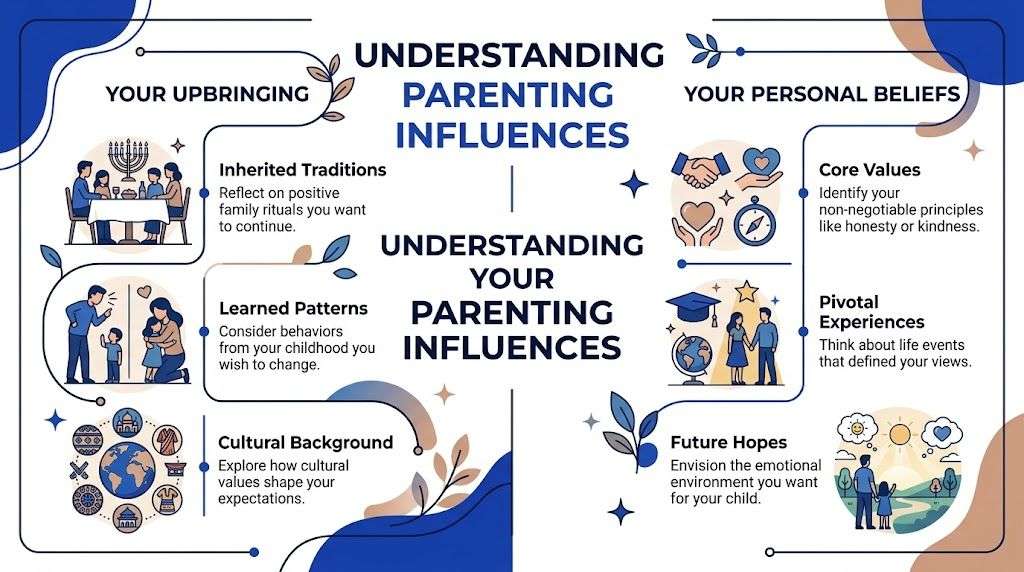
Use this concept as a starting point. As you talk through specific topics, you'll quickly see where your ideas align and where they might differ. To get you started, we've put together a table with some conversation prompts for the most common—and often most contentious—parenting domains.
Core Parenting Value Conversation Starters
Use these prompts to explore key parenting domains, understand each other's perspectives, and identify areas for alignment.
| Parenting Domain | Guiding Question for Partner 1 | Guiding Question for Partner 2 |
|---|---|---|
| Discipline & Guidance | "When you picture our child misbehaving, what’s your gut reaction? What does respectful guidance look like to you?" | "What did discipline feel like in your house? What's one thing you'd want to do the same, and one thing you'd want to do differently?" |
| Education & Learning | "What do you think is the most important thing for a young child to learn before they start school? Is it academics, social skills, or something else?" | "What kind of school environment do you imagine for our kids? What was your own best (or worst) school experience?" |
| Family & Traditions | "How involved do you see our extended families being in our child's life? What boundaries might we need to set?" | "Which family traditions from your childhood do you absolutely want to carry on? What new traditions can we create that are uniquely ours?" |
| Screen Time & Tech | "What role do you think technology should play in our family's life? When do you think it's okay for a child to have a screen?" | "What are your biggest fears when it comes to kids and technology? What rules would make you feel more comfortable?" |
These questions are designed to go beyond a simple "yes" or "no." They get you talking about the feelings, memories, and values that shape your opinions.
The real breakthrough in these talks comes when you dig for the "why" behind your partner's view. You might disagree on a specific method (like sleep training), but you'll often find you share the exact same underlying value (like wanting your baby to feel safe, secure, and loved). That shared value is your anchor and your common ground.
Finding Common Ground Through Compromise
Let's be realistic: no matter how in sync you and your partner are, you will disagree on parenting stuff. It's guaranteed. You're two different people, shaped by different families and life experiences. The goal isn’t to erase those differences, but to figure out how to navigate them together, with respect.
When you hit a point of friction, try to shift your mindset. This isn't a battle where one person has to win. It's more like a puzzle you're solving as a team. You’re not giving something up; you’re co-creating a solution that genuinely works for the family you’re building.

Doing this work before the baby arrives is one of the most powerful things you can do for your relationship. While direct statistics linking pre-baby conversations to divorce rates can be complex, relationship experts widely agree that a strong foundation of communication and shared values is a key predictor of marital satisfaction after a child is born.
Your Toolkit for Healthy Disagreements
When you’re sleep-deprived and arguing about something like sleep training, it’s all too easy for emotions to take over. Having a few practical communication tools in your back pocket can help you stay connected, even when you’re on opposite sides of an issue.
- Actually Listen (Don't Just Wait to Talk): This is more than just being quiet. It’s about putting your phone away, looking at your partner, and trying to understand the feeling behind their words. A simple, "It sounds like you're really worried about…" shows you’re hearing them.
- Start with "I Feel…": This is a game-changer for avoiding the blame game. Instead of saying, "You're being way too rigid about bedtime," you could try, "I feel anxious when we have such a strict schedule because I worry about feeling trapped." It’s a softer, more honest way to express yourself.
- Look for the 'Third Way': This is the heart of creative compromise. Maybe one of you wants a very structured sleep schedule, while the other prefers to be more responsive and flexible. The ‘third way’ isn't one person caving. It might be creating a gentle routine—a predictable bedtime, but with flexibility if the baby needs extra comfort.
The goal is to move from "your way vs. my way" to discovering "our way." It’s a collaborative solution that respects both of your underlying values.
Seeing It in Action
Let’s play out a common scenario: you disagree on how to handle unsolicited advice from the grandparents. One of you wants to shut it down with firm boundaries, while the other is terrified of hurting feelings and starting a family war.
Using these tools, the conversation completely changes. The boundary-setter might say, "I feel so frustrated and undermined when your parents question our choices. It makes me feel like they don't trust us."
The other partner, after really listening, can reply, "I hear you. I hate that it makes you feel that way. I'm just worried about causing a big fight, but I agree we need to be a united front."
Now you’re on the same team. From here, you can find your 'third way.' Perhaps you agree on a simple, polite script you can both use, and you decide who will take the lead in those conversations.
This approach solves the immediate problem while honouring both of your feelings. More importantly, you're building a conflict-resolution muscle that will serve you well when you face other challenges, like figuring out how to divide household chores fairly after marriage. You're not just solving one problem; you're learning how to solve any problem, together.
When You Might Need a Little Outside Help
Let’s be honest: these conversations can be incredibly tough. Even with the best intentions and a whole lot of love, you might find yourselves going in circles, hitting the same wall over and over.
Maybe you keep having the same fight about screen time, and it never goes anywhere. Or perhaps one of you consistently feels steamrolled, like your perspective just isn’t landing. This isn't a sign that your relationship is doomed. Far from it. It’s simply a signal that bringing in a neutral third party could be a game-changer. Thinking about professional support isn't admitting defeat—it's one of the most proactive and caring things you can do for your future family.
Red Flags That a Professional Could Help
If any of these situations feel a little too familiar, it might be the right time to seek out some guided support:
You're Stuck on Repeat: The same argument about discipline, money, or the role of your in-laws keeps surfacing, and you never seem to find a resolution. It just gets pushed aside until next time.
Someone Always Feels Unheard: After these talks, does one of you consistently walk away feeling misunderstood or completely invalidated? That's a huge sign that your communication wires are crossed.
The "What Ifs" Are Causing Serious Anxiety: If the thought of parenting disagreements is already causing a lot of stress or making you question your future together, it's time to address it head-on.
Your Beliefs Feel Non-Negotiable: Sometimes, our values are so deeply tied to our own childhoods that compromising feels like betraying a core part of ourselves. A professional can help you explore that.
You've Started Avoiding the Topics Entirely: Are these conversations so loaded that it feels safer just not to have them? That avoidance creates a massive elephant in the room that will only get bigger once the baby arrives.
Reaching out for help is an act of strength. It shows you value your partnership enough to invest in building the strongest possible communication tools for your family's future.
Working through these big, emotional topics with a trained professional gives you a safe container for the conversation. It creates a space where you can both share your deepest fears and hopes without the risk of the discussion escalating into a fight. A counsellor can help you untangle complex feelings, teach you new ways to really listen to each other, and find creative solutions that honour both of your perspectives. You can learn more about what couples counselling involves and see if it feels like the right kind of support for you. The goal is to ensure you’re stepping into this incredible new chapter as a truly united team.
Your Questions on Aligning Parenting Values Answered
Diving into conversations about your future as parents is a huge, exciting step. But let's be honest, it can also feel a little overwhelming. It's completely normal to have questions and wonder where on earth to start. Let’s tackle some of the most common worries we hear from couples just like you.
What if we discover we have completely different parenting styles?
First, take a deep breath. This is not only common, it's practically guaranteed. You're two individuals who grew up in different families with different experiences; it would be strange if you had identical ideas from the get-go. The real work isn't about having the same initial thought but about getting curious about the "why" behind each other's perspective. For instance, one of you might advocate for firm, clear boundaries around behaviour, while the other feels that gentle explanations are the better path. It might look like a conflict, but if you dig deeper, both of you probably share the exact same core value: raising a child who is respectful and kind. When you focus on that shared goal, you can start blending your ideas into something that is uniquely yours.
How do we start these conversations without it turning into a fight?
The secret here is all about the setup. You can't just spring a "let's talk about discipline" conversation on your partner when they're tired, hungry, or walking in the door from a stressful day. Instead, frame it as a fun, collaborative project—like you're dreaming together. Pick a relaxed time, maybe on a weekend morning with a cup of coffee. Start with the positive and connect over your hopes. You could ask something like, "What's one happy memory from your childhood you really want to give our kids?" This builds a foundation of warmth and shared excitement before you wade into trickier topics. If you're looking for more ways to keep these chats productive, you might find some great advice in our frequently asked questions section.
Is it okay if we don't agree on everything before the baby comes?
Yes! Not only is it okay, it’s impossible to have every single detail buttoned up. Trying to create a perfect, exhaustive parenting rulebook before you’ve even met your child is a shortcut to frustration. Kids are not theoretical, and parenting is all about adapting. The true goal of these pre-baby talks is to practice how you communicate about disagreements. It’s about aligning on the big-picture stuff—your core family values like honesty, kindness, and safety. You will learn and evolve constantly as your child grows and new situations arise. What matters most is building the trust that you can face those future challenges as a united team, ready to figure it out together.
What are the most important values to discuss before having a baby?
While every couple is different, some key areas tend to be universal. It’s helpful to talk about your core values around family life (traditions, involvement of extended family), education (what you value most in learning), discipline (your approach to guidance vs. punishment), and health (including mental health and screen time). Don’t forget the practicals, like how you’ll divide responsibilities and manage finances with a new baby. The goal isn't to agree on every detail but to understand each other's perspectives and know you can talk through anything.
These conversations are not about finding perfect answers; they are about strengthening the bond between you and your partner. By turning toward each other with curiosity and love, you are building the most important thing your future child will ever need: a secure, united, and loving home. If you're ready to explore these topics further, we are here to support you on your journey.
Clinically Reviewed By
Amy Mosset, MCP, RCC-S
Amy Mosset is a Master Practitioner in Clinical Counselling, Clinical Supervisor, and the owner of Interactive Counselling. She provides trauma-informed, evidence-based care and clinical supervision to registered therapists, with a focus on ethical practice, client safety, and high-quality therapeutic outcomes.