TL;DR: For more information, see our couples counselling.
- Love languages are a helpful conversation starter but not a definitive measure of love or happiness.
- The quiz measures relative preferences, which can change with life circumstances and stress.
- Effective relationships rely on ongoing curiosity, communication, and adaptability beyond fixed love languages.
Have you ever felt like you and your partner are speaking completely different emotional languages? You show love in one way, they express it in another, and somehow the signals keep missing each other. It’s one of the most common sources of quiet frustration in relationships, and it leaves many people feeling unseen or underappreciated. The love language quiz promises a shortcut to understanding, and for millions of couples, it’s become a go-to starting point. But how reliable is it, really? This guide walks you through what the quiz actually measures, how to take it thoughtfully, and what to do with your results once you have them.
Table of Contents
- Preparing to take a love language quiz: What you need to know
- Step-by-step: Taking a love language quiz and what to expect
- Interpreting your results: Beyond the primary language
- Putting insights to work: How to use your love language results with a partner
- Why your love language may not be the whole story
- Taking the next step: When to seek additional support
- Frequently asked questions
Key Takeaways
| Point | Details |
|---|---|
| Quiz as conversation starter | Love language quizzes are most useful for opening up honest discussion in relationships, not as diagnostic labels. |
| Results are flexible | Personal preferences and ‘love languages’ can shift over time and shouldn’t be used to rigidly classify yourself or your partner. |
| Responsiveness matters most | True relationship satisfaction is built on empathy and adapting to each other’s needs, not on matching quiz results. |
| Consider professional help | If relationship patterns are challenging or communication stalls, counselling can offer deeper guidance than a quiz alone. |
Preparing to take a love language quiz: What you need to know
Now that you’re interested in exploring your love language, it pays to understand what the quiz really measures and what to keep in mind before you begin.
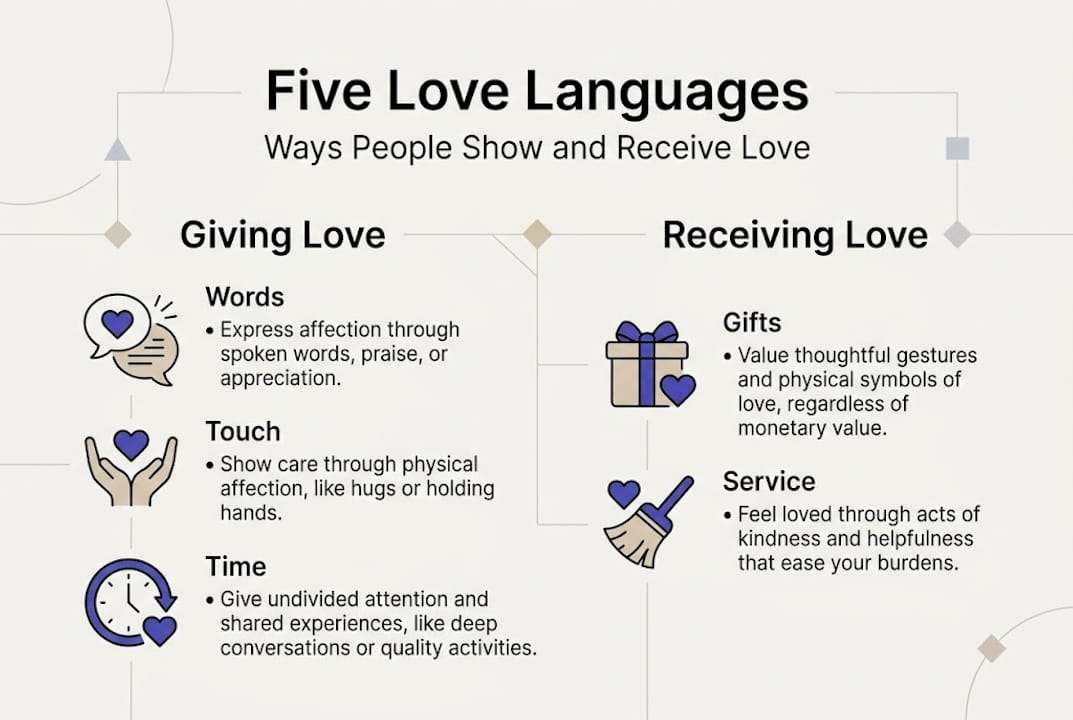
The love language framework, originally developed by Gary Chapman, groups expressions of affection into five categories: words of affirmation, acts of service, receiving gifts, quality time, and physical touch. The quiz designed around this framework uses 30 forced-choice items, where you must pick between two options. This format artificially creates a single primary language, even though independent rating scales consistently show that most people value all five categories highly.
This is worth sitting with for a moment. The quiz isn’t measuring something fixed inside you. It’s measuring your relative preferences within a constrained set of choices. That’s a meaningful distinction.
Before you start, consider these important points:
- The categories may be too simple. Empirical reviews find no strong support for core claims, including no single primary language, not exactly five categories, and no clear happiness boost from partners matching each other’s language.
- Cultural context matters. How you were raised, what your family modelled, and your cultural background all shape how you give and receive affection.
- The quiz is a conversation starter, not a diagnosis. Treat your results as one data point among many, not a definitive personality label.
- Your answers may reflect current stress. If you’re going through a difficult period, your responses may shift compared to a calmer time in your life.
Here’s a quick comparison to help you set realistic expectations:
| What the quiz does well | What the quiz doesn’t do well |
|---|---|
| Opens dialogue between partners | Predict relationship satisfaction |
| Helps you reflect on your needs | Capture the full complexity of love |
| Provides shared vocabulary | Account for cultural or contextual variation |
| Encourages empathy and curiosity | Replace professional relationship support |
Pro Tip: Before taking the quiz, browse some examples of love language questions so you know what to expect. You might also find it useful to read a 7 love languages guide to broaden your frame of reference before interpreting your score.
Step-by-step: Taking a love language quiz and what to expect
With that context, you’re ready to dive into the process. Here’s a concrete walkthrough of what the quiz involves.
Most love language quizzes are available online and take roughly ten to fifteen minutes to complete. The experience is straightforward, but a few intentional steps can make your results far more useful.
- Find a quiet moment. Don’t rush through the quiz during a busy day. Your answers will be more reflective if you’re calm and not distracted.
- Read each question carefully. The forced-choice format asks you to pick between two statements, like “I feel loved when my partner helps me with tasks” versus “I feel loved when my partner tells me they appreciate me.” Neither option is wrong.
- Go with your gut. Overthinking each item can skew your results. Your instinctive response is usually more honest than a carefully reasoned one.
- Notice where you hesitate. If you find yourself stuck between two options repeatedly, that’s useful information. It may mean you genuinely value both expressions of love equally.
- Record your scores across all five categories. Don’t just focus on your top result. The full spread of numbers tells a richer story than a single label.
- Invite your partner to take it separately. Comparing results together is where the real insight begins.
Once you have your scores, resist the urge to immediately declare yourself a “quality time person” and leave it at that. Quizzes work best as conversation starters for couples to discuss needs, but should be treated as prompts rather than diagnostics. What matters most is responsiveness to each other, not rigid category matching.
“The goal isn’t to find your label. It’s to find your language, and then use it to actually talk to each other.”
If you’re unsure how to interpret your scores, exploring resources on finding your love language can help you think through the nuances. You might also look at acts of service examples to see how one category plays out in everyday life.
Pro Tip: Take the quiz twice, once thinking about what makes you feel loved, and once thinking about how you naturally express love to others. The two results are often different, and that gap is worth exploring.
Interpreting your results: Beyond the primary language
Once you have your results in hand, the most important work begins: thoughtful interpretation for real-world relationships.

Your quiz results are not a personality type carved in stone. They reflect tendencies, not absolutes. Most people score meaningfully across several categories, not just one. Think of your results less like a single spotlight and more like a full dimmer panel where multiple lights are on at varying brightness.
Here are some common pitfalls to watch for when reading your results:
- Over-identifying with one category. Saying “I’m a physical touch person” and expecting your partner to simply adjust their behaviour can feel transactional rather than loving.
- Using results to avoid growth. Some people use their “love language” as a reason not to try other forms of affection. Real intimacy often means stretching beyond your comfort zone.
- Ignoring power dynamics. Preferences shift with context and life stages, and there are real risks of oversimplification, transactional care, and ignoring consent, particularly around physical touch.
- Treating results as permanent. A new parent, someone grieving a loss, or a person navigating a major health challenge may find their emotional needs look completely different than they did two years ago.
Here’s a helpful way to think about your score distribution:
| Score range | What it might mean |
|---|---|
| One category much higher than others | Strong current preference, worth exploring in dialogue |
| Two or three categories closely tied | You likely value multiple expressions of love equally |
| All five categories scored similarly | You may be highly adaptable, or the format didn’t resonate |
| Low score on one category | May reflect past experience or cultural norms, not a fixed limit |
Looking at real-life love language examples can help you see how these categories show up in daily moments rather than abstract concepts. It’s also worth understanding how attachment styles in relationships interact with your love language results, since the two frameworks often illuminate each other.
Putting insights to work: How to use your love language results with a partner
Understanding your and your partner’s scores is only the beginning. The power comes from what you do next.
Sharing quiz results can feel vulnerable, and that’s actually a good sign. It means you’re opening a real conversation. Here’s how to make that conversation count:
- Share your full score profile, not just your top result. Saying “I scored highest in quality time, but words of affirmation was close behind” gives your partner far more to work with.
- Ask questions, not just for answers. Try “What does quality time actually look like for you on a hard week?” rather than assuming you already know.
- Acknowledge where your styles differ without making it a problem. Difference is normal. Curiosity about difference is what builds closeness.
Practical ways to respond to each other’s needs with flexibility:
- Offer small, consistent gestures rather than grand occasional ones
- Check in regularly about whether your efforts are landing well
- Be willing to try expressions of love that don’t come naturally to you
- Celebrate effort, even when the execution isn’t perfect
Pro Tip: Think of why love languages matter less as a matching exercise and more as an ongoing practice of paying attention. The couples who thrive aren’t the ones with identical quiz results. They’re the ones who keep asking each other what they need.
The biggest risk in using love language results is turning care into a transaction. “I did the thing you said you needed, so now you owe me.” That mindset corrodes connection rather than building it. Quizzes are most useful as prompts for discussion, not as rigid frameworks for keeping score. Explore couple compatibility with love languages and love language examples to keep your approach grounded and human.
Why your love language may not be the whole story
Let’s step back from the quiz for a moment and consider what truly builds lasting intimacy.
At Interactive Counselling, we see many couples who arrive having already taken the quiz, sometimes more than once. They’ve read the results, shared them with each other, and still feel stuck. That experience points to something important: knowing your love language isn’t the same as feeling loved.
The science behind the framework is more modest than its popularity suggests. No Canada-specific data exists on love language effectiveness, and the concept is used universally, including by University of Toronto researchers who have critiqued it. The categories may be a useful starting vocabulary, but they’re not a complete emotional grammar.
What actually sustains connection over time is something harder to quiz: genuine curiosity about your partner’s inner world, the willingness to repair after conflict, and the habit of noticing what the other person needs, even when it’s inconvenient. These qualities don’t fit neatly into five boxes. Exploring therapeutic use of love language tools alongside broader relationship frameworks can offer a more complete picture of how to build lasting closeness.
The quiz is a door. What matters is what you do once you walk through it.
Taking the next step: When to seek additional support
If you’re ready for more personalised support, or if challenges persist, consider these next steps.
Sometimes a quiz opens conversations that are bigger than you expected. Old wounds surface, communication patterns feel entrenched, or you realise you and your partner need more than a shared vocabulary to move forward. That’s not a failure. It’s a sign that you’re taking your relationship seriously. At Interactive Counselling, our licensed therapists across Kelowna, Vernon, Grande Prairie, Penticton, and online across Canada can help you build on what the quiz has started. Whether you’re exploring relationship therapy options or looking for compassionate professional counselling services, we’re here to support you with flexible, non-judgmental care tailored to your unique needs.
Frequently asked questions
Are love language quizzes scientifically valid?
Most research finds love language quizzes helpful for conversation but lacking strong scientific proof of core claims. Empirical reviews find no strong support for a single primary language, exactly five categories, or a happiness boost from matching languages.
Can my love language change over time?
Yes, your preferences may shift with life stages, circumstances, or relationship contexts. Preferences shift with context and there is a real risk of oversimplification if you treat early results as permanent.
Is there a love language specific to Canadians or Canadian relationships?
No, the model is used worldwide and there is no Canada-specific love language, though cultural influences do play a role. No Canada-specific data exists on the framework, even as Canadian researchers engage critically with it.
What if my partner’s quiz results are different from mine?
View differences as a prompt for conversation and empathy, not a problem to solve. Quizzes work best as conversation starters and what matters most is mutual responsiveness, not matching categories.
Do professional counsellors use love language quizzes in therapy?
Some therapists use love language tools to open meaningful discussions, but they integrate broader relationship frameworks for deeper understanding. Love language concepts are used universally in counselling settings, though they are subject to critique and thoughtful adaptation.
Recommended
- What are the 7 love languages: A practical guide
- Love language compatibility: solutions for couples in 2026
- 5 Love Language Examples to Deepen Your Connection
- Love Language Examples – Interactive Counselling
- Why Naming Your Feelings Helps — The Caia Journal
Discovering your love language is a great first step — living it out together is where real change happens. If you’d like support along the way, our Kelowna counselling team is here, in person or online.