TL;DR: For more information, see our couples counselling.
- Over half of couples experience mismatched love languages, leading to emotional disconnection.
- Understanding and intentionally translating love languages can improve relationship satisfaction and reduce burnout.
- Effective communication, curiosity, and professional support are key to bridging love language gaps.
More than half of all couples, roughly 52.6% of pairs, are mismatched in how they give and receive love. That’s a striking number, and it explains why so many partners feel quietly unappreciated despite genuinely trying their best. You cook dinner, plan a weekend away, or offer a long hug, yet somehow your partner still feels unseen. That gap between intention and impact is one of the most common sources of relationship pain we see. This guide walks you through why love language differences happen, what the research actually says, and the practical steps Canadian couples can take to feel genuinely connected again.
Table of Contents
- Why love languages matter in relationships
- How mismatched love languages impact couples
- Practical steps for bridging love language gaps
- Limits and critiques: beyond the classic love language framework
- A Canadian therapist’s perspective: what really moves the needle for couples
- Professional support for couples: your next steps
- Frequently asked questions
Key Takeaways
| Point | Details |
|---|---|
| Mismatch is common | More than half of couples have different love languages, which can create emotional confusion if not addressed. |
| Skills beat natural match | Relationship satisfaction grows when couples intentionally learn and adapt to each other’s love languages. |
| Model is just a tool | Love languages are a helpful starting point, but blending tools and ongoing communication is key for lasting connection. |
| Therapist support matters | Counselling and professional guidance can help Canadian couples bridge love language gaps and prevent burnout. |
Why love languages matter in relationships
Love languages are the five primary ways people express and experience emotional connection: Words of Affirmation, Acts of Service, Receiving Gifts, Quality Time, and Physical Touch. Developed by Dr. Gary Chapman, the framework suggests that each person has a preferred “language” for feeling loved. When partners share the same language, connection often feels effortless. When they don’t, even the most loving gestures can miss the mark entirely.
Think of it like speaking French to someone who only understands Mandarin. The warmth behind the words is real, but the message doesn’t land. Love language examples in everyday life look like this: one partner cleans the kitchen to show care (Acts of Service), while the other craves a long walk together (Quality Time). Neither person is wrong. They’re simply operating from different emotional vocabularies.
Here’s what makes mismatches so quietly damaging:
- Invisible effort: You’re working hard, but your partner doesn’t register it as love.
- Growing resentment: Over time, feeling unappreciated can breed frustration on both sides.
- False conclusions: Partners begin assuming the other doesn’t care, when the real issue is miscommunication.
- Emotional withdrawal: One or both partners pull back, creating distance that compounds the original problem.
The good news? Recent findings on love languages suggest that mismatch is not a relationship death sentence. As one key insight from relationship research puts it, partners with mismatched languages often experience misunderstandings because each expresses love in their preferred way, not because they lack love for each other. Understanding the difference between intent and impact is the first, most important step.
Exploring the ways we give and receive love reveals that most people actually have a primary and a secondary language. That nuance matters enormously in practice. A partner whose primary language is Physical Touch but secondary is Words of Affirmation will respond very differently to a hug paired with a sincere compliment than to either gesture alone.
“A love language mismatch doesn’t mean you’re incompatible. It means you have an opportunity to learn each other more deeply.”
This reframe is central to everything that follows.
How mismatched love languages impact couples
Knowing that mismatches are common is one thing. Feeling their weight in daily life is another. The concrete consequences can be significant, and they often build slowly before couples even realise what’s happening.
Over half of couples report being mismatched in their love language preferences, and the emotional toll shows up in predictable patterns. Consider the typical progression:
- Early confusion: One partner feels their efforts go unnoticed; the other feels pressured or smothered.
- Repeated misinterpretation: Gestures meant as love are read as obligation, indifference, or even control.
- Emotional distance: Conversations become surface-level; vulnerability decreases.
- Resentment and burnout: The partner who “gives more” (by their own measure) starts to feel depleted.
- Crisis point: Arguments become more frequent, often about symptoms rather than the underlying disconnection.
The research offers a hopeful counterpoint. RCT evidence shows that love language interventions can meaningfully improve relationship satisfaction when both partners commit to the process. In fact, 89% of mismatched couples report higher satisfaction when they make deliberate effort to speak each other’s language, even imperfectly.
| Factor | Matched couples | Mismatched couples (no effort) | Mismatched couples (with effort) |
|---|---|---|---|
| Emotional satisfaction | High | Low | Moderate to high |
| Communication quality | Strong | Strained | Improving |
| Risk of emotional burnout | Low | High | Reduced significantly |
| Sense of being valued | Consistent | Inconsistent | Growing over time |
For Canadian couples, the challenge is often compounded by busy schedules, geographic distance (think long-distance relationships between cities like Vancouver and Calgary), and cultural backgrounds that shape how love is expressed. Learning to manage mismatches becomes even more pressing when life stressors pile on.

It’s also worth naming the connection between prolonged mismatch and emotional neglect. When partners feel consistently unseen, the impact can go beyond frustration. If this resonates with you, exploring resources on how to address emotional neglect in a relationship can be a valuable next step alongside the strategies below.
Practical steps for bridging love language gaps
Understanding the problem is only half the work. The other half is building new habits, together. Here’s where real change happens.
Start with self-awareness. Finding your love language through a short quiz or guided conversation can open up dialogue that many couples have never had. Ask each other: “What makes you feel most appreciated?” and “What do I do that means the most to you?” These questions often reveal surprising answers.
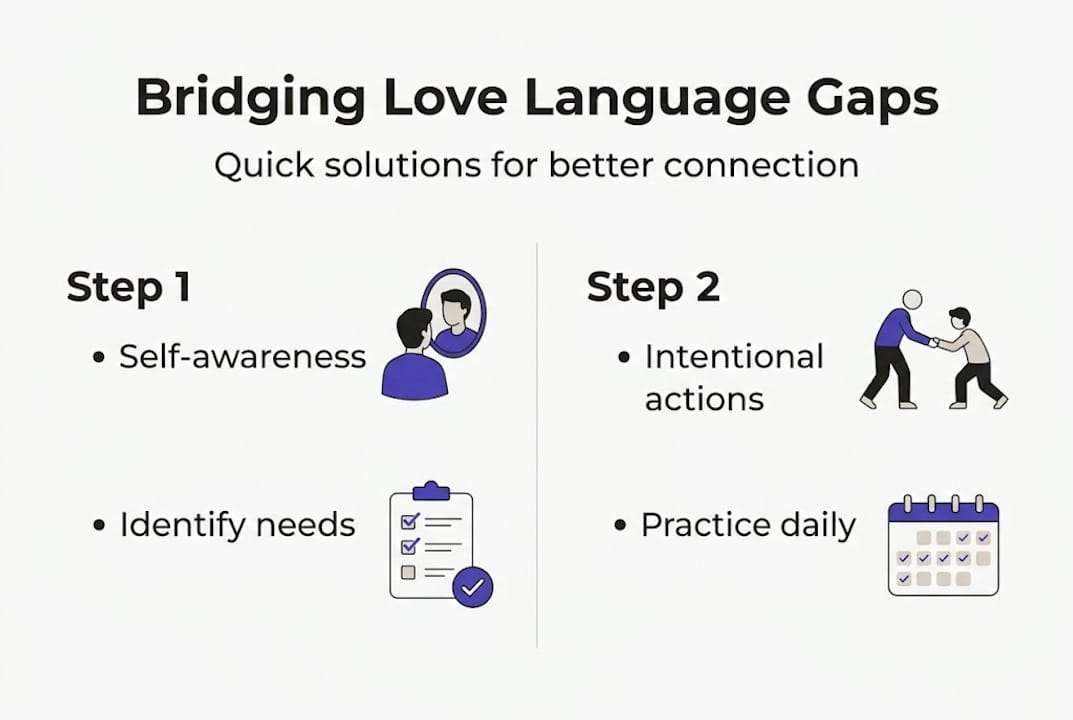
Once you both have a clearer picture, the goal is intentional translation. Psychologist-backed advice recommends identifying primary languages via quizzes and discussions, then deliberately “speaking” your partner’s language through targeted actions like affirmations, touch, or service.
| Your language | Partner’s language | Translation action |
|---|---|---|
| Acts of Service | Words of Affirmation | Write a note while doing a task for them |
| Quality Time | Physical Touch | Hold hands during your evening walk |
| Words of Affirmation | Gifts | Pair a heartfelt card with a small, thoughtful item |
| Physical Touch | Quality Time | Cuddle while watching a film together |
| Gifts | Acts of Service | Offer to take over a chore they dislike |
Small, consistent actions matter far more than grand gestures. Here are daily habits that make a difference:
- Morning check-ins: A 5-minute conversation before the day starts builds Quality Time and connection.
- Physical acknowledgement: A brief touch on the shoulder or a hug when you reunite after work costs nothing.
- Verbal appreciation: Saying “I noticed what you did, and it meant a lot” speaks directly to Words of Affirmation needs.
- Shared rituals: A weekly activity you both enjoy blends Quality Time with whichever secondary language fits.
Pro Tip: Avoid the trap of only “speaking” your own language louder when you feel disconnected. If your partner needs Quality Time and you respond to distance by doing more Acts of Service, the gap widens. Pause, ask, and adjust.
If you’re curious about a broader framework, exploring the expanded love languages model can add even more nuance to how you understand each other’s needs.
Limits and critiques: beyond the classic love language framework
The love languages model is a genuinely useful starting point. But it’s worth being honest about where it falls short, because leaning on it too heavily can actually create new blind spots.
The classic five-language model may oversimplify emotional needs, with some research suggesting there are 7 to 10 primary emotional needs that better capture the complexity of human connection. Gottman Institute research, for instance, places far more emphasis on “bids for connection,” the small, everyday moments where one partner reaches out emotionally and the other either turns toward or away from them. A bid might be as simple as pointing out a bird at the window and hoping your partner looks up. How you respond to those bids, consistently and over time, may matter more than which love language category you fall into.
There’s also a cultural dimension that the original model doesn’t address well. Cultural research shows that how love is expressed and received varies significantly across cultural backgrounds, something especially relevant in Canada’s diverse communities.
“Proponents see love languages as tools for empathy; critics argue the model is an unvalidated folk theory that risks reducing complex emotional dynamics to a simple quiz result.”
This critique of the love language model is worth taking seriously. The framework works best as a conversation starter, not a final diagnosis.
Pro Tip: Use love languages to open the door to deeper dialogue, then walk through that door with curiosity rather than a checklist. Pair the model with ongoing communication, and consider alternative models or professional support for a richer picture.
Building emotional intimacy over time requires more than matching categories. It requires showing up, again and again, in ways that feel responsive to your specific partner.
A Canadian therapist’s perspective: what really moves the needle for couples
Here’s something we’ve observed consistently in counselling work with Canadian couples: the love languages framework rarely produces breakthroughs on its own. What actually moves the needle is the conversation it starts.
When couples come in feeling disconnected, they’re often already doing the “right” things by their own measure. The shift happens when they become genuinely curious about their partner’s inner world, not just their love language category. Real connection grows from flexibility, from being willing to stretch beyond what feels natural, and from noticing and responding to small bids for closeness throughout the day.
The couples who make the most progress aren’t the ones who “match” perfectly. They’re the ones who stay curious, communicate openly, and treat disconnection as information rather than failure. Local therapists recommend awareness and flexibility via counselling to bridge gaps and prevent emotional burnout, with virtual therapy available nationwide for Canadian couples who need accessible support.
Love languages are a tool. Genuine responsiveness is the skill.
Professional support for couples: your next steps
If you’ve recognised your relationship in any part of this guide, you’re not alone, and you don’t have to figure it out without support. At Interactive Counselling, we work with couples across Canada who are navigating exactly these kinds of communication gaps. Whether you’re in Kelowna, Grande Prairie, Penticton, or anywhere in between, both in-person and virtual options are available to fit your life. Learn more about our couples counselling in Kelowna.
Exploring the advantages of online couples therapy can help you decide whether virtual sessions might work for your schedule. When you’re ready to take the next step, our team can help you find a relationship counsellor who fits your needs. Compassionate, non-judgmental support is available, and the first step is simply reaching out.
Frequently asked questions
Can couples with different love languages have a successful relationship?
Absolutely. Success depends on mutual effort and openness to learning, not on having a natural match, and professional support can accelerate that process significantly.
Is there scientific proof that matching love languages leads to happier couples?
The evidence is mixed. Some studies show increased satisfaction, but critics note there is no strong evidence that matching languages alone improves outcomes, and other relational approaches may be equally or more effective.
How do Canadian couples typically resolve love language mismatches?
Canadian therapists recommend building awareness, practising flexible communication, and accessing counselling, including virtual options available across the country.
What if neither partner’s love language is ‘gifts’ or ‘touch’?
Partners can absolutely thrive by focusing on their actual languages, building hybrid rituals that blend Quality Time, Words of Affirmation, or Acts of Service in ways that feel natural and meaningful to both people.
Recommended
- When Love Languages Don’t Match: How to Reconnect When You Feel Out of Sync
- How to rekindle attraction in your relationship in 2026
- What are the 7 love languages: A practical guide
- Marriage after kids: maintain love and connection in 2026
When love-language differences keep leading to the same argument, working with a professional can shift the pattern. Our marriage counselling in Kelowna is designed for exactly that.