
TL;DR:
- EMDR is a structured, evidence-based trauma therapy that does not require detailed verbal recounting.
- Bilateral stimulation, like eye movements or taps, facilitates brain reprocessing of traumatic memories.
- Therapy results depend on therapist skill and client readiness, often showing improvement in 6 to 12 sessions.
Many people assume that healing from trauma means sitting across from a therapist and recounting every painful detail, session after session. That belief stops a lot of people from ever reaching out. EMDR therapy, which stands for Eye Movement Desensitisation and Reprocessing, works differently. It is a structured, evidence-based approach that helps your brain process distressing memories without requiring you to narrate every detail out loud. In this guide, we walk through what EMDR is, how it works, who it helps, and what you can realistically expect from the process.
Table of Contents
- What is EMDR therapy?
- The eight phases of EMDR therapy
- How does bilateral stimulation work in EMDR?
- Who can benefit from EMDR and what results to expect
- A fresh perspective: Why EMDR’s real power is misunderstood
- Explore EMDR and trauma support with Interactive Counselling
- Frequently asked questions
Key Takeaways
| Point | Details |
|---|---|
| Structured eight-phase process | EMDR therapy uses eight clearly defined phases to guide trauma recovery step by step. |
| Rapid results possible | Many people experience improvement within 6 to 12 sessions of EMDR therapy. |
| No need for detailed retelling | EMDR allows trauma healing without requiring clients to share every detail of their memories. |
| Backed by science | Major health bodies and research confirm EMDR’s effectiveness for PTSD and trauma. |
| Success depends on therapist | Choosing a well-trained EMDR therapist is crucial for optimal results. |
What is EMDR therapy?
EMDR stands for Eye Movement Desensitisation and Reprocessing. It is a form of psychotherapy developed by psychologist Dr. Francine Shapiro in the late 1980s, originally designed to reduce the distress tied to traumatic memories. Since then, it has grown into one of the most rigorously studied trauma treatments available.
What makes EMDR stand out from traditional talk therapy is its foundation in adaptive information processing (AIP). Think of your brain like a filing system. Normally, when something difficult happens, your brain processes the experience and files it away so it no longer feels raw. Trauma disrupts that filing process. The memory gets stuck, unprocessed, still loaded with the emotion and physical sensations of the original event. EMDR helps your brain complete that interrupted process.
Unlike talk therapy, where insight and verbal exploration are the primary tools, EMDR uses a structured protocol combined with bilateral stimulation (explained fully in a later section) to help the brain do its own reorganising. You can learn more about what is EMDR and how it fits into a broader mental health plan.
Major health organisations, including the American Psychological Association and the World Health Organisation, recommend EMDR for PTSD. Meta-analyses confirm large effect sizes compared to waitlist controls, with outcomes equivalent to Trauma-Focused Cognitive Behavioural Therapy (TF-CBT), often achieved in just 6 to 12 sessions.
EMDR is used to address a wide range of concerns, not just PTSD. People seek it out for:
- Post-traumatic stress disorder (PTSD)
- Anxiety and panic disorders
- Grief and loss
- Childhood trauma and abuse
- Phobias
- Depression linked to adverse life experiences
- Performance anxiety
If you want to understand how EMDR fits into a broader healing journey, trauma counselling explained offers helpful context.
“EMDR does not require clients to describe their experiences in detail, making it accessible for those who find verbal recounting overwhelming.” — EMDRIA glossary
The eight phases of EMDR therapy
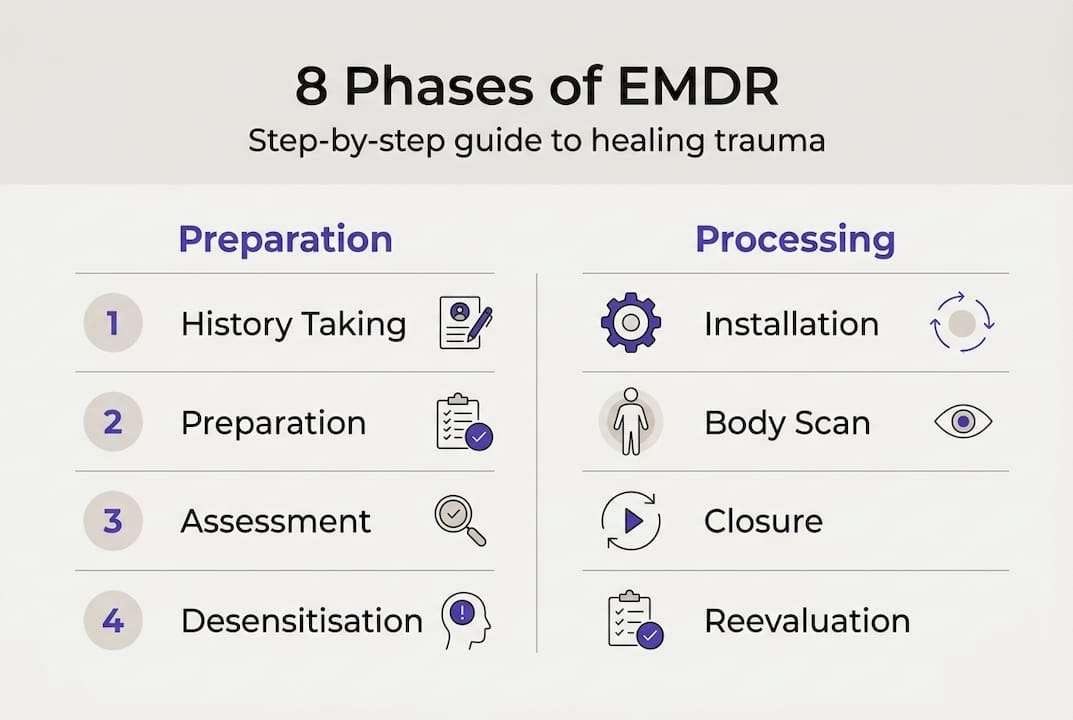
One of EMDR’s greatest strengths is its structure. There is nothing random about how a session unfolds. EMDR follows a structured eight-phase protocol, giving both you and your therapist a clear roadmap from the very first appointment.
Here are the eight phases:
- History taking — Your therapist gathers background information, identifies target memories, and assesses your readiness.
- Preparation — You learn coping and stabilisation techniques to manage distress between and during sessions.
- Assessment — The specific target memory is identified, including the negative belief tied to it and the physical sensations you notice.
- Desensitisation — Bilateral stimulation begins while you hold the target memory in mind. Distress gradually reduces.
- Installation — A positive belief is strengthened to replace the negative one tied to the memory.
- Body scan — You check for any remaining physical tension or sensation connected to the memory.
- Closure — The session is brought to a calm, grounded end, with stabilisation techniques used if needed.
- Re-evaluation — At the start of the next session, your therapist checks what has shifted and what still needs attention.
| Phase | Primary goal | What you experience |
|---|---|---|
| History taking | Build a treatment plan | Collaborative conversation |
| Preparation | Build safety and coping skills | Learning grounding techniques |
| Assessment | Identify the target memory | Awareness of thoughts and feelings |
| Desensitisation | Reduce emotional charge | Eye movements or taps while recalling memory |
| Installation | Strengthen positive belief | Repeating affirming statements |
| Body scan | Clear residual tension | Attention to physical sensations |
| Closure | Return to baseline | Grounding and stabilisation |
| Re-evaluation | Track progress | Reflection on changes between sessions |
Pro Tip: Do not rush through the preparation phase. Clients who feel genuinely safe and equipped with coping tools tend to move through the desensitisation phase more smoothly. Trust in the EMDR therapy process is not just helpful, it is foundational. Understanding your own emotional patterns in therapy can also support your progress.
How does bilateral stimulation work in EMDR?
Bilateral stimulation is the defining feature of EMDR, and it is also the part that raises the most questions. Put simply, bilateral stimulation means alternately activating both sides of the brain through:
- Eye movements — following a therapist’s fingers or a light bar moving side to side
- Auditory tones — sounds alternating between left and right ears through headphones
- Tactile taps — gentle taps alternating on each knee or hand
The current leading explanation is that bilateral stimulation facilitates reprocessing of traumatic memories through the Adaptive Information Processing model. Some researchers compare it to the rapid eye movement (REM) stage of sleep, where the brain naturally processes and integrates emotional experiences. When bilateral stimulation is applied while holding a distressing memory in mind, it appears to reduce the emotional intensity of that memory and help your brain file it away more adaptively.
What does this feel like in practice? Most clients describe a gradual loosening of the emotional grip a memory holds. The memory itself does not disappear. It simply loses its charge. You may notice shifts in how you see the event, a softening of the body’s physical response, or a new perspective forming almost spontaneously.
“The mechanisms are still being studied, but the outcomes of EMDR are consistently validated across clinical populations.” — Harvard Health on EMDR
It is fair to say that the exact reason bilateral stimulation works remains a topic of research and some debate. What is not debated is that it works. This is important for anyone feeling hesitant. You do not need to understand the neuroscience to benefit from the results. Exploring what healing from trauma looks like in practice can help you decide if EMDR feels right for you.

Pro Tip: Staying actively engaged during bilateral stimulation, rather than trying to control or analyse what comes up, tends to produce better results. Let the process lead. Your therapist is there to guide you safely.
Who can benefit from EMDR and what results to expect
EMDR is not limited to veterans or survivors of acute trauma. Its applications are broader than many people realise. Research and clinical practise show it is effective for:
- Adults with PTSD, complex trauma, or childhood abuse histories
- Children and adolescents experiencing anxiety, PTSD, or grief
- Individuals dealing with grief and complicated loss
- People with phobias or performance anxiety
- Those managing depression rooted in adverse life experiences
Meta-analyses confirm that EMDR produces large effect sizes for PTSD compared to waitlist controls, with outcomes matching TF-CBT. For families wondering about younger clients, counselling effectiveness for youth outlines what the evidence says about therapeutic support for children and teens.
| Therapy type | PTSD evidence level | Sessions typically needed | Verbal recounting required |
|---|---|---|---|
| EMDR | High (APA, WHO recommended) | 6 to 12 | No |
| TF-CBT | High | 12 to 20 | Yes |
| Traditional talk therapy | Moderate | Variable | Yes |
It is important to set realistic expectations. EMDR is not a single-session cure. Progress looks different for everyone. Some notice meaningful shifts after just a few sessions. Others with complex or layered trauma may need a longer course of treatment. What you can generally expect is a reduction in the emotional intensity of target memories, less physical reactivity to triggers, and a greater sense of personal agency. Accessing dedicated trauma counselling support ensures you receive care matched to your specific needs. For those working on deeper patterns, emotional safety and healing resources can complement EMDR work beautifully.
A fresh perspective: Why EMDR’s real power is misunderstood
Here is something most articles will not tell you. The debate about whether eye movements are the active ingredient in EMDR is largely beside the point for clients sitting in the therapy chair. The energy spent arguing over mechanisms has, in some ways, distracted from the far more important truth: EMDR’s structure is itself therapeutic.
For people who have spent years avoiding trauma because traditional therapy felt like reopening a wound with no sutures, the structured, titrated (carefully measured) approach of EMDR offers something different. It says: you are in control, and we go at your pace. That alone shifts the therapeutic relationship.
What we also see, and what gets overlooked, is that EMDR outcomes are heavily dependent on therapist skill and client readiness, not just the technique itself. A poorly timed session or an unprepared client can make the process harder. This is why the preparation phase matters so much. Those who invest in that foundation tend to move through the later phases with greater confidence and less distress.
For those wondering whether trauma-informed CBT might work alongside EMDR, the answer is often yes. The approaches can complement each other depending on your specific profile and goals.
Explore EMDR and trauma support with Interactive Counselling
If what you have read resonates with you, taking the next step does not have to feel overwhelming. At Interactive Counselling, our therapists are trained in understanding EMDR therapy and offer personalised support tailored to where you are right now. Whether you are navigating PTSD, processing grief, or simply curious about whether this approach could help, we are here to talk it through. Our trauma counselling sessions are available in-person across Kelowna, Vernon, Grande Prairie, and Penticton, as well as online across Canada. Explore all of our counselling services and book a time that works for you.
Frequently asked questions
How quickly can EMDR therapy show results?
Many clients notice meaningful improvement within 6 to 12 EMDR sessions, though timelines vary depending on individual history and the complexity of the trauma being addressed.
Does EMDR therapy require talking about my trauma in detail?
No. EMDR is designed so that detailed verbal recounting is not required, which makes it especially accessible for people who find it difficult or distressing to narrate their experiences.
Are eye movements essential for EMDR to work?
Bilateral stimulation is central to the EMDR process, but research consistently shows that outcomes remain strong even amid ongoing theoretical discussions about the precise role of eye movements.
Is EMDR effective for children and teens?
Yes. Meta-analyses show large effect sizes for EMDR with youth experiencing PTSD, placing it among the leading evidence-based treatments for younger clients.
What is the most important factor for EMDR success?
A well-trained therapist and a client who feels prepared and safe are the most critical ingredients. Therapist training and readiness consistently appear as key predictors of positive outcomes in the research.
Recommended
- Emotionally focused therapy explained: improve connections
- Therapy and Emotional Patterns: Building Self-Awareness
- How to Heal from Trauma: A Compassionate Guide to Recovery
- Rebuilding emotional intimacy in couples: a 2026 guide