It is a hot July evening in Penticton. The beach is full, traffic is slow, your phone keeps buzzing, and the day that was supposed to feel easy has somehow turned into another argument about dinner, timing, money, or who is carrying more. For many local couples, that moment does not come out of nowhere. It builds as summer piles several kinds of pressure into the same small window of time. For more information, see our Penticton couples counselling.
This article starts from a simple idea. Relationship stress in Penticton often rises in summer not because couples care less, but because this season asks more of them in several ways at once. Heat wears down patience. Tourism changes traffic, noise, schedules, and access to everyday spaces. A seasonal economy can stretch work hours and income worries in the same month. The housing squeeze leaves many people with less privacy and less room to recover. Even the staycation promise of living in a beautiful place can create pressure to enjoy summer while you are already exhausted. For more information, see our counselling in Penticton.
That combination works like a pressure cooker. Each stressor on its own may feel manageable. Put them together in one community, during one season, and small frustrations start to spark faster than usual. For more information, see our couples counselling.
If one partner is picking up extra shifts while the other is managing children, visitors, smoke, heat, and a calendar with no blank spaces, tension makes sense. Local patterns in seasonal work stress for Penticton residents often shape what happens at home, even when the argument seems to be about something minor.
Many couples feel ashamed or confused by this. They look around and see lake days, patios, festivals, and vacation photos, then wonder why their own relationship feels more strained at the very time Penticton is supposed to feel carefree. That confusion is understandable. A season can be beautiful and draining at the same time.
If summer has been bringing out more friction between you, there may be a local pattern underneath it, not a personal failure.
The Summer Paradox in Penticton
A lot of local couples live inside a strange contradiction. Other people arrive in Penticton to slow down, but residents often have to speed up.
One person might be picking up every shift they can because summer income matters. The other might be holding the home together, managing childcare, family visits, and daily logistics while roads, beaches, and stores feel busier than usual. By the end of the day, both people are depleted. Then a simple exchange, like “Did you remember ice?” or “Why are we always the ones hosting?” lands harder than it should.
Why beautiful seasons can feel hard
Summer stress is often misunderstood because it does not always look dramatic. It can show up as:
- More snapping over minor things like dishes, noise, parking, laundry, or timing
- Feeling emotionally unavailable because one or both partners are tired
- Less privacy when children are home more, visitors come through, or housing feels cramped
- More pressure to be happy because everyone around you seems to be enjoying summer
- Less recovery time between work, social plans, and family demands
That last one matters. Many couples are not just dealing with one stressor. They are dealing with a season that removes the pauses that normally help them reset.
If summer leaves you feeling more irritated than refreshed, that reaction may reflect overload, not a lack of love.
Why people get confused about this
Readers often assume relationship problems must come from “communication issues” alone. Communication matters, but context matters too.
In Penticton, summer can change the whole emotional environment around a couple. The town gets louder, hotter, busier, and more expensive-feeling in daily life. If one or both partners work in hospitality, retail, tourism, events, or service roles, the season may also mean longer hours and less flexibility. When people have less rest, less privacy, and less margin, they usually become less patient.
That is one reason why relationship stress often peaks in Penticton summers. The season creates friction even in caring, committed relationships.
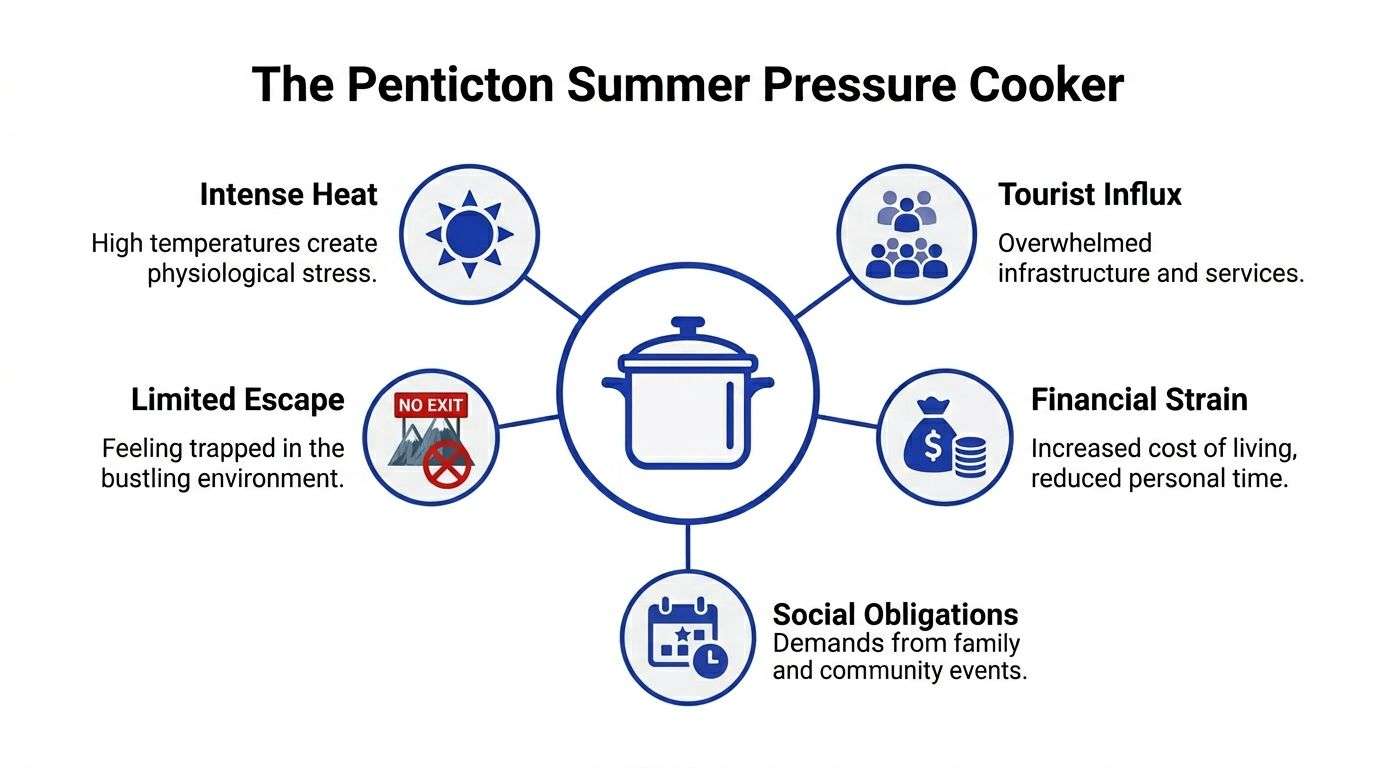
The Penticton Summer Pressure Cooker
A Penticton couple can care greatly about each other and still find themselves arguing more in July than they did in March. One partner is picking up extra shifts. The other is trying to keep the household running while the town feels louder, fuller, and less predictable. By the time they finally sit down together, even a small decision, whether to spend money on an outing, host visiting family, or stay home again, can carry far more weight than it should.
That is why the pressure cooker metaphor fits so well. The problem is rarely one dramatic issue. It is several manageable stressors heating up in the same small space, at the same time.
Several local pressures stack together
Penticton summer has a very specific mix of strain. In many places, summer means school breaks and nicer weather. Here, the season often brings heat, peak work demands, heavier tourism, packed public spaces, higher day-to-day spending, and the strange pressure of living in a place that other people treat like a vacation destination.
That combination matters.
A beautiful setting can still feel hard to live in when your routines stop fitting. A tourist town in summer works a bit like a house where every room is in use at once. Nothing is necessarily wrong, but there is less space, less quiet, and less margin for mistakes.
Four forces often create the "pressure cooker" feeling
Heat strains the system
Heat affects more than comfort. It can wear down patience, disturb sleep, and lower the energy people need for calm conversations. The next section looks at that physical side more closely, so the key point here is simple. When bodies are under stress, relationships feel that stress too.
Summer work can consume the season
For many local households, summer is earning season. Longer shifts, weekend work, event schedules, and fewer breaks can leave couples feeling like they are living beside each other rather than with each other. If that pattern is familiar, this article on why seasonal work creates unique stress for Penticton residents explains why it can affect home life so strongly.
Money questions often ride alongside those schedule changes. Even enjoyable plans can create tension if one partner is trying to relax while the other is calculating costs. For couples trying to plan shared spending more intentionally, a modern travel budget guide for couples and families can help structure those conversations.
Tourism changes ordinary life
Summer in Penticton does not only add recreational options. It changes the rhythm of ordinary tasks. Errands take longer. Parking gets harder. Restaurants, beaches, and downtown spaces fill up. A simple family outing can start to feel like a logistics project.
That shift can create a subtle emotional burden. Locals are not only managing their own summer. They are living inside everyone else's summer too.
The staycation paradox creates guilt
This is one of the most Penticton-specific pieces of the puzzle. Couples often feel they should be enjoying the season because they live somewhere people travel to on purpose. If they feel tired, overstretched, or uninterested in another outing, they may judge themselves for it.
That pressure can turn rest into guilt. Instead of asking, "What do we need this weekend?" couples start asking, "Are we wasting summer?"
Stressors interact, not just accumulate
This part is easy to miss. These pressures do not sit in separate boxes.
A hot, underslept partner may have less patience for a budget discussion. A partner working peak-season hours may feel hurt when there is no time left for connection. A crowded town can make a short trip feel draining, which means the couple arrives home with less goodwill than they started with. If housing already feels tight, summer visitors, kids at home more often, or the need to stay indoors during extreme heat can make that closeness feel less like togetherness and more like friction.
So the issue is not just "communication skills." Context shapes communication. Penticton summers can reduce the time, space, privacy, and recovery that good communication depends on.
What it often looks like at home
| Summer pressure | How it often shows up in a relationship |
|---|---|
| Heat and disrupted sleep | Shorter tempers, more sensitivity, less patience |
| Peak-season work demands | Feeling alone, missed time together, resentment about roles |
| Tourist-town congestion | More friction around errands, parking, timing, and crowds |
| Staycation pressure | Conflict about saying yes, spending money, or "making the most" of summer |
| Too little downtime | Small arguments that do not get time to settle |
A pressure cooker does not mean a relationship is failing. It means the environment is adding strain from several directions at once. Once couples can name that pattern clearly, they are often less likely to blame each other for every spike in tension.
How Summer Heat Directly Affects Your Mood
Some summer conflict is relational. Some of it is physical first, relational second.

When people are too hot, the body has to work harder to regulate itself. That can change how we think, how we sleep, and how quickly we become overwhelmed. In Penticton, this is not a minor issue. During the 2021 heat dome, 619 British Columbians died, mostly from indoor hyperthermia between June 25 and July 1, and temperatures in the region exceeded 40°C. The same analysis notes a 10% annual recurrence risk under warming scenarios and projects 30+ days above 30°C yearly by mid-century (Canadian Climate Institute analysis of the BC heat wave).
Heat narrows your emotional bandwidth
When readers hear that heat can affect relationships, they sometimes think that sounds exaggerated. It is not.
A hot body often means a stressed body. You may notice:
- Less patience with normal household mess or noise
- More irritability during routine conversations
- Lower motivation to problem-solve
- More tension around cooling choices, windows, fans, and expenses
- Stronger reactions to things that would not normally feel so sharp
In plain language, heat lowers the margin between feeling okay and feeling overloaded.
Sleep disruption changes the tone of conflict
Many couples recognise this once it is pointed out. They are not only hot during the day. They are also sleeping badly at night.
Poor sleep makes it harder to stay calm, listen well, or recover after a disagreement. A comment that might usually feel manageable can sound harsh. A request can feel like criticism. A delay in response can feel like rejection.
Before assuming “we are the problem,” ask whether the room is too hot, the night was too short, and both of you are running on fumes.
If your household feels more fragile in the summer, that does not automatically mean deeper damage. Sometimes it means your nervous systems are stretched.
Home can become the hardest place
Most heat-related fatalities during the 2021 event occurred in private residences, which highlights how intense home conditions can become during extreme heat, especially without adequate cooling, as noted in the same climate analysis. This matters for relationships because the home is where people expect relief. If home stops feeling restorative, frustration rises quickly.
That strain can be sharper in older rentals, shared homes, and households where people cannot easily leave for cooler space. Families may find themselves arguing not because the relationship is uniquely broken, but because everyone is trying to cope in a physically difficult environment.
If seasonal shifts affect your energy and mood, some people find it helpful to read about how seasonal changes impact energy levels in Kelowna. The patterns are often familiar across the Okanagan.
A more compassionate reframe
Instead of saying, “Why are you being so difficult?” summer often invites a better question.
Try, “Are we both overheated, underslept, and at our limit?”
That question softens blame. It also makes better problem-solving possible.
The Tourist Town Squeeze on Your Time and Finances
A Penticton summer can put couples in a bind that outsiders often miss. The town looks playful and relaxed from the beach or the brewery patio. Meanwhile, many local couples are working longer hours, paying close attention to every dollar, and trying to share limited space without much privacy.

That tension is part of Penticton’s specific summer pattern. A tourist economy brings income and pressure at the same time. Housing strain leaves less room to cool off, emotionally and physically. The result can feel like trying to rest in a house where every room is already full.
Less space often means less patience
As noted earlier, housing pressure in Penticton is not just a policy issue. It shows up in daily relationship life.
When people are packed into smaller spaces, or sharing homes across generations longer than expected, ordinary moments carry more friction. A private talk gets postponed because someone is always within earshot. A small disagreement over dishes, noise, guests, or bedtime routines grows faster because nobody has much room to reset.
Privacy works like a pressure-release valve. When couples have less of it, stress has fewer places to go.
Summer can sharpen this problem in very practical ways. Children are home more. Visitors pass through. Some households spend more time indoors to avoid the hottest part of the day. If a couple cannot find a quiet corner to talk, reconnect, or be off duty for a few minutes, irritation starts standing in for communication.
Seasonal work changes the rhythm of a relationship
Tourism keeps many local households afloat. It can also pull partners onto completely different tracks.
One person may be working evenings, weekends, split shifts, or extra hours just when the town is full and everyone else seems to be enjoying themselves. The other may be holding the home routine together, managing childcare, errands, meals, or emotional fallout. Both people can be exhausted. Both can feel unseen. That is where arguments often start.
The surface topic may be money, chores, or who is doing more. Underneath, couples are often reacting to a deeper question. Are we still on the same team, or are we just surviving beside each other?
The staycation paradox adds another layer
Living in a destination town can create a strange kind of pressure. Fun is everywhere, and much of it looks normal, affordable, and easy from the outside. For locals who are tired or stretched thin, that can stir up disappointment and self-judgment.
A winery visit, a day at the lake, festival tickets, or dinner out may mean very different things to each partner. One sees a memory worth making. The other sees another expense, another crowded place, or one more thing to organize. Neither person is necessarily wrong. They may be responding to different kinds of strain.
This is why summer money conflict in Penticton is rarely just about the receipt total. It is often about safety, fairness, rest, and the fear of missing the season in your own hometown.
Some couples find it helpful to use outside planning tools such as a modern travel budget guide for couples and families, especially when summer spending decisions keep turning into the same argument. Others benefit from creating a financial plan as a couple for a strong future, because clear agreements can reduce the feeling that every outing is also a referendum on the relationship.
Couples usually cope better when they name the pressure accurately. In Penticton summers, the strain is often a mix of crowded living, tourism-driven work hours, higher spending pressure, and too little shared recovery time.
Practical Ways to Protect Your Connection
By the time a Penticton couple notices they are snapping at each other, the underlying problem is often already in the room. Heat, packed schedules, crowded public spaces, irregular work hours, and the pressure to make summer feel special can stack up like stones in a backpack. The goal is not to create a perfect season. It is to lighten the load before one of you drops it on the other.
A helpful way to view this is simple. Summer stress needs recovery points. Without them, even loving couples start reacting instead of responding.
Pick the right window for hard conversations
Some talks need better timing, not better wording.
If you need to discuss money, parenting, housework, or intimacy, choose a time when your bodies have a chance of cooperating. Early morning. Later evening. After food. After a shower. After ten quiet minutes. In a Penticton summer, that matters more than many couples realize, because physical discomfort can make an ordinary discussion feel like a threat.
Keep the start gentle. A conversation usually goes better when it opens with orientation instead of impact. “Can we talk tonight about the weekend plan?” often lands better than raising it in the car, in line, or while one person is rushing out the door.
If either of you is flooded, pause and return later. That is not avoidance. It is temperature control.
Stop treating summer like a relationship report card
Penticton can make couples feel as if a good summer should look obvious. Beach time, patios, festivals, quick getaways, smiling photos. But living in a place and visiting it are not the same experience.
For locals, a healthy summer may look much quieter. One couple may choose fewer outings because one partner is working longer tourism hours. Another may stay home more because housing costs have squeezed the budget. Another may need rest more than entertainment. None of that means you are failing each other.
It helps to ask one direct question together: “What kind of summer can we sustain this year?”
That question shifts a couple from comparison to teamwork.
Build small rituals that fit real life
Many couples wait for a full day off, a weekend away, or a big date night. Then summer passes and none of it happens. In a season like this, connection often works more like watering a plant than planning a banquet. Small, steady care keeps it alive.
Try one ritual that is easy enough to repeat:
- tea or coffee together before the house gets busy
- a ten-minute walk after sunset
- sitting outside for a few minutes without phones
- a short drive with no errands and no planning talk
- a daily check-in that starts with “What took the most out of you today?”
Tiny rituals help couples remember, “We are on the same side.”
Name the pressure clearly
Couples suffer more when stress gets mistaken for character.
Instead of “You are miserable lately,” try “I think this week has worn both of us down.”
Instead of “You never want to do anything,” try “I think we want summer to feel good, but we are both more stretched than we expected.”
That shift matters. It keeps the problem in focus. The heat, the scheduling strain, the local cost pressure, the noise, the lack of privacy. Those are real forces. When you name them accurately, your partner is less likely to hear blame and more likely to hear understanding.
Add movement that feels light, not demanding
Some couples reconnect faster when they stop talking face to face and start doing something side by side. Shared movement can soften tension because it gives the nervous system another job besides defending itself.
The activity does not need to be serious. A walk, a swim at a quiet hour, stretching on the deck, or learning something new together can all help. Some couples even enjoy reading about how ballroom dance lessons can elevate your love life because playful, coordinated movement can bring back a sense of rhythm and partnership.
The point is not performance. The point is shared ease.
Protect downtime before the week fills up
In Penticton summers, free time disappears quickly if you do not claim it on purpose. Someone gets called into work. Family wants to visit. Friends text about the beach. An event pops up. Suddenly the week is full and neither of you has recovered.
A simple agreement can help:
- One quiet block together each week.
- One short block of solo recovery for each partner.
- One planning check-in so the weekend does not become a string of assumptions and disappointments.
This works like shade in extreme sun. It does not remove the weather. It helps you stay regulated inside it.
Reach for help while there is still softness between you
Couples often wait until every exchange feels loaded. Earlier support is usually easier because there is still some energy for curiosity, repair, and goodwill.
If the same arguments keep coming back, or if summer keeps exposing the same sore spots every year, outside help can give you structure and language for what is happening. As noted earlier, some couples look for relationship support during stressful seasons when they need a calmer place to sort out what belongs to summer strain and what needs deeper attention.
A strong relationship is not one that avoids summer pressure. It is one that learns how to protect closeness while the pressure is real.
Your Questions About Summer Relationship Strain Answered
Is it normal to argue more in summer even if we usually get along?
Yes. Seasonal pressure can increase conflict in otherwise solid relationships. Heat, disrupted routines, seasonal work hours, crowded spaces, and constant activity can all reduce patience. More arguments do not automatically mean the relationship is in serious trouble.
My partner works in tourism and comes home exhausted. How do I support them without burning out myself?
Try to separate care from overfunctioning. You can be understanding without carrying everything alone. Be specific about what support looks like. Ask, “What would help most this week?” Then name your own limits too. Couples do better when both people’s fatigue counts.
We live with family right now and summer feels extra tense. Is that part of it?
For many households, yes. Less privacy often leads to more irritability, more misunderstandings, and less intimacy. Crowded housing can make ordinary relationship repair harder because there is so little quiet space to reset.
How do we know if this is seasonal stress or a deeper issue?
A useful clue is whether tension eases when rest, privacy, and routine improve. If conflict remains intense across seasons, feels emotionally unsafe, or keeps circling the same painful themes without resolution, it may be time for more focused support. Some people start by exploring available options through Penticton counselling.
What if one of us wants help and the other does not?
Start small. Share what you have noticed about the season rather than diagnosing the relationship. Saying, “I think summer has been hard on us and I want us to feel more like a team,” often lands better than “We need help because we are doing badly.”
Moving Through Summer with Hope and Connection
Penticton summers can be joyful, but they can also stretch couples thin. Heat affects mood. Tourism changes daily life. Seasonal work can eat up time and energy. Housing pressure can shrink privacy and calm. When all of that lands at once, even loving couples can feel reactive, distant, or worn down.
There is relief in naming the pattern accurately. It helps you stop turning every hard moment into a story about personal failure or relationship failure. Often, the season is applying pressure to parts of life that already need care.
That does not mean you are powerless. Small shifts in timing, expectations, boundaries, and rest can make a real difference. Many couples feel better when they stop asking, “What is wrong with us?” and start asking, “What is this season doing to us, and how can we respond together?”
If this summer has felt heavier than expected, you are not alone. Understanding why relationship stress often peaks in Penticton summers is often the first step toward feeling more connected inside them.
If you want more support navigating stress, conflict, family pressure, or major life transitions, Interactive Counselling offers compassionate, evidence-informed care for individuals, couples, and families. You can learn more at Interactive Counselling.
Clinically Reviewed By
Amy Mosset, MCP, RCC-S
Amy Mosset is a Master Practitioner in Clinical Counselling, Clinical Supervisor, and the owner of Interactive Counselling. She provides trauma-informed, evidence-based care and clinical supervision to registered therapists, with a focus on ethical practice, client safety, and high-quality therapeutic outcomes.