TL;DR:
- Empty nest syndrome involves complex emotions, including grief, loss of purpose, and mixed feelings of relief.
- Factors such as gender, parenting role, and social support influence how intensely individuals experience ENS.
- Engaging in hobbies, strengthening relationships, and seeking therapy can foster resilience and positive growth.
Many parents spend years imagining the day their last child moves out. They picture quiet mornings, spontaneous travel, and a long-overdue sense of freedom. Then the day actually arrives, and instead of relief, a wave of grief moves in. The house feels too large. The silence feels wrong. You find yourself standing in their bedroom doorway wondering who you are now that your primary role has shifted. This experience is far more common than most people admit, and it has a name: empty nest syndrome (ENS). Understanding why it hits so hard, and what you can actually do about it, is the first step toward finding your footing again.
Table of Contents
- The emotional impact of the empty nest: More than sadness
- Why does the empty nest feel harder than expected?
- Who feels the empty nest most intensely? Risk factors and resilience
- Coping with empty nest syndrome: Strategies for resilience and growth
- Why the hardest part of empty nest is actually an opportunity
- Get support for your empty nest journey
- Frequently asked questions
Key Takeaways
| Point | Details |
|---|---|
| Identity loss is real | Empty nest syndrome often feels harder because parents underestimate the impact on their sense of self. |
| Most parents adapt | Despite initial emotional struggles, most parents eventually find increased satisfaction and freedom post-empty nest. |
| Healthy coping matters | Acknowledging feelings and using healthy strategies supports resilience and positive growth. |
| Support is available | Professional counselling and strong relationships boost your ability to thrive through this transition. |
The emotional impact of the empty nest: More than sadness
Empty nest syndrome is not a clinical diagnosis, but the emotional weight of it is absolutely real. When your child leaves home, you do not just lose their daily presence. You lose a version of yourself. For many parents, the role of active caregiver has been central to their identity for eighteen years or more. Suddenly, that structure is gone, and what remains can feel disorienting and even frightening.
The emotional experience of ENS tends to unfold in recognisable stages. Research published in 2024 outlines the mechanics of ENS as a progression through mourning and resistance, feelings of loss and passive behaviours, sublimation and impulsive behaviours, adaptation, and finally relief, with the process typically initiating at the departure of the last child. Knowing these stages exist can be genuinely reassuring. What you are feeling is not weakness. It is a predictable human response to a significant life change.
Here is what many parents experience in the early weeks and months:
- Grief and sadness that feels disproportionate, even embarrassing
- Loss of purpose or confusion about what to do with unstructured time
- Irritability or restlessness that seems to come from nowhere
- Longing for the noise, mess, and busyness of family life
- Moments of unexpected joy followed by guilt for feeling relieved
That last point matters. ENS is rarely all darkness. Many parents feel both the ache of loss and the first glimmers of personal freedom at the same time. Both are valid.
“The empty nest does not mean the end of your story. It means a new chapter is beginning, one you get to write for yourself.”
One of the most overlooked aspects of ENS is how it disrupts your daily routine. When your schedule was built around school runs, meal times, and weekend activities, its sudden absence creates a vacuum. Learning the difference between coping vs avoidance becomes critical here, because many parents unconsciously fill that vacuum with busyness rather than actually processing the transition. Similarly, if you share your home with a partner, this shift can surface long-standing patterns of emotional neglect in marriage that were previously masked by the demands of parenting.
Why does the empty nest feel harder than expected?
Most parents know, intellectually, that their children will eventually leave. So why does the actual moment feel so much harder than anticipated? The answer lies in the gap between what we expect emotionally and what we actually experience.
Identity loss is the core issue. For years, being a parent was not just something you did. It was who you were. Your choices, your friendships, your daily rhythms all revolved around your children. When that central organising force disappears, the identity scaffolding collapses with it. This is not something you can prepare for simply by knowing it is coming.
Cultural context adds another layer of complexity. Longitudinal research shows that cultural shifts, including the rise of working mothers, delayed adulthood, and boomerang kids returning home, have meaningfully changed how ENS unfolds. These shifts mean parents today may experience the transition multiple times, or feel uncertain about whether the nest is truly empty at all.
Here is an honest look at what makes ENS harder versus what actually helps:
| What makes it harder | What research shows helps |
|---|---|
| Defining yourself solely as a parent | Maintaining interests outside parenting |
| Expecting to feel only relief | Allowing the full range of emotions |
| Withdrawing socially | Strengthening friendships and partnerships |
| Avoiding the grief | Acknowledging and processing the loss |
| Comparing your experience to others | Recognising your unique journey |
The good news is that most parents adapt positively, gaining a renewed sense of freedom and often experiencing deeper, more satisfying relationships once the transition settles. This is not a myth or wishful thinking. It is backed by evidence.
Pro Tip: If low mood is lingering beyond a few weeks, exploring coping strategies for depression early, before symptoms deepen, can make a significant difference. You do not have to wait until you are struggling to seek support.
For parents whose partners work away from home or who already feel isolated, the empty nest can amplify loneliness considerably. Resources designed for support for lonely partners can offer a helpful starting point for addressing that specific kind of isolation.
Who feels the empty nest most intensely? Risk factors and resilience
Not every parent experiences ENS with the same intensity. Research points to several factors that influence how deeply the transition affects you.
Empirical data consistently shows that mothers are more affected than fathers, and that stay-at-home parents and single parents face a higher risk of significant emotional difficulty during the transition. This makes sense when you consider that these parents often have the most concentrated investment of time and identity in the parenting role.
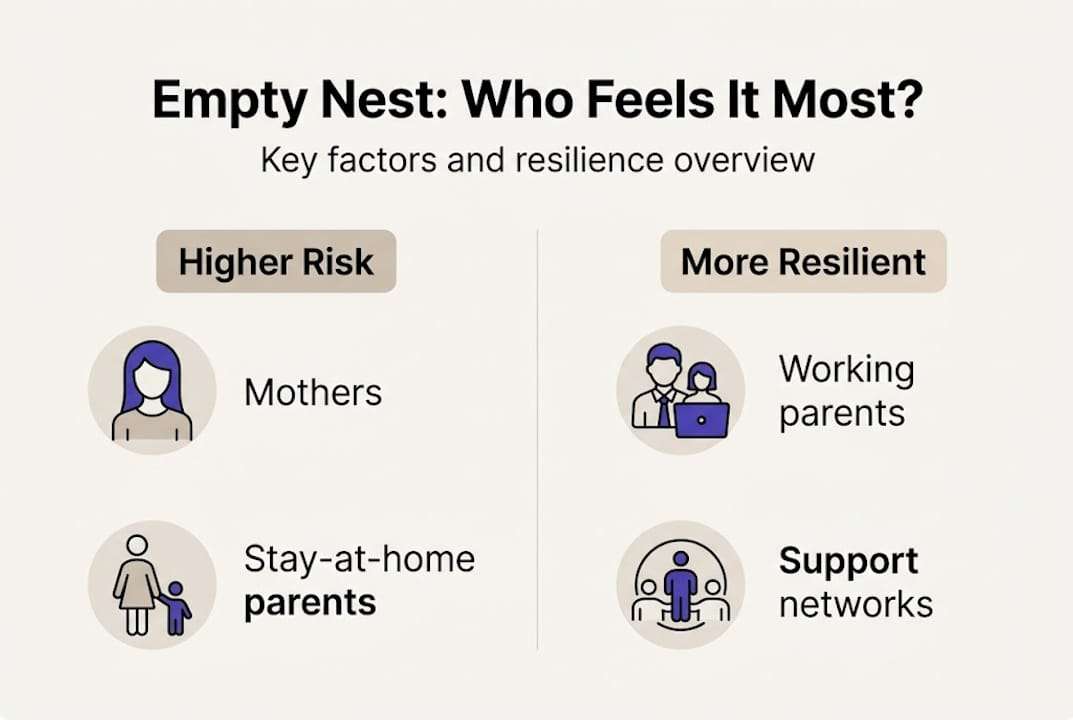
| Group | Risk level | Key factor |
|---|---|---|
| Stay-at-home parents | Higher | Identity closely tied to caregiving |
| Single parents | Higher | No partner to share the transition |
| Mothers (general) | Moderate to high | Primary caregiver role in many families |
| Fathers (general) | Lower to moderate | Often experience more satisfaction post-transition |
| Parents with strong social networks | Lower | Existing support buffers the loss |
Interestingly, many fathers report increased satisfaction after the transition, often because they gain more time with their partners and more freedom to pursue personal interests. This gender difference is worth noting without judgement. It simply reflects different patterns of parental role investment.
Several factors build resilience and ease the transition:
- Strong social support from friends, family, or community groups
- A positive outlook and the ability to reframe change as opportunity
- Previous experience with navigating difficult life transitions
- A sense of identity beyond the parenting role
- A healthy partnership or close relationship with a trusted person
If you and a co-parent are navigating this shift separately after a separation, co-parent counselling can help you both process the transition without conflict. For parents who feel their own emotional patterns are surfacing during this time, reparenting therapy offers a powerful way to address deeper wounds that the quiet of the empty nest may bring to light.
Coping with empty nest syndrome: Strategies for resilience and growth
Knowing that ENS is real and that it follows recognisable stages of mourning and adaptation gives you something important: a map. You are not lost. You are in a transition, and transitions have an end point.
Here are the strategies that research supports for navigating ENS with genuine resilience:
- Acknowledge your feelings without judging them. Grief is not a sign of failure. It is a sign of love.
- Rediscover hobbies and interests that were set aside during the parenting years. This is not indulgence. It is necessary.
- Strengthen your relationships with your partner, close friends, and extended family. Invest in the connections that will carry you forward.
- Create new routines that give your days shape and meaning without revolving around your children.
- Stay connected with your children in ways that respect their independence. A weekly call is connection. Daily check-ins can become hovering.
- Move your body. Exercise and mindfulness are not clichés. They genuinely regulate mood and reduce anxiety.
- Seek therapy if sadness persists, deepens, or begins to interfere with daily functioning.
Pro Tip: Try scheduling one new activity per week for the first two months after your child leaves. It does not have to be dramatic. A class, a walk with a friend, or a creative project can begin to rebuild your sense of self in small, sustainable ways.
For parents whose children are still young or who are supporting a child through their own emotional challenges, understanding emotional regulation skills can also deepen your own self-awareness. And if you have been supporting a child in counselling, you already know how important it is to tend to your own emotional health alongside theirs.
Why the hardest part of empty nest is actually an opportunity
Here is a perspective that most articles skip over: the pain of the empty nest is not the problem. It is the signal.
When the house goes quiet and the grief moves in, what you are actually feeling is the outline of everything you gave. That ache is proportional to your love and your investment. It means you did something that mattered deeply. The difficulty is not a sign that something has gone wrong. It is a sign that something significant has ended, and that something new is possible.
We see this consistently in our work with parents navigating this transition. The ones who struggle most are often the ones with the most capacity for growth, because they cared so fully. The question is not how to stop hurting. It is how to let the hurt point you toward what comes next.
Learning the difference between coping and avoidance is where that shift begins. Avoidance keeps you stuck in the loss. Coping moves you through it toward something new. The empty nest is not the end of your purpose. It is the beginning of a chapter where your purpose gets to be about you.
Get support for your empty nest journey
You do not have to navigate this transition alone. At Interactive Counselling, we work with parents, couples, and individuals across Canada who are finding their footing after a major life shift. Whether you are feeling grief, confusion, loneliness, or simply a quiet sense of not knowing what comes next, our licensed counsellors are here to help.
Explore our counselling services to find the right fit for your needs, whether in person in Kelowna, Vernon, Grande Prairie, or Penticton, or online from anywhere in Canada. If low mood is part of your experience, our coping strategies for depression resource is a helpful starting point. And if you are wondering whether now is the right time to reach out, our guidance on mental health support makes it clear: you do not have to wait for a crisis.
Frequently asked questions
What are the main stages of empty nest syndrome?
The stages of ENS include mourning, resistance, feelings of loss, adaptation, and relief, typically beginning when the last child leaves home. Knowing these stages exist can help you recognise where you are in the process and trust that movement forward is possible.
Are some parents more affected by empty nest syndrome than others?
Yes. Mothers, stay-at-home, and single parents tend to experience ENS more intensely, though most parents, regardless of their starting point, adapt positively over time.
How can I cope with empty nest syndrome effectively?
Healthy coping includes acknowledging your feelings, rediscovering personal interests, strengthening your relationships, building new routines, and seeking professional support if sadness becomes persistent or overwhelming.
Is empty nest syndrome always negative?
Not at all. Research shows that many parents experience increased life satisfaction, improved relationships, and a renewed sense of personal freedom after the transition, often more than they expected.
When should I seek professional help for empty nest feelings?
If sadness, low motivation, or difficulty adjusting persists beyond a few weeks or begins to affect your daily life, reaching out to a mental health counsellor is a wise and caring step for yourself.
Recommended
- How divorce impacts children differently at each age – Interactive Counselling
- Support for lonely partners during oilfield camp work
- Manage reintegration stress after camp rotations: 5 tips
- Reconnect as a couple after camp work emotional distance