Have you ever found yourself wondering why you react the way you do in relationships? Why some people feel like a safe harbour while others trigger a storm inside you? We all have a deep-seated need to connect, but the way we go about it is shaped by our earliest experiences. This forms a kind of internal blueprint for how we relate to others as adults—what experts call our attachment style. For more information, see our couples counselling.
"Your attachment style is the emotional and behavioural blueprint that shapes how you connect with others, influencing your sense of safety, intimacy, and independence in adult relationships."
Why Your Attachment Style Matters

Learning about your attachment style isn't about labelling yourself or assigning blame. It's about gaining clarity and, ultimately, empowerment. Think of it as finally getting the operating manual for your own heart. This internal guide can help you understand the recurring dynamics in your partnerships, friendships, and even your approach to parenting.
This invisible force influences everything from who you’re attracted to and how you navigate disagreements to the way you ask for what you need. It’s the reason you might feel a surge of anxiety when a partner asks for a little space, or why you might find yourself pulling away just when things start to feel serious.
The Impact on Your Relationships
The patterns you’ve developed have a real, measurable effect on your connections. Research on attachment styles in adults reveals just how profound this impact is. For instance, studies show that a secure attachment style is consistently linked to higher satisfaction in romantic partnerships and lower separation rates compared to insecure styles.
Conversely, other patterns, like anxious or avoidant attachment, often correlate with more frequent conflict, emotional distance, and a general sense of dissatisfaction in relationships.
A Path Toward Growth
Here’s the most hopeful part of all this: your attachment style isn't a life sentence. It’s your starting point, not your destiny. With a bit of self-compassion and understanding, you can start to see where your patterns come from and how they play out day-to-day.
This guide will walk you through the four main attachment styles, offering practical, evidence-based strategies for healing and growth. Your journey toward healthier, more fulfilling connections begins right here.
For a deeper dive into these core ideas, this guide on understanding attachment styles in relationships is another excellent resource. Change is always within reach, and every step you take toward knowing yourself better is a step toward building the relationships you truly deserve.
Exploring the Four Adult Attachment Styles
It helps to think of attachment styles not as rigid boxes we’re stuck in, but as flexible maps of our inner emotional world. They offer a compassionate guide to understanding why we act and feel the way we do in relationships. These patterns are deeply ingrained, but they are not our destiny.
Let’s look at the four primary attachment styles in adults. The goal isn’t to label or diagnose, but to bring some clarity. Simply recognizing these patterns in yourself and the people you care about is the first, most powerful step toward building stronger, more secure connections.
1. Secure Attachment: The Anchor
Imagine someone whose inner world feels like a well-tended garden. From a young age, they learned that their needs would likely be met, that they were worthy of love, and that reaching out for comfort was safe. This foundation of consistent, reliable care builds an internal sense of safety that they carry into adulthood.
People with a secure attachment style tend to have a positive view of themselves and of others. They’re comfortable with both intimacy and independence, striking a healthy balance that allows relationships to thrive. They can be vulnerable and express their needs clearly, but they’re also happy to give their partners space without feeling insecure.
When conflict comes up, they don’t treat it like a five-alarm fire. They see it as a problem to solve—together.
Securely attached individuals tend to approach disagreements with a collaborative spirit. They can communicate their feelings and listen to their partner's perspective, working toward a resolution that strengthens the connection rather than erodes it.
Some of their key characteristics include:
- High self-esteem: They feel inherently worthy of love and respect.
- Emotional regulation: They can manage big feelings without getting completely swept away.
- Trust: They operate from a belief that people are generally reliable and well-intentioned.
- Resilience: They bounce back from relational bumps and bruises and aren’t easily discouraged by conflict.
2. Anxious-Preoccupied Attachment: The Wave
For someone with an anxious-preoccupied attachment style, relationships can feel like riding an emotional wave. They are often searching for reassurance to feel stable, haunted by a quiet worry that they are "too much" or that their partner will inevitably leave.
This anxiety often traces back to childhood experiences where care was inconsistent—sometimes there, sometimes not. This unpredictability created a hyper-vigilance to any sign of abandonment. As adults, they might have a negative view of themselves but a positive one of their partner, putting them on a pedestal while feeling unworthy of the very love they crave.
In a relationship, they might seek intense closeness and feel a surge of anxiety when their partner needs space. A simple unreturned text can trigger a spiral of worry, not because they are inherently "needy," but because their attachment system is wired to detect any potential threat of disconnection. Their deepest fear is being left, so they work incredibly hard to maintain closeness to feel safe.
3. Dismissive-Avoidant Attachment: The Fortress
The dismissive-avoidant individual has learned to build a fortress around their heart. Early in life, they discovered that relying on others was often disappointing or even felt unsafe. To cope, they developed a powerful sense of self-reliance, suppressing their own needs for connection to avoid the sting of being let down.
As adults, they prize their independence above all else. They typically hold a high opinion of themselves but can be cynical or dismissive of others, operating on the belief that they don’t really need anyone. To them, emotional intimacy often feels messy and overwhelming.
You might notice these behaviours:
- Prioritizing independence: They can feel suffocated by too much closeness and may need a lot of personal space.
- Downplaying emotions: They tend to intellectualize feelings or dismiss their own (and others') emotional needs.
- Creating distance: Just when a relationship starts to feel deeply intimate, they may pull away or even start a fight to get some breathing room.
During an argument, a person with an avoidant style might shut down, withdraw, or insist "everything is fine" when it clearly isn't. This isn't done to be cruel; it’s a deeply ingrained protective mechanism designed to keep vulnerability at bay.
4. Fearful-Avoidant (Disorganized) Attachment: The Unpredictable Path
Also known as disorganized attachment, this is the most complex of the four styles. Someone with this pattern walks an unpredictable path, desperately craving intimacy while being terrified of it at the same time. This style often forms in a childhood environment that felt frightening or chaotic—where the very person who was meant to be a source of comfort was also a source of fear.
This creates an internal "push-pull" dynamic in relationships. They have no single, coherent strategy for getting their needs met. They swing between feeling worthy and unworthy, between trusting someone and being terrified of them.
They may pursue a close bond with incredible intensity, only to pull away abruptly as soon as the other person gets close. Their behaviour can seem erratic or confusing because they are caught between two powerful, competing drives: the biological need for connection and the learned, deep-seated fear of it.
For someone with a fearful-avoidant style, a partner's love can feel like both a lifeline and a threat. This internal tug-of-war is incredibly distressing and is often at the heart of tumultuous relationship cycles. Bringing this pattern into the light is the first step toward finding a path to inner calm and finally building the safety they have always yearned for.
To make these distinctions clearer, it can be helpful to see the styles side-by-side.
A Quick Guide to Adult Attachment Styles
This table offers a clear, at-a-glance comparison of how the four primary attachment styles manifest in relationships, communication, and emotional regulation.
| Attachment Style | View of Self & Others | Behavior in Relationships | Response to Conflict |
|---|---|---|---|
| Secure | Positive view of self, positive view of others. | Balances intimacy and independence. Trusts easily. Communicates needs directly. | Collaborative. Sees conflict as a problem to be solved together. |
| Anxious-Preoccupied | Negative view of self, positive view of others. | Craves high levels of intimacy and approval. Worries about partner leaving. Can be clingy. | Can become highly emotional. Seeks reassurance. May "protest" to regain connection. |
| Dismissive-Avoidant | Positive view of self, negative view of others. | Highly independent. Avoids emotional closeness. Suppresses feelings. | Withdraws, shuts down, or dismisses the issue. Avoids emotional expression. |
| Fearful-Avoidant (Disorganized) | Unstable/conflicted view of self and others. | Desires intimacy but is also afraid of it. Behavior can be unpredictable or chaotic. | Can be erratic. May freeze, flee, or become angry. Torn between approach and avoidance. |
Remember, these are not life sentences. Understanding your primary attachment style is like getting a clear look at the map you've been using—and realizing you have the power to draw a new one.
How Your Attachment Pattern Affects Mental Health
Our attachment style is more than just how we act in relationships; it’s deeply woven into the fabric of our overall mental and emotional well-being. Think of a secure attachment as an internal anchor. It doesn't stop life's storms from happening, but it gives you a sense of stability and helps you find your footing again when the waves get rough. This inner security often acts as a powerful buffer, fostering emotional resilience.
In contrast, insecure attachment patterns can leave us feeling more vulnerable to certain mental health struggles. This isn't a sign of weakness or a personal flaw. It’s simply about understanding the profound link between our need for connection and our mental state. Seeing this connection is the first, most compassionate step toward getting the right kind of support.
This diagram helps visualize how these different patterns create distinct internal worlds.
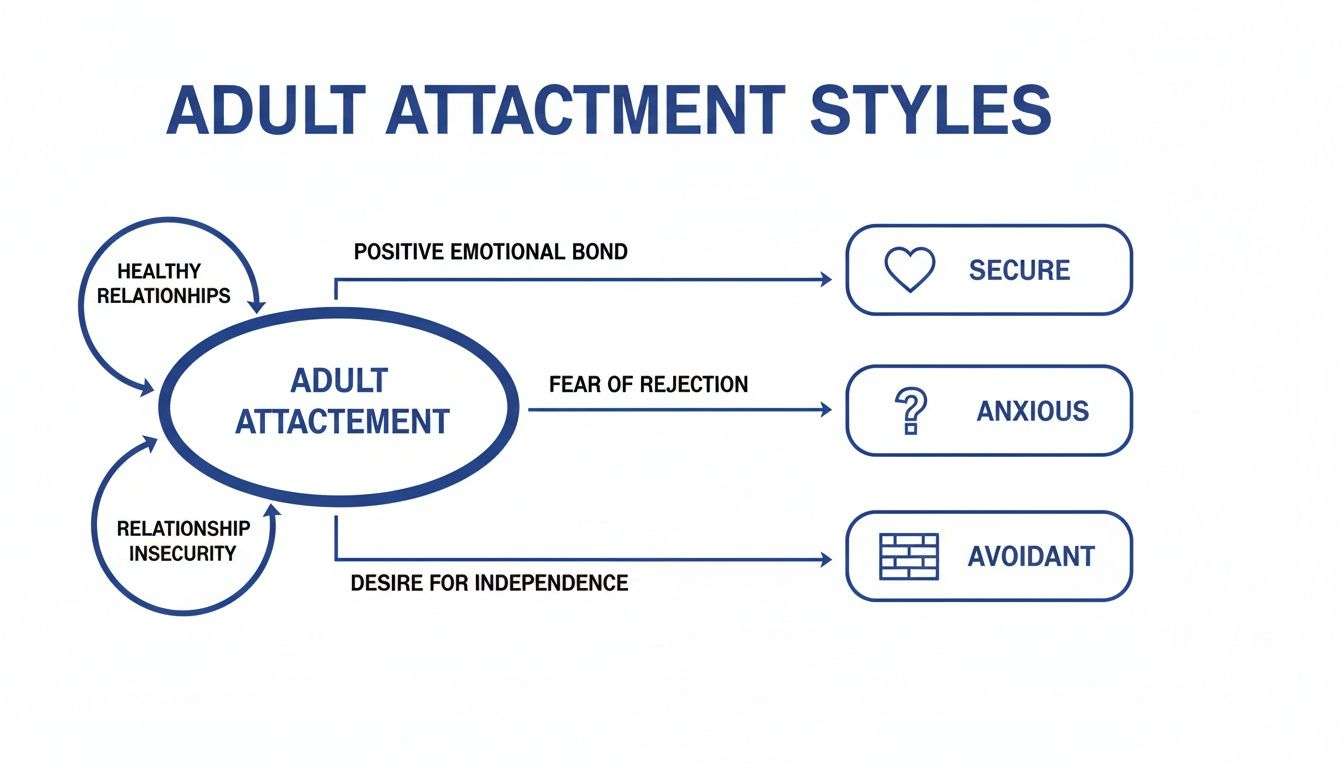
As you can see, a secure style is grounded in a feeling of safety, while insecure styles often involve managing relationships through either anxiety or emotional distance.
The Link Between Attachment and Well-Being
The connection between our attachment patterns and our mental health is a tangible one that shows up in our daily lives. For someone with an anxious attachment style, the constant fear of being left behind can fuel a state of hyper-vigilance. Always scanning for signs of trouble can easily spiral into generalized anxiety, social anxiety, or just a persistent, nagging feeling of unease.
On the other hand, a dismissive-avoidant style often involves pushing feelings away to maintain a sense of independence and control. While this can feel safer in the short term, consistently suppressing emotions can lead to a kind of numbness, a low-grade depression, or a feeling of emptiness. You become disconnected from a vital part of your own human experience. This pattern can also contribute to a state of nervous system dysregulation.
The key takeaway here isn't one of doom and gloom, but of connection. Realizing your anxiety might be tied to your need for reassurance, or that your numbness is a protective strategy, reframes the struggle. It’s not a character flaw; it’s a call for a different kind of care.
A Deeper Look at the Connections
Research consistently highlights these connections. For instance, studies have found that individuals with secure attachment report higher levels of psychological well-being compared to those with insecure attachment styles.
Further evidence shows that insecure patterns are often associated with a higher prevalence of depression and anxiety.
The findings get even more specific when you break them down by style:
- Adults with an anxious-preoccupied style are more likely to seek therapy for relationship-specific anxiety.
- Those with a fearful-avoidant (disorganized) style, which is often linked to unresolved trauma, tend to show more severe trauma-related symptoms.
These findings aren't meant to be discouraging. Far from it. They illuminate why understanding attachment styles in adults is so critical for mental health. They show that what feels like a personal failing is often a shared, understandable response to our earliest relational experiences.
Most importantly, research also shows that with effective, attachment-focused support, people can shift toward a more secure attachment pattern. Healing isn't just possible; it's a well-documented outcome.
The Role of Attachment in Family and Parenting
Our attachment patterns don’t just stick to romantic relationships; they echo through our entire family life, especially in how we parent. Think of it as an emotional blueprint passed down from one generation to the next. The way we learned to connect with our own parents often becomes the default for how we connect with our kids, which then shapes their attachment style.
But this isn't about blaming anyone or feeling doomed to repeat the past. It’s simply about awareness. When we understand these patterns, we gain the power to create a more stable, loving home for everyone.
How Attachment Styles Show Up in Parenting
Let's walk through a simple, everyday scenario: a toddler takes a tumble at the park and scrapes their knee. How might parents with different attachment styles instinctively react?
A securely attached parent likely remains calm. They can scoop up their crying child, offer a hug, and validate their feelings—"Ouch, that was a big fall! It's okay to cry." They provide comfort while also projecting safety.
An anxiously attached parent might feel a surge of their own anxiety. Their child’s pain can feel like their own, causing them to become highly distressed and perhaps overreact, making the situation feel more frightening than it is.
A dismissive-avoidant parent might try to downplay the incident with a quick, "You're fine, just brush it off." Their own discomfort with big emotions can lead them to push for a quick recovery, which can unintentionally send the message that the child's feelings are an inconvenience.
A fearful-avoidant parent's response could be confusing. They might rush in to offer comfort one second, only to feel overwhelmed and pull back the next. This hot-and-cold reaction can leave a child feeling uncertain and insecure.
A caregiver's early responsiveness is what builds a secure foundation. Knowing how to soothe a crying baby, for example, is about more than just stopping tears; it’s about building trust. To go deeper into how family dynamics shape us, our guide on Family Roles in Dysfunctional Families offers more insight.
Navigating Co-Parenting and Family Transitions
These different attachment styles can really clash when parents are trying to co-parent, particularly through the stress of a separation or divorce. An anxious co-parent might seek constant updates to feel reassured, while an avoidant co-parent may find this intrusive and respond by pulling away even more. It’s a classic push-pull dynamic that can turn parenting into a constant source of conflict.
Research really brings this to light. Studies have found that insecure attachments can be a driving factor in high-conflict mediations and co-parenting disputes. On the flip side, securely attached parents tend to report better child outcomes in blended families, showing just how much a secure base helps families navigate tough changes. You can dig into more of these findings on attachment in adults.
The wonderful news is that you can actively work toward "earned security." By understanding your own attachment patterns and those of your co-parent, you can develop more effective communication strategies and build a more cooperative, supportive partnership for the benefit of your children.
This kind of work has a ripple effect. When you begin to heal your own attachment wounds and practice a more secure way of relating, you’re not just improving your own life. You’re giving an incredible gift to the next generation by breaking old cycles and building a new family legacy based on connection and emotional safety.
Can You Change Your Attachment Style?

If you’ve recognized some of your own tendencies in the descriptions of insecure attachment, you’re probably asking one big question right now: Can I change?
Let me answer that with a hopeful, resounding yes. Your attachment style isn't a life sentence. Think of it as a learned relational strategy—and anything that has been learned can be unlearned and relearned in a healthier way.
This potential for change is grounded in the incredible science of neuroplasticity. Your brain isn't fixed; it’s more like a muscle that can forge new pathways and strengthen new connections throughout your entire life. Through conscious effort and consistent practice, you can build new, more secure ways of relating to others and, most importantly, to yourself. This journey is what we call earning an “earned secure attachment.”
From Awareness to Action
Simply understanding your attachment style is a huge first step. The next is to move from knowing to doing.
Earning security is a process of consistently and gently showing up for yourself in new ways. It means learning to notice your old, automatic patterns without judgment and then consciously choosing a different response.
This doesn't happen overnight—it's more like tending a garden than flipping a switch. You’re planting new seeds of security and nurturing them with patience, compassion, and the right tools.
Here are a few gentle, evidence-based strategies to begin:
- Practise Mindfulness: Insecure attachment tends to drag your attention to the past (regret, resentment) or the future (anxiety, what-ifs). Mindfulness helps anchor you in the present, allowing you to observe your feelings without getting carried away by them.
- Cultivate Self-Compassion: A harsh inner critic often fuels insecure patterns. Self-compassion is the perfect antidote. It’s about learning to treat yourself with the same kindness you’d offer a dear friend who is struggling.
- Journal for Clarity: Writing down your thoughts and feelings is a fantastic way to spot your emotional triggers. You can start to see the direct line between an event (like a partner needing space) and your internal reaction (like a surge of abandonment fear).
Strategies for Building Security
Moving toward a more secure attachment involves taking small, practical steps in your daily life. It’s all about building new habits that reinforce your sense of safety and self-worth.
Noticing and Naming Your Triggers
A trigger is anything that activates your attachment system and sends you spiralling into an old, reactive pattern. For someone with an anxious style, a trigger might be an unreturned text. For someone with an avoidant style, it could be a partner’s push for deep emotional intimacy.
The first step is simply to notice when you're triggered. Instead of reacting on autopilot, try to pause and name what’s happening internally: "I’m feeling really anxious right now because I’m afraid they’re pulling away." This simple act creates just enough space between the feeling and your response to give you the power to choose differently.
Practising New Behaviours
Once you can name your feelings, you can start to practise new behaviours.
- If you lean anxious: Instead of immediately reaching out for reassurance, try to self-soothe first. Take a few deep breaths, go for a walk, or gently remind yourself that your partner’s need for space isn’t always a personal rejection.
- If you lean avoidant: Instead of shutting down or pulling away, try to stay with the discomfort for just a few moments longer. You could even say, "This is hard for me to talk about, but I'm trying to stay with it."
This process isn't about perfection; it’s about practice. Every time you choose a new response, you are strengthening the neural pathways for secure attachment. You are, in essence, re-parenting yourself with the consistency and care you may not have received. Exploring how reparenting therapy builds emotional safety can offer more perspective on this healing journey.
The Role of Therapy in Earning Security
While self-help strategies are powerful, sometimes the journey is much easier with a guide. A trained therapist can provide a safe, supportive space to explore your patterns and heal the wounds at their source. Certain therapeutic approaches are especially effective for working with attachment styles in adults.
One highly effective method is Emotionally Focused Therapy (EFT). EFT helps individuals and couples get to the heart of their attachment-based fears and needs. It creates a space where you can communicate those needs in a way that actually brings you closer to your partner, rather than pushing them away.
Ultimately, remember that this is a journey of empowerment. With patience, self-compassion, and the right support, you absolutely have the ability to build the secure, fulfilling relationships you deserve.
Common Questions on Your Attachment Journey
As you start digging into attachment theory, a lot of questions are bound to pop up. It’s a topic that can feel both incredibly illuminating and a little overwhelming at first. Below, we’ve gathered some of the most common questions we hear, with answers aimed at bringing you clarity and a sense of direction.
Can my partner and I have different insecure attachment styles?
Yes, and you're not alone in this. It's very common for partners to have different, even clashing, insecure attachment styles. The good news is that a healthy, lasting relationship is absolutely possible. The secret ingredient? Awareness.
When you can both look at your own patterns—and your partner's—with curiosity instead of blame, you build a powerful foundation of empathy. That shared understanding changes everything. You begin to see difficult moments not as a personal failure or attack, but as an old wound getting bumped.
Suddenly, it’s not you versus them. It’s both of you, working as a team to support each other through those tricky spots. This teamwork is what ultimately builds a stronger, more secure bond.
How long does it take to develop a secure attachment?
This is a deeply personal journey, and there’s no universal timeline. Think of it less like a race with a finish line and more like learning a new language. It involves gently unlearning old, automatic reactions and consistently practising new, more intentional ways of connecting with yourself and others.
The most powerful mindset you can adopt is one of patience and self-compassion. Instead of asking "Am I there yet?", try to celebrate the small wins. Notice the time you calmed yourself down instead of reacting, the moment you stayed present in a tough conversation, or the day you kindly held a boundary. Those are the moments that build real, lasting change.
Is it possible to have traits of more than one attachment style?
Absolutely. In fact, it’s more common than not. Very few people fit neatly into one single attachment category. Life is nuanced, and so are our attachment patterns. You’ll likely have one style that feels most dominant, but you may see glimmers of other styles pop up in certain situations or with different people.
For example, you might feel quite secure and at ease in your friendships but find anxious patterns creeping in when you start a new romantic relationship. It's much more helpful to think of attachment styles in adults as a spectrum, not as rigid boxes. This complexity is what makes us human.
Moving Forward With Self-Compassion and Hope
Think of what you’ve learned about attachment styles in adults as a map. It’s not a life sentence or a label, but a guide that shows you where you are and, more importantly, how you got here. This understanding is the first, most powerful step toward real change. It gives you the clarity to begin building the kind of secure, trusting relationships you deserve—not just with others, but with yourself.
This isn’t about a quick fix; it’s a journey of steady, intentional growth. Every small step you take is a huge win, a testament to your courage in choosing a new path. The most essential tool you'll need is self-compassion. Treat yourself with the same kindness you'd offer a friend who is learning something difficult and new.
Your past doesn't have to write your future. You have the power to create a new relational story, one built on a solid foundation of safety, mutual trust, and a deep sense of your own worth.
If you find yourself wanting support along the way, remember that you don't have to do this alone. Working with a professional can provide a safe, non-judgmental space to explore these patterns more deeply and practise new ways of connecting. Exploring this further with counselling is a sign of strength. The road ahead is paved with hope.
Clinically Reviewed By
Amy Mosset, MCP, RCC-S
Amy Mosset is a Master Practitioner in Clinical Counselling, Clinical Supervisor, and the owner of Interactive Counselling. She provides trauma-informed, evidence-based care and clinical supervision to registered therapists, with a focus on ethical practice, client safety, and high-quality therapeutic outcomes.