TL;DR: For more information, see our couples counselling.
- Canadian couples often underestimate household chores by half, leading to resentment and relationship strain.
- Addressing chores early and using structured methods promotes fairness and emotional wellbeing in partnerships.
- Perceived fairness and ongoing communication are more important than perfect equality in household responsibilities.
Most Canadian couples underestimate by half the number of recurring household tasks they share, often counting 15 to 20 when the real list runs 30 to 50. That gap is not just a logistical surprise. It is the quiet source of resentment that erodes partnerships before they fully begin. When one person silently carries more, frustration builds without a clear target, and the relationship pays the price. This article gives you a practical, research-grounded framework for dividing household responsibilities fairly before you marry, so you can begin your life together on solid, equal footing.
Table of Contents
- Why household responsibilities matter before marriage
- Step-by-step approach: Fair division of household tasks
- Beyond 50/50: Mental load and full ownership
- Handling edge cases: Income, standards, and common conflicts
- Legal and financial considerations for Canadian couples
- A new perspective: Fairness is about perception, not perfection
- Take the next step: Strengthen your partnership with support
- Frequently asked questions
Key Takeaways
| Point | Details |
|---|---|
| List and discuss all tasks | Start by mapping out every household chore to surface hidden imbalances early. |
| Prioritise perceived fairness | Aim for an arrangement you both feel good about, not strict 50/50 splits. |
| Address mental load directly | Use systems that assign one partner full ownership of tasks to prevent burden clustering. |
| Plan for exceptions | Be ready to negotiate special cases, such as income differences or outside help. |
| Protect your interests legally | Consider agreements to clarify finances or property, but keep communicating openly about chores. |
Why household responsibilities matter before marriage
Talking about chores might feel mundane compared to planning your wedding, but it is one of the most consequential conversations you will have as an engaged couple. The numbers tell a clear story. In Canada, women spend roughly 50% more time on housework than men, averaging about 15 hours per week compared to men’s 10, which adds up to over 717 hours per year per adult. That is not a small difference. It is nearly 18 full work weeks.
This imbalance carries real emotional weight. Research consistently links uneven chore division to lower relationship satisfaction, higher rates of conflict, and increased risk of separation. When one partner feels like the household manager while the other is a guest, the emotional roles and wellbeing of both people suffer. The overburdened partner feels unseen. The other may not even realise there is a problem.
Here is what an unbalanced division can look like in practice:
- One partner plans, schedules, and executes most cleaning and cooking tasks
- Grocery lists, appointment tracking, and household admin fall to one person by default
- The other partner “helps” only when asked, rather than taking full ownership
- Feelings of unfairness go unspoken until they become arguments
- Intimacy and connection quietly erode under accumulated stress
“Uneven division of household labour is one of the most commonly cited sources of dissatisfaction in long-term relationships, and it rarely resolves itself without deliberate conversation.” — Verywell Mind on chores and relationship quality
Addressing this before marriage, rather than after, gives you a genuine advantage. You can build fair habits from the start, rather than trying to dismantle entrenched ones later. The earlier you have this conversation, the more natural and collaborative it feels.
Step-by-step approach: Fair division of household tasks
Understanding why this matters leads to a concrete question: how do you actually divide the work? The good news is that a clear process exists, and it works best when both partners approach it as a team exercise rather than a negotiation.
- List every recurring task. Sit down together and write out every household chore, from daily tasks like washing dishes to monthly ones like cleaning the oven. Most couples are surprised to find 30 to 50 tasks on their list. Do not skip the invisible ones: taking out recycling, replacing light bulbs, managing pet care, or scheduling repairs.
- Weight each task by effort. Not all chores are equal. Scrubbing bathrooms is more draining than loading the dishwasher. Rate each task by time required, physical effort, and how much you dislike it. This weighting helps you avoid a lopsided split that looks fair on paper but feels exhausting in practice.
- Assign based on genuine preference first. Some tasks will have a natural owner. If one of you loves cooking and the other enjoys vacuuming, start there. Preference-based assignment creates willing participation rather than reluctant compliance.
- Rotate the tasks neither of you wants. For the chores you both dislike, build a rotation schedule. Alternating these tasks weekly or monthly prevents one person from becoming the default holder of the worst jobs.
- Use tools to stay accountable. Shared apps, digital calendars, or even a simple whiteboard can track who is responsible for what and when. Visibility reduces the need for reminders and eliminates the “I forgot” cycle.
| Approach | Strengths | Weaknesses |
|---|---|---|
| Preference-based | High willingness, less conflict | May leave disliked tasks unassigned |
| Equal time split | Feels mathematically fair | Ignores effort and preference |
| Efficiency-based | Tasks done by most capable person | Can reinforce existing imbalances |
Pro Tip: Schedule a monthly 20-minute check-in specifically about household responsibilities. Treat it like a brief team meeting. This keeps the system current as life changes and gives both partners a regular space to raise concerns before they become grievances.
Discussing this before living together is one of the most protective steps you can take for your relationship.
Beyond 50/50: Mental load and full ownership
With your division method in place, it is vital to move beyond surface fairness into the reality of mental and emotional effort. Dividing tasks on paper is only part of the picture.

The mental load refers to the cognitive and emotional work of managing a household: remembering, planning, anticipating, and coordinating. It is the effort that happens before any physical task begins. And it falls disproportionately on one partner in most relationships, often without either person realising it.
Signs of mental load imbalance include:
- One partner always initiates household conversations
- One person tracks upcoming appointments, bills, and supply levels
- One partner feels they can never fully “switch off” at home
- The other partner waits to be told what needs doing
- Exhaustion is felt by one person even when physical tasks seem split
The solution is full ownership, a concept central to Eve Rodsky’s Fair Play method and supported by Gottman-based approaches. Full ownership means one person conceives, plans, and executes a task entirely, from start to finish, without reminders or supervision.
| Task | Shared (vague) | Full ownership |
|---|---|---|
| Grocery shopping | Both add to list; one shops | One person owns the entire process |
| Bill payment | Both aware; one pays when reminded | One person tracks, schedules, pays |
| Social planning | Ideas discussed; one executes | One person plans and confirms |
Pro Tip: Replace “just ask me if you need help” with “I own this task completely.” That shift removes the invisible labour of asking, reminding, and following up from your partner’s plate entirely.
Handling edge cases: Income, standards, and common conflicts
Even with strong systems, life brings complexity. Here is how to address special situations and common pitfalls that many Canadian couples face.
Income gaps are one of the most common sources of tension. If one partner earns significantly more, a strict 50/50 split of both financial contributions and household labour can feel unfair. A proportional approach often works better: the higher earner contributes more financially, while the other may take on more household tasks, or vice versa, depending on what you both agree is equitable.
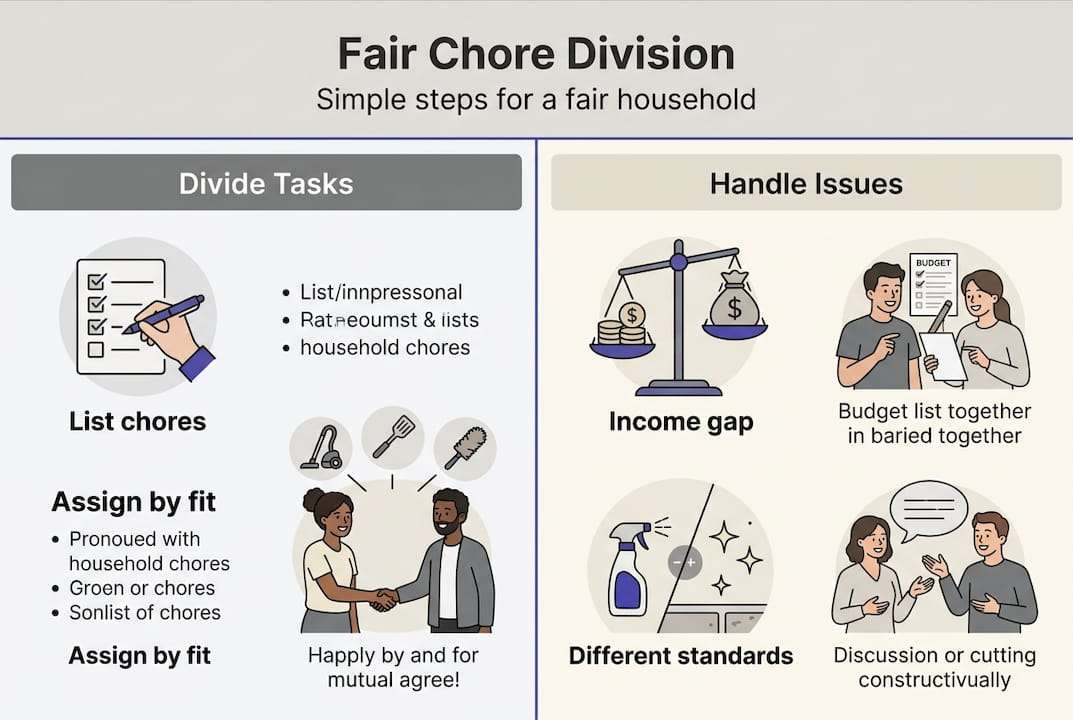
Cleanliness standards differ between people, and this is a surprisingly common source of conflict. Rather than arguing about whose standard is correct, negotiate a minimum acceptable level for shared spaces and allow each person autonomy in their own areas.
Outsourcing is worth considering when both partners are time-poor. Hiring a cleaner, using a grocery delivery service, or outsourcing laundry can reduce conflict and free up time for connection. Think of it as an investment in your relationship, not a luxury.
Gendered expectations are still deeply embedded in many Canadian households. In British Columbia, women are three times more likely to handle laundry than men, regardless of employment status. Awareness of these patterns helps couples challenge them consciously.
Conversation starters for tough edge cases:
- “How do we want to handle chores if one of us loses their job?”
- “What is the minimum cleanliness standard we both feel comfortable with?”
- “Are there tasks we would both rather outsource than argue about?”
- “How do we revisit this if our circumstances change?”
“In Canada, gender norms continue to shape who does what at home. Naming this openly is the first step to changing it.”
Legal and financial considerations for Canadian couples
Beyond everyday logistics, the legal and financial landscape directly affects your household dynamics. Many couples do not realise how much their legal status shapes their rights and obligations.
In Canada, the distinction between common-law and married partners matters significantly. Married spouses have stronger automatic property rights in most provinces, while common-law partners may have fewer protections depending on where they live. Getting clarity on this before you move in together is essential.
Steps to create an effective legal agreement:
- Consult independent lawyers. Each partner should have their own legal counsel to ensure the agreement is fair and fully understood.
- Disclose all assets and debts. Full financial transparency is legally required for a valid agreement in most Canadian provinces.
- Specify expense division clearly. Address how rent or mortgage, utilities, groceries, and shared expenses will be handled.
- Include provisions for change. Life circumstances shift. Build in a process for reviewing the agreement if income, employment, or family size changes.
These documents require full financial disclosure and independent legal advice to be enforceable.
Key topics to cover with your lawyer:
- Property owned before the relationship
- Debt responsibility during and after the relationship
- How shared savings or investments will be treated
- What happens if one partner leaves the workforce
“A cohabitation agreement is not a sign of distrust. It is a sign of maturity and mutual respect.”
Exploring premarital counselling and prenups together can help you approach these conversations with greater clarity and less anxiety.
A new perspective: Fairness is about perception, not perfection
Here is something most chore-division guides will not tell you: the couples who thrive are not the ones with the most perfectly balanced spreadsheets. They are the ones who both feel that things are fair, even when the numbers are not exactly equal.
Research supports this. Perceived fairness matters more than strict 50/50 splits. When both partners feel heard, respected, and appreciated, minor imbalances rarely cause lasting damage. When one partner feels invisible, even a technically equal split breeds resentment.
This means your goal is not mathematical perfection. It is ongoing, honest dialogue. It is the willingness to say, “I am feeling stretched this week,” and have your partner respond with genuine care. It is adapting your system as seasons of life change, whether that means a new job, a health challenge, or a new child.
Fairness in later life and marriage looks different from fairness in your first year together. The couples who understand this build systems that breathe and evolve, rather than rigid structures that crack under pressure. Start with a good framework, then stay curious about each other.
Take the next step: Strengthen your partnership with support
Building a fair household system is a meaningful first step, but some conversations are harder to navigate alone. If you and your partner find yourselves stuck in recurring disagreements about responsibilities, or if you simply want to start your marriage on the strongest possible foundation, professional support can make a real difference. At Interactive Counselling, our therapists work with engaged and newly married couples across Canada, in person and online. You can explore counselling services tailored to your needs, or book directly through our couples counselling page. You deserve a partnership where both of you feel seen, valued, and supported.
Frequently asked questions
What is the first step to dividing chores before marriage?
Start by listing all recurring tasks together, aiming for 30 to 50 items, then assign them based on preference and a shared sense of fairness.
Should chores always be split 50/50 between partners?
Not necessarily. What matters most is that both partners feel the division is equitable, which may look different from a strict mathematical split.
What can we do if one of us earns much more than the other?
Consider a proportional contribution model where financial and household labour contributions reflect each partner’s capacity rather than a rigid equal split.
Are legal agreements like a prenup necessary for household chores?
Legal agreements like cohabitation contracts address finances and property rather than chores directly, but open conversations about both topics are equally important.
How often should we revisit our household responsibilities?
A monthly review of your arrangements keeps the system fair and gives both partners a regular opportunity to raise concerns before they become bigger issues.
Recommended
- What to discuss before living together: a guide for couples
- When to separate vs when to work on it: a guide for couples
- Set healthy in-law boundaries before marriage: 5 steps
- Financial conflict in marriage: 47% face this challenge