Deciding to explore mental health support is a significant and courageous first step. If you find yourself asking, "what is a clinical counsellor?" you're already on the right path to gaining clarity. With so many different professional titles and types of therapy available, it's completely understandable to feel a bit confused. This guide is designed to offer clear, straightforward, and reassuring answers. For more information, see our anxiety counselling.
"A clinical counsellor is a highly trained mental health professional who uses evidence-based talk therapy to help individuals navigate emotional, psychological, and relational challenges in a safe and confidential setting."
Your Partner in Navigating Life's Challenges

At its heart, a clinical counsellor is a confidential partner dedicated to supporting your mental and emotional well-being. They are skilled professionals trained to help you work through life’s complexities—whether that means managing anxiety, navigating a difficult life transition, or simply understanding why you feel stuck.
Their primary role is to create a safe, non-judgmental space where you feel comfortable exploring your thoughts, feelings, and experiences with honesty and self-compassion.
What Does This Partnership Look Like in Practice?
A clinical counsellor works with you. This isn't about receiving unsolicited advice or being told what to do. Instead, it’s a collaborative and empowering process where they guide you toward discovering your own answers and strengths.
In a session, this means they:
- Listen with Genuine Empathy: They hear your story and validate your perspective without judgment, helping you feel truly seen and understood.
- Offer a New Lens: They can help you identify recurring patterns or limiting beliefs that you might not see on your own.
- Teach You Practical Tools: You’ll learn proven, evidence-based strategies and coping skills to manage stress, handle difficult emotions, and communicate more effectively.
- Help You Build Resilience: The ultimate goal is to nurture your inner strength so you can face future challenges with greater confidence and self-awareness.
In Canada, clinical counsellors play an essential role in the healthcare landscape. With many Canadians experiencing symptoms of anxiety and depression, accessible and ethical support is more important than ever. The Canadian Counselling and Psychotherapy Association (CCPA), for example, now represents a large community of professionals dedicated to providing these vital services across the country.
Ultimately, counselling is about empowering you to make meaningful, lasting changes on your own terms. Whether you need individual, couples, or family therapy, a clinical counsellor is there to guide the process. You can learn more about how different counselling services are structured to meet a wide range of needs.
The Role of a Clinical Counsellor Explained
Have you ever wished for a skilled, impartial guide to help you navigate life's challenges? That’s essentially what a clinical counsellor does. They are mental health professionals trained to help you understand your thoughts, feelings, and behaviours through a supportive and confidential partnership.
Their work is centred on talk therapy—a process grounded in proven, evidence-based methods—to help you build practical skills for coping with everything from daily stress to significant psychological hurdles. It’s not just about talking; it’s about creating real, positive change in your life.
What Qualifications Are Required?
Becoming a clinical counsellor is a demanding path, and for good reason. These high standards ensure that when you sit down with a counsellor, you’re entrusting your well-being to a professional with verified expertise and a strong ethical foundation.
So, what does it actually take? While the specifics can differ slightly between provinces in Canada, the core requirements are consistently high.
A registered clinical counsellor has almost always completed:
- A Master's Degree: This isn't just any postgraduate program. It’s a specialized degree in a field like Counselling Psychology from a recognized university. This education provides a deep understanding of human development, ethical guidelines, and effective therapeutic techniques.
- Extensive Supervised Clinical Hours: This is where theory meets practice. Before they can work independently, counsellors-in-training must complete a significant number of direct client work hours. This is all done under the watchful eye of a senior, approved supervisor who guides their development, ensuring they are competent and safe to practice.
- Registration with a Professional Body: In British Columbia, for instance, a qualified professional will be registered with the BC Association of Clinical Counsellors (BCACC). This registration is your assurance that they've met all educational and practical requirements and are bound by a strict code of ethics and a commitment to ongoing professional development.
Think of it this way: the combination of advanced education, hands-on supervised experience, and accountability to a professional body is what separates a professional counsellor from someone who simply gives advice. It’s a framework built to protect you and ensure you receive quality, ethical care.
Understanding these credentials helps clarify what makes this profession unique. To dig a little deeper, you can find more information about the role of a licensed counsellor and how they fit within the larger mental health care system.
How Does a Clinical Counsellor Differ From Other Professionals?
Trying to find mental health support can feel a bit overwhelming, especially when you see titles like counsellor, psychologist, and psychiatrist. It’s completely normal to wonder what the difference is and who you should see. Knowing how each professional works can give you the confidence to choose the support that’s right for you.
Think of it this way: these professionals aren't in competition. They're all specialists on the same healthcare team, just with different tools and areas of focus. The “best” one is simply the one whose approach matches what you need right now.
Becoming a clinical counsellor involves a clear, standardized path, ensuring they meet high professional and ethical standards.
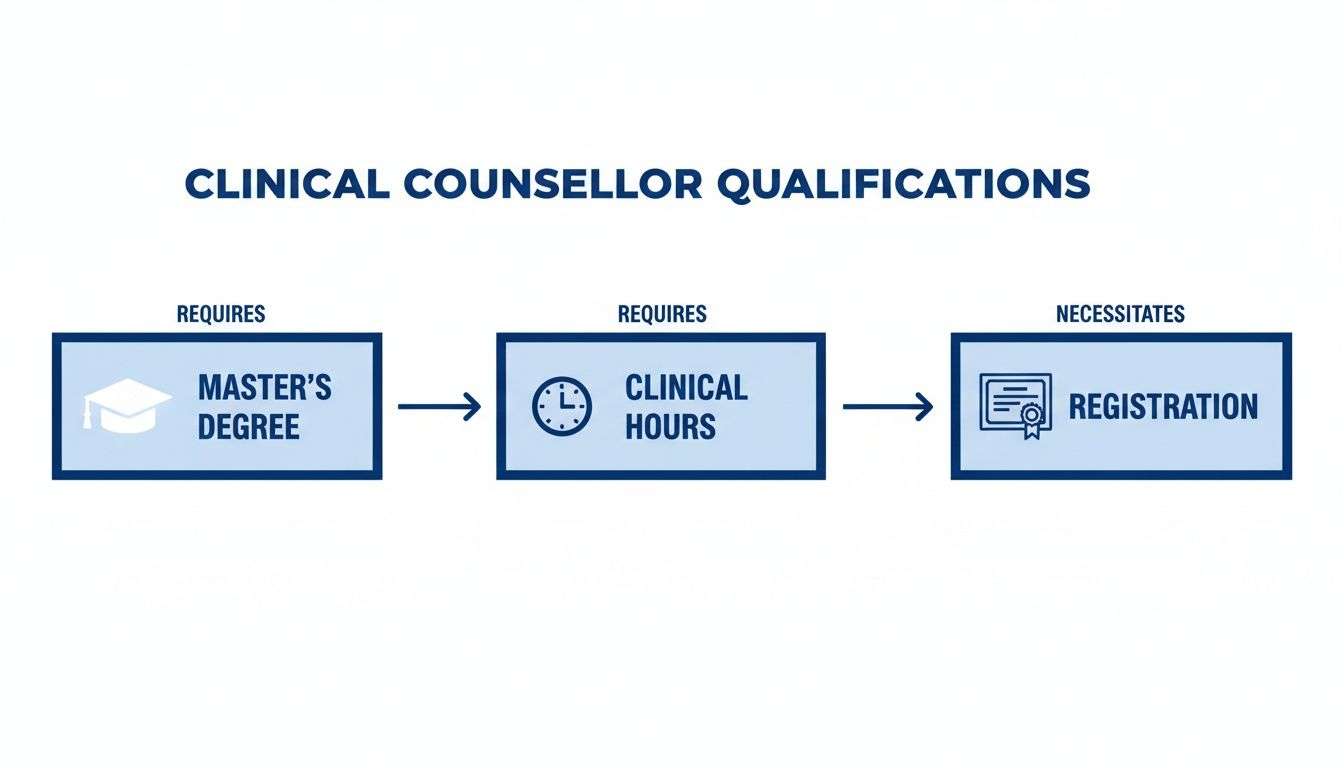
This journey requires a rigorous mix of postgraduate education, thousands of hours of supervised practice, and registration with a professional regulatory body. It's a process designed to make sure they're fully equipped to provide safe, effective, and compassionate care.
The Key Differences in Their Roles
So, what really sets these roles apart? While everyone is working toward your well-being, their training, primary focus, and scope of practice are quite distinct.
A Clinical Counsellor's world is talk therapy. Armed with a Master's degree, they use proven therapeutic approaches to help you build coping skills, work through difficult emotions, and navigate life's challenges. Their expertise is rooted in building a strong therapeutic relationship and working collaboratively with you.
A Psychologist typically holds a doctoral degree (Ph.D. or Psy.D.). Their training is extensive, covering not only therapy but also psychological assessment, testing, and research. In many Canadian provinces, they are authorized to provide a formal diagnosis of mental health conditions.
A Psychiatrist is a medical doctor (MD) who has completed a specialization in psychiatry. Their unique qualification is the ability to diagnose and prescribe medication. While some also offer therapy, their main focus is often on the biological and neurological side of mental health.
To make this even clearer, here is a simple breakdown of how these professionals compare.
Comparing Mental Health Professionals in Canada
This table gives a quick overview of the key distinctions between the most common mental health care providers.
| Professional | Primary Focus | Typical Education | Can Prescribe Medication? |
|---|---|---|---|
| Clinical Counsellor | Talk therapy, skill-building, and emotional support. | Master's Degree (MA, MEd, MCP) | No |
| Psychologist | Psychological assessment, diagnosis, and therapy. | Doctoral Degree (Ph.D., Psy.D.) | No |
| Psychiatrist | Diagnosis, medication management, and medical treatment. | Medical Doctor (MD) | Yes |
Ultimately, the right choice comes down to your specific needs. If you're looking for a space to talk, process your experiences, and learn new strategies for managing your mental health, a clinical counsellor is often the perfect fit.
If you’d like to dig a little deeper into this, you can learn more by comparing counselling and psychology in more detail. Each of these professionals offers incredible value—it’s just a matter of finding the right kind of support for your journey.
What Kinds of Problems Do Clinical Counsellors Help With?
It often feels like you're the only one going through something, but the truth is, we all face challenges that can feel too big to handle alone. People come to counselling for just about every reason you can imagine—there’s no issue too big or too small.
A clinical counsellor gives you a safe, private space to make sense of it all. They're there to help you find your footing and develop real-world skills to move forward.

Whether you’re wrestling with emotions that feel out of control or trying to get through a major life change, therapy can bring so much clarity. It's a reminder that what you're feeling is normal, and you don’t have to do this by yourself.
Taming Anxiety and Lifting Depression
Anxiety can feel like an internal alarm system that’s stuck in the 'on' position. Depression, on the other hand, can feel like a heavy blanket that smothers your energy and joy. These are two of the most common reasons people reach out for support, and counsellors are experts at helping you navigate these heavy feelings.
In your sessions, a counsellor can help you:
- Pinpoint the triggers and thought patterns that keep you stuck in a cycle of worry or sadness.
- Learn practical grounding techniques to manage panic or get through overwhelming emotional waves.
- Begin to quiet that harsh inner critic and cultivate a more supportive way of thinking about yourself.
- Build simple, healthy habits that support your mental health for the long haul.
Think of a counsellor as a guide. They help you untangle these complicated emotions and find proven strategies to feel more like yourself again, focusing on what actually works for you.
Healing From Trauma and PTSD
Trauma—whether from a single, terrifying event or from ongoing, painful experiences—can leave deep wounds. It can disrupt your sense of safety in the world and make it hard to move on. A trauma-informed counsellor understands this deeply and creates a patient, supportive space where you can process what happened without feeling re-traumatized.
The goal isn't to erase the memory, but to help you reclaim your life from it. This means building resilience, processing difficult memories at a pace that feels safe for you, and learning to manage symptoms like flashbacks, nightmares, or feeling constantly on edge.
Navigating Relationship Issues
Our relationships are at the heart of our lives, but they can also be our greatest source of pain and stress. Clinical counsellors are skilled in helping both individuals and couples work through issues like a lack of communication in a relationship to build healthier, more fulfilling connections.
This often includes helping with:
- Marriage and Couples Counselling: Learning to really hear each other, rebuilding trust after a breach, and finding better ways to handle conflict.
- Family Dynamics: Easing friction between family members and creating new, healthier ways of relating to one another.
- Divorce and Co-Parenting: Supporting you through the emotional turmoil of a separation and helping you build a cooperative co-parenting plan that puts the kids first.
The need for this kind of support has become more visible than ever. In British Columbia, for example, government and public health initiatives continue to recognize the growing demand for mental health care. The positive impact is clear, as many couples report greater satisfaction after marriage counselling, and co-parents often find they can resolve conflicts much more effectively after therapy.
What to Expect in Your Counselling Sessions
Deciding to book a counselling session is a huge step, but it often comes with a big question: what actually happens in there? For many, the whole idea feels a bit mysterious, maybe even intimidating. Pulling back the curtain can help ease any of those first-time jitters, so let's walk through what your time with a clinical counsellor will really look like.

Think of it as a partnership. You’re always in the driver's seat; your counsellor is there to act as a skilled navigator, helping you read the map and find your way. Their entire focus is on creating a space where you feel safe, truly heard, and respected from start to finish.
Your First Session and Setting Goals
Your first session, often called an "intake," is really just a chance to get acquainted. It’s a low-pressure meeting for you and your counsellor to see if you're a good fit. You'll be invited to share what's on your mind and what brought you to counselling, but only at a pace that feels right for you.
During this initial chat, your counsellor will also cover important details like confidentiality, making sure you have a crystal-clear understanding that your conversations are kept private. This first meeting is less about diving into deep therapeutic work and more about building a solid foundation of trust.
From there, you’ll start to explore what you hope to get out of your time together. This collaborative goal-setting is a cornerstone of effective therapy. It ensures every session is focused on what’s most important to you. You can get a more detailed look at what to expect when you start your therapy journey.
The Collaborative Therapeutic Journey
As you settle into a rhythm, the sessions become a dynamic, collaborative process. Your counsellor will draw on evidence-based approaches—therapeutic methods that research has shown to be effective—to help you navigate your challenges.
They might suggest tools from modalities like:
- Cognitive Behavioural Therapy (CBT): A practical, hands-on approach focused on helping you spot and change unhelpful thought patterns and behaviours that might be holding you back.
- Eye Movement Desensitization and Reprocessing (EMDR): A specialized therapy designed to help your brain process and heal from traumatic memories so they lose their power.
These aren't just buzzwords. They represent structured, compassionate frameworks for building new skills and finding real relief. Your counsellor will always tailor the approach to your specific situation, working with you to figure out what helps you most.
More and more Canadians are turning to counselling for support, and clinical counsellors are a trusted resource. This includes those with specific needs where counselling has been shown to provide significant reductions in trauma symptoms and improved well-being.
How to Find the Right Counsellor for You
Deciding to look for a counsellor is a huge step forward. But once you've made that decision, the next big question is, "How do I find the right one?" The relationship you build with your counsellor is the foundation of your progress, so finding a good personality fit is just as crucial as their credentials.
Think of it like finding a good teammate. You need someone who understands your goals and has the right skills to help you get there. So, where do you begin? Start by reflecting on what you're hoping to work on. Are you wrestling with anxiety, navigating grief, or trying to improve your relationships?
Knowing your focus helps narrow the search. Many counsellors specialize in certain areas and work in dedicated mental health therapy practices that concentrate on specific challenges, which can make your search a lot easier.
Practical Steps to Begin Your Search
Your first move should always be to confirm a counsellor's qualifications. A great way to do this is by checking the public registry of your province's regulatory body. In British Columbia, for instance, you can search the BC Association of Clinical Counsellors (BCACC) database to find a Registered Clinical Counsellor (RCC).
As you start looking at profiles and websites, keep these key questions in mind:
- Specialization: Does this person have real experience with the issues I'm facing? Look for mentions of anxiety, trauma, couples counselling, etc., on their profile.
- Approach: Do their therapy methods resonate with you? Whether it's CBT, EMDR, or a more mindfulness-based practice, you want an approach that feels right.
- Logistics: Does their schedule work with yours? Do they offer the format you prefer, like in-person sessions, virtual appointments, or a mix of both?
Finding the right person is a journey, not a one-step task. For a deeper dive into navigating this process, we've put together a full guide on how to find a therapist that walks you through every step.
Frequently Asked Questions
Thinking about counselling brings up a lot of questions. It’s completely natural to feel curious and maybe even a little hesitant. We get it. Here are some of the most common questions we hear from people just starting to explore therapy.
How do I know if I need a clinical counsellor?
Many people wonder if their problems are "big enough" for therapy. The truth is, you don't need to be in a crisis to benefit from counselling. If you're feeling stuck, overwhelmed by emotions like anxiety or sadness, or finding it hard to navigate relationships or life changes, a counsellor can offer valuable support. Think of it as proactive care for your mental well-being—a space to build coping skills and gain clarity before challenges feel unmanageable.
Is everything I say in counselling confidential?
Yes, absolutely. Confidentiality is a cornerstone of therapy and a strict professional and ethical duty for every registered clinical counsellor in Canada. What you share in your session stays in your session. The only exceptions are rare and specific situations required by law, such as an immediate risk of harm to yourself or others, concerns about child safety, or a court order. Your counsellor will explain these limits clearly in your first meeting, so you can feel completely secure.
How long does counselling take to work?
There’s no one-size-fits-all answer, because your journey is unique. Some people find the clarity and tools they need in just a few sessions to address a specific issue. Others may benefit from longer-term support to explore deeper patterns or heal from past experiences. It’s a collaborative process. You and your counsellor will regularly check in on your progress and goals to ensure the pace and duration feel right for you. Your needs always lead the way.
What if I don't feel a connection with my counsellor?
This is such an important question. The therapeutic relationship—that sense of trust, safety, and being understood—is one of the most significant factors in successful therapy. It is perfectly okay if the first person you meet doesn’t feel like the right fit. A good, ethical counsellor will understand and support you in finding someone who is a better match. Your comfort and progress are always the top priority.
Taking the first step toward getting support is an act of strength and self-care. It's a sign that you're ready to invest in your own well-being. If you feel ready to take the next step, we invite you to learn more about our counselling services.
Clinically Reviewed By
Amy Mosset, MCP, RCC-S
Amy Mosset is a Master Practitioner in Clinical Counselling, Clinical Supervisor, and the owner of Interactive Counselling. She provides trauma-informed, evidence-based care and clinical supervision to registered therapists, with a focus on ethical practice, client safety, and high-quality therapeutic outcomes.