TL;DR:
- Joint bank accounts simplify shared expenses and build financial transparency in relationships.
- They carry risks like loss of privacy, shared liability, and potential legal complications during separation.
- Hybrid banking balances independence and partnership through personal accounts combined with a joint account.
Money is one of the most intimate things you share as a couple, yet 47% of Canadian couples argue about it regularly, and 30% admit to keeping finances secret from their partner. That tension doesn’t disappear once you get engaged. If anything, it intensifies. The question of whether to open a joint bank account sits right at the intersection of love, trust, and practicality. It’s not just a banking decision. It’s a relationship decision. This guide walks you through what joint accounts actually are, what they offer, where they fall short, and how to find an approach that works for both of you.
Table of Contents
- What is a joint bank account and how does it work for couples?
- The advantages of joint bank accounts for engaged couples
- Potential risks and drawbacks of joint banking
- Hybrid banking: balancing independence and partnership
- A real-world perspective: more than just numbers
- Next steps: support for building healthy financial partnerships
- Frequently asked questions
Key Takeaways
| Point | Details |
|---|---|
| Joint accounts build transparency | Combining finances helps manage expenses and encourages open communication for Canadian couples. |
| Risks require clear ground rules | Shared accounts can cause privacy and trust issues, underscoring the need for honest discussions. |
| Hybrid banking offers flexibility | Keeping both joint and personal accounts allows partners to balance unity and independence. |
| Communication is key | Money arrangements work best for engaged couples who regularly talk about finances and expectations. |
What is a joint bank account and how does it work for couples?
A joint bank account is simply a bank account shared between two or more people, where every account holder has equal rights to deposit, withdraw, and manage the funds. Neither partner needs the other’s permission to access the money. That’s an important detail, and we’ll come back to it.
For engaged couples in Canada, joint accounts provide equal access to funds and make managing shared expenses far simpler. Think of it like a shared household pot: both of you contribute, and both of you draw from it for things you both benefit from.
Common uses for engaged couples include:
- Paying rent or a mortgage together
- Covering shared utility bills and groceries
- Saving for the wedding or a future home
- Managing subscriptions and household services
One of the biggest misconceptions is that opening a joint account means merging everything. It doesn’t. You can absolutely keep your individual accounts running alongside a joint one. Another misconception is that it signals a loss of personal identity or financial independence. In reality, a joint account is a tool, not a takeover. You decide together what goes in and what stays separate.
Another thing worth knowing: you don’t have to merge finances immediately after getting engaged. Many couples open a joint account gradually, starting with one shared goal like saving for a wedding, before expanding its role.
“Financial planning as a couple works best when both partners understand what they’re agreeing to before the first dollar moves.”
For broader context on financial planning as a couple, it helps to approach this as an ongoing conversation, not a one-time decision. The Canadian Financial Consumer Agency also recommends that couples discuss their financial values, goals, and habits before combining any accounts.
Pro Tip: Before opening a joint account, sit down together and write out your expectations. How much will each person contribute? What counts as a shared expense? What stays personal? Having this conversation early prevents a lot of friction later.
The advantages of joint bank accounts for engaged couples
With a clear understanding of how joint accounts function, let’s look at the specific benefits they offer engaged couples.
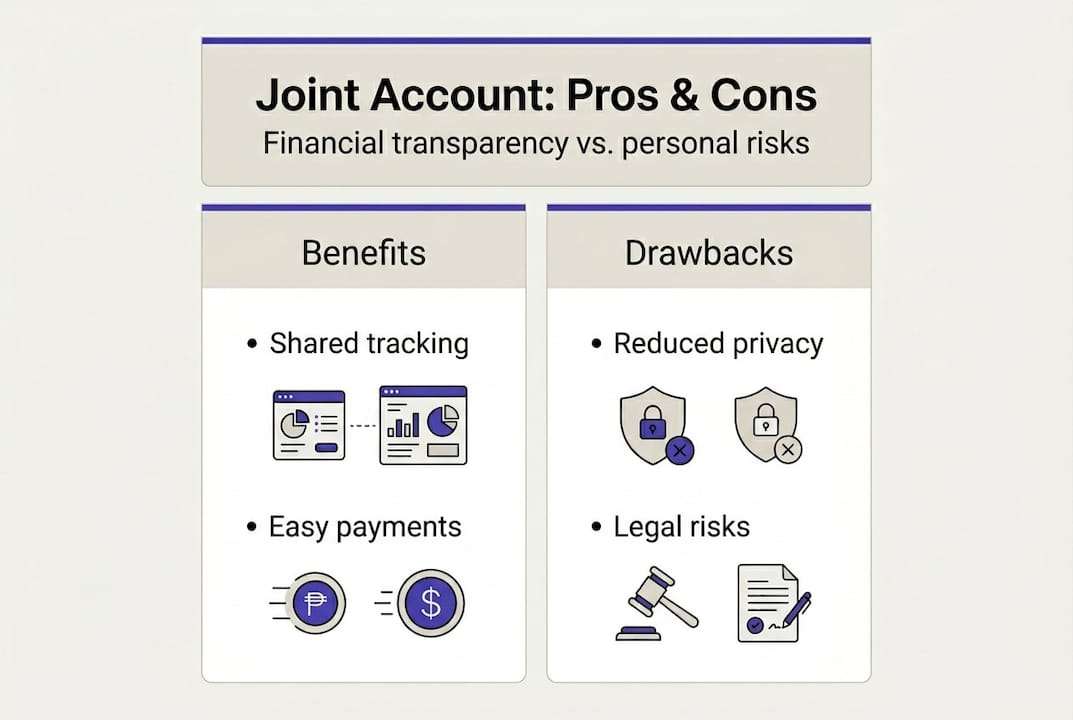
The most immediate advantage is simplicity. Instead of splitting every bill, transferring money back and forth, or keeping a running tally of who owes what, a joint account makes household expenses straightforward. Both partners contribute, and shared costs are covered from one place.
Pooling finances is linked to higher relationship satisfaction, and it’s easy to see why. When you can both see exactly where the money goes, there’s less room for suspicion or resentment. Transparency becomes a natural byproduct of the structure.
Here’s a quick look at the key advantages:
- Easier expense management: One account for bills, groceries, and shared savings means fewer transfers and less mental load
- Financial transparency: Both partners see every transaction, which builds trust over time
- Fewer banking fees: Combining into one account often reduces monthly fees compared to maintaining two separate accounts for shared costs
- Commitment signal: Opening a joint account is a meaningful step that reflects shared intention and long-term thinking
- Right of survivorship: In most Canadian provinces (with the notable exception of Quebec), the surviving partner automatically inherits the full account balance without going through probate
| Benefit | Impact on relationship | Impact on finances |
|---|---|---|
| Shared expense tracking | Reduces resentment | Simplifies budgeting |
| Transparency | Builds trust | Prevents hidden spending |
| Fewer fees | Less financial stress | Saves money monthly |
| Survivorship rights | Provides security | Avoids legal delays |
A striking 96% of couples say financial alignment is important to their relationship satisfaction. That stat alone tells you how much this matters. The pros of joint accounts include easier management of household expenses, increased transparency, building healthy financial habits, and serving as a meaningful commitment signal.
For couples who struggle with handling financial conflict, having a joint account can actually reduce arguments by making spending visible and agreed-upon from the start.

Potential risks and drawbacks of joint banking
For every benefit, joint accounts also bring risks. Understanding the downsides helps you avoid common mistakes before they become relationship problems.
The most fundamental risk is this: a joint account gives both partners full, unrestricted access. That’s not just an emotional trust arrangement. It’s a legal one. Either person can withdraw every cent without the other’s consent. If trust breaks down, the account is vulnerable.
Shared responsibility for debts, overdrafts, and fees is another real concern. If your partner overspends and the account goes into overdraft, that affects both of you, including your credit in some cases. You’re financially linked, whether you caused the problem or not.
Here are the key risks to be aware of:
- Loss of financial privacy: Every transaction is visible to both partners, which can feel uncomfortable for personal spending
- Shared liability: Overdrafts, fees, or debt linked to the account are both partners’ responsibility
- Risk of unauthorised withdrawals: Legally, either partner can access all funds at any time
- Complications during separation: If the relationship ends, dividing the account can become contentious and legally complex
- Quebec-specific rules: In Quebec, joint accounts may be frozen automatically upon a partner’s death, unlike other provinces where survivorship rights apply
“Money fights are among the most damaging to relationships, and financial incompatibility is a leading source of long-term relationship strain.”
The numbers reflect this reality. 47% of Canadian couples argue about money, and 11% have seriously considered ending their relationship because of financial stress. That’s not a small problem.
For couples weighing separate finances versus joint, it’s worth understanding the legal considerations in Canada before making any decisions. The law doesn’t always protect the more financially responsible partner.
Pro Tip: Before merging any funds, establish clear ground rules together. Agree on a spending threshold above which you’ll consult each other, and revisit those rules every few months as your situation evolves.
Hybrid banking: balancing independence and partnership
The risks of an all-in approach can be offset by hybrid banking. This model is increasingly popular among Canadian couples, and for good reason: it lets you stay financially connected without giving up your individual autonomy.
The hybrid approach works like this: you each keep your own personal account, and you open a joint account specifically for shared expenses. Each partner contributes to the joint account proportionally, based on income or a flat agreed amount, while personal spending stays private.
Here’s how to set it up step by step:
- List all your shared monthly expenses (rent, groceries, utilities, streaming, etc.)
- Calculate the total monthly cost of those shared expenses
- Decide on a contribution method: equal split or proportional to income
- Set up automatic transfers from each personal account into the joint account on payday
- Keep personal accounts for individual spending, savings goals, and personal purchases
A sample budget split might look like this:
| Category | Monthly amount | Paid from |
|---|---|---|
| Rent | $2,200 | Joint account |
| Groceries | $600 | Joint account |
| Utilities | $200 | Joint account |
| Personal spending (each) | $400 | Individual account |
| Personal savings (each) | $300 | Individual account |
This model resolves most of the privacy and independence concerns that come with a fully merged account. Your partner doesn’t need to know about every coffee or personal purchase, and you don’t need to feel monitored. At the same time, shared goals stay visible and funded.
For couples exploring premarital counselling insights, the hybrid model often comes up as a practical foundation for financial conversations. TD’s guidance on merging finances after marriage also supports this flexible approach as a starting point for newly committed couples.
A real-world perspective: more than just numbers
Here’s something most financial guides won’t tell you: the structure of your bank account matters far less than the conversations you have before setting it up.
We see this repeatedly. Couples open a joint account thinking it will create financial harmony, only to find that the account becomes a new arena for old arguments. Why? Because a joint account doesn’t fix a communication gap. It just makes that gap more visible.
Experts favour transparency, early discussion, and legal preparation over defaulting to a joint account simply because it feels like the next logical step. The couples who thrive financially aren’t the ones who merged everything on day one. They’re the ones who talked about money before any account was opened.
Financial transparency, when it’s chosen rather than imposed, becomes an act of genuine trust. It says: “I’m willing to let you see all of this.” That’s powerful. But it only works when both partners feel safe.
The hybrid model isn’t a compromise. It’s actually a sophisticated expression of both love and pragmatism. It says you’re building a shared life and honouring each other as individuals. For support navigating the emotional side of this, exploring emotional intimacy tips can help you build the foundation that makes any financial structure work.
Next steps: support for building healthy financial partnerships
Navigating joint finances is genuinely challenging, especially when you’re also planning a wedding, managing family expectations, and receiving conflicting advice from every direction. The emotional weight of money conversations can feel overwhelming, and that’s completely understandable.
At Interactive Counselling, we work with couples across Canada, both in person and online, to address the emotional side of financial decisions. Understanding the types of counselling services available can help you find the right fit for where you are right now. Our couples therapy options are designed to help you communicate more clearly, resolve financial conflict with compassion, and build a partnership that feels secure for both of you. You don’t have to figure this out alone.
Frequently asked questions
What happens to a joint bank account if we break up or divorce in Canada?
In most provinces, both partners retain full access to the account, but funds may be frozen or divided during divorce proceedings. In Quebec specifically, accounts may be frozen automatically upon a partner’s death, which differs from other provinces where survivorship rights apply.
Is it safe to have a joint account if only one partner earns more?
The hybrid approach of combining individual accounts with a joint account using proportional contributions is widely recommended to balance fairness and preserve independence when incomes differ.
Do joint bank accounts help or hurt relationships?
Pooling finances is linked to higher relationship satisfaction when both partners communicate well, but without open dialogue, a joint account can amplify existing financial tensions rather than resolve them.
Can we keep our finances private with a joint account?
Privacy is largely reduced in a fully joint account since both partners can see every transaction. A hybrid model, where personal accounts run alongside a joint one, helps retain partial privacy while still sharing costs.
How common is financial disagreement among Canadian couples?
About 47% of Canadian couples argue about money regularly, and 11% have seriously considered ending their relationship due to financial stress, making financial communication one of the most critical relationship skills to develop.
Recommended
- Create a financial plan as a couple: build a strong future
- Financial conflict in marriage: 47% face this challenge
- 7 Key Advantages of Online Therapy for Couples – Interactive Counselling
- What to discuss before living together: a guide for couples