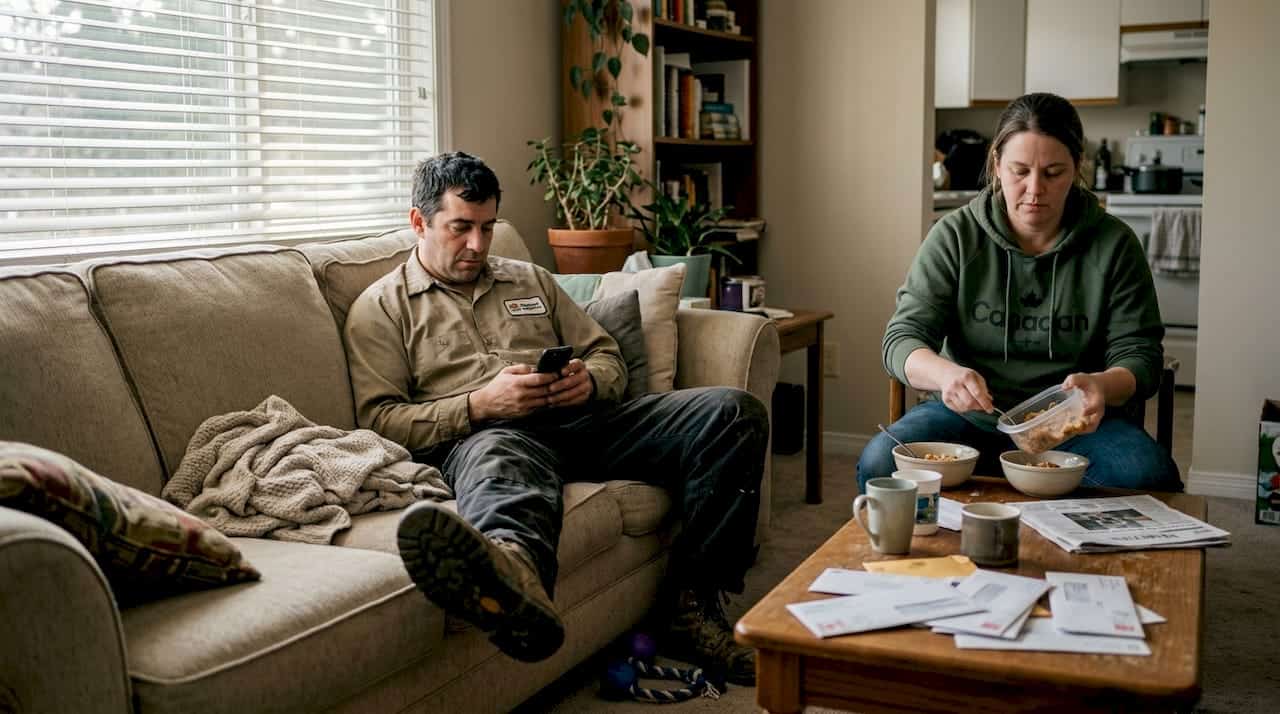
Coming home from a camp rotation should feel like a relief. But for many Canadian couples, the reunion is where the real tension begins. You might expect the hardest part to be the weeks apart, yet research consistently shows that reintegration, the period when a partner returns home from rotational work, often triggers more conflict than the separation itself. Mismatched expectations, exhaustion, and disrupted routines collide in ways that can leave both partners feeling unheard and overwhelmed. This guide explains why that happens and, more importantly, what you can do about it. For more information, see our couples counselling.
Table of Contents
- Why couples fight more after camp rotations
- Main stressors during reintegration periods
- Emotional impact on partners and children
- Why reintegration is harder than separation
- Management strategies for couples facing reintegration stress
- Resilience and long-term outcomes: balancing financial benefits and emotional costs
- Find support for reintegration stress
- Frequently asked questions
Key Takeaways
| Point | Details |
|---|---|
| Reintegration stress worsens conflict | Canadian couples report increased tension after rotational camp reunions due to mismatched expectations and emotional distance. |
| Children face emotional challenges | Family wellbeing and children’s mental health are impacted by work rotations, making ongoing support essential. |
| Proactive strategies reduce fights | Transition rituals, honest talks, and scheduled check-ins can significantly ease reintegration stress for couples and families. |
| Support and counselling help | Accessing couples therapy and mental health resources mitigates long-term relationship strain after camp rotations. |
Why couples fight more after camp rotations
When a partner returns from a fly-in/fly-out (FIFO) or camp rotation, both people arrive at the reunion carrying very different emotional loads. The returning worker is often physically drained and craving quiet. The at-home partner, who has been managing the household, the children, and every unexpected crisis alone, is equally exhausted and desperately wants relief and connection. These two needs pull in opposite directions, and that tension is where conflict is born.
Reintegration stress in rotational camp work causes couples to fight more due to mismatched expectations, fatigue, role confusion, and emotional disconnection. This is not a character flaw in either partner. It is a structural problem built into the nature of rotational work itself.
Common triggers for post-rotation conflict include:
- Role confusion: Who is in charge of the household now that the returning partner is home?
- Emotional distance: Weeks apart can create a subtle but real gap in intimacy and shared experience.
- Fatigue: Both partners are running on empty, making patience scarce.
- Unspoken resentment: Frustrations that built up during the rotation rarely disappear on their own.
The impact of 14-on/7-off rotations on marriages is well-documented in Canadian communities, particularly in resource-sector regions like Grande Prairie and the Athabasca oil sands. The FIFO impact on families shows that these patterns affect not just couples but entire family systems.
“The reunion is not a reset button. It is a negotiation, and both partners need to understand that before the first conversation happens.”
Main stressors during reintegration periods
Now that we know what sparks conflict, let’s look closer at the specific stressors couples in Canada face during transitions. Understanding these stressors clearly is the first step toward managing them.
Key stressors include the returning worker needing rest while the stay-at-home partner seeks immediate help, disrupted routines and intimacy, and at-home partner burnout from solo parenting. These are not minor inconveniences. They are sustained pressures that erode connection over time.
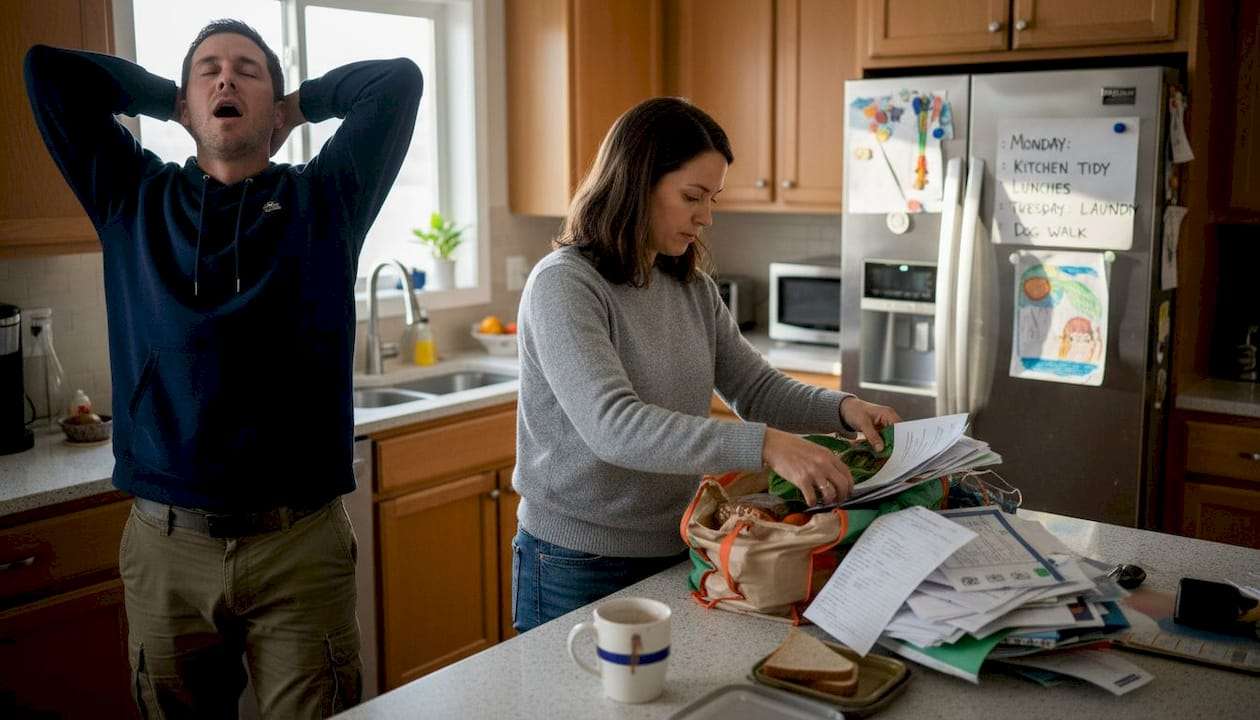
Here is a comparison of what each partner typically experiences during reintegration:
| Stressor | Returning worker | At-home partner |
|---|---|---|
| Energy levels | Physically depleted from shift work | Emotionally depleted from solo parenting |
| Primary need | Rest and decompression | Help and acknowledgement |
| Intimacy | May feel disconnected or awkward | May feel neglected or resentful |
| Routine | Adjusting back to home rhythms | Disrupted by partner’s return |
| Communication | May withdraw or minimise | May feel unheard or dismissed |
The rotation work impact review confirms that these stressors compound over multiple rotations, making early intervention critical. Understanding interpersonal strain and relationship dynamics can help couples name what they are experiencing rather than simply reacting to it.
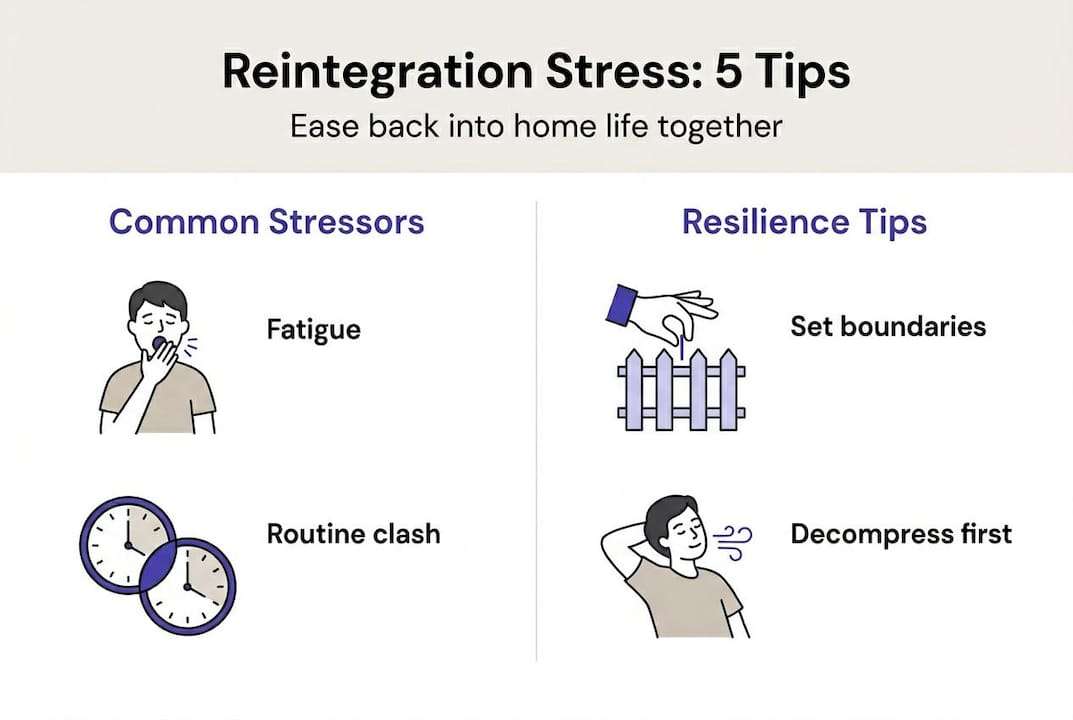
Pro Tip: Before diving into household tasks or difficult conversations, schedule a short decompression window of a few hours where neither partner is expected to perform or problem-solve. Think of it as a buffer zone between camp life and home life.
Emotional impact on partners and children
The stress doesn’t just impact couples. Children feel it too, often in ways they cannot articulate. A parent who disappears for two or three weeks and then reappears changes the emotional landscape of the home, and children respond to that instability in predictable ways.
A systematic review of 19 studies shows adverse mental and physical health impacts on partners and children from rotation work separations and reunions. The effects are real, measurable, and worth taking seriously.
| Who is affected | Common impacts |
|---|---|
| At-home partner | Anxiety, loneliness, burnout, depression |
| Returning worker | Fatigue, identity confusion, guilt, isolation |
| Children | Separation anxiety, behavioural changes, disrupted routines |
Stigma is a significant barrier. Many families, particularly in male-dominated camp cultures, feel pressure to appear strong and self-sufficient. This reintegration stress research highlights that stigma prevents help-seeking, and that longer rosters such as 21-on/7-off schedules worsen strain considerably.
Children may show signs of anxiety that are easy to miss or misattribute to other causes. Knowing how to talk to your child about their mental health during these transitions can make a meaningful difference in how they process the disruption.
Why reintegration is harder than separation
You might expect separation to be the hardest part, but experts reveal why the coming home phase is even more challenging. When a partner leaves for camp, the at-home partner adjusts. Routines solidify. Independence grows. Then the returning partner arrives and, without meaning to, disrupts a system that has been working.
The emotional toll of FIFO life is shaped by what researchers call “performance mode,” where both partners feel pressure to make the reunion feel good, suppressing honest feelings in the process. Unspoken resentments accumulate beneath the surface, and eventually, they surface as conflict.
The Canadian context, particularly in regions like the Athabasca oil sands, mirrors global FIFO challenges. Family wellbeing must be considered alongside worker recovery for operations to remain sustainable long-term.
Pro Tip: Designate a dedicated transition day when the returning partner arrives. Set clear, gentle boundaries: no major decisions, no big conversations, no pressure to reconnect physically or emotionally right away. Give the relationship room to breathe before expecting it to perform.
If you are unsure whether your relationship needs professional support, exploring when to separate versus when to work on it can provide helpful clarity. Kelowna couples counselling and similar services across Canada offer a safe space to work through these dynamics with professional guidance.
Management strategies for couples facing reintegration stress
Recognising the sources of tension, here are practical ways couples can reduce stress and fight less after rotations. These strategies are not complicated, but they do require intention.
- Create a transition ritual. A simple, consistent routine when the partner returns home signals safety and predictability to both partners and children.
- Communicate expectations before arrival. A brief phone or video call before the return home can prevent the most common mismatches.
- Schedule regular check-ins. A weekly 20-minute conversation focused on how each partner is feeling prevents small frustrations from becoming large resentments.
- Seek couples counselling early. Preventative couples therapy reduces conflicts by addressing cycles early, and communication during shifts is key to relationship satisfaction.
- Prioritise self-care for the at-home partner. Burnout in the at-home partner is one of the most underrecognised risks in rotational work families.
Management strategies such as transition rituals, open communication on expectations, consistent routines, scheduled check-ins, and self-care for the at-home partner are proven to reduce reintegration conflict. Exploring co-parent counselling can also help families navigate the parenting dimension of these transitions. Couples counselling provides a structured, supportive environment to practise these skills with professional guidance.
For the at-home partner specifically, consider:
- Asking for help clearly rather than hoping your partner will notice what needs doing.
- Maintaining at least one personal activity or social connection during the rotation.
- Acknowledging your own emotional needs without guilt.
Resilience and long-term outcomes: balancing financial benefits and emotional costs
Finally, let’s consider the bigger picture for Canadian couples: is rotational work worth the emotional cost, and how can families build lasting resilience?
The honest answer is that it depends. The financial benefits versus emotional costs of FIFO work are real on both sides, and many families report a net negative impact on their relationships over time.
Potential benefits of rotational work:
- Higher income and financial stability
- Extended time at home during off-rotations
- Career advancement in specialised industries
Common emotional costs:
- Relationship strain and increased conflict
- Parenting challenges and children’s anxiety
- Isolation and mental health impacts for both partners
Families that build resilience tend to share a few things in common: they use scheduled rituals, they communicate proactively, and they treat professional support as a strength rather than a last resort. Stakeholders including employers and unions should collaborate to reduce stressors, destigmatise mental health, and provide family support in rotational work environments.
| Long-term outcome | Families who struggle | Families who build resilience |
|---|---|---|
| Communication | Reactive, conflict-driven | Proactive, scheduled check-ins |
| Support-seeking | Delayed or avoided | Early and normalised |
| Routines | Disrupted each rotation | Consistent transition rituals |
| Relationship satisfaction | Declining over time | Maintained or improved |
Exploring the full range of types of counselling services available in Canada can help couples and families find the right fit for their specific situation.
Find support for reintegration stress
If you recognise your relationship in what you have read here, you are not alone, and you do not have to figure this out without support. At Interactive Counselling, we work with couples and families across Canada who are navigating the very real emotional weight of rotational work. Whether you are in Kelowna, Grande Prairie, Penticton, or anywhere else in the country, our team of licensed therapists offers in-person, phone, and online sessions to fit your schedule. You can explore the full range of types of counselling services we offer, access online relationship counselling from wherever you are, or connect with family counselling in Kelowna for in-person support. Reaching out is not a sign of failure. It is one of the most practical things you can do for your relationship.
Frequently asked questions
What is reintegration stress after camp rotations?
Reintegration stress is the emotional and practical strain couples face when a partner returns home from rotational camp work, often causing increased conflict due to mismatched expectations and disrupted routines. It is a recognised pattern, not a personal failing.
How can couples reduce fights and emotional stress after rotational work reunions?
Couples can reduce fights by using transition rituals and check-ins, communicating expectations clearly before the return home, and accessing couples therapy early rather than waiting for conflict to escalate.
Are there resources for children affected by camp work and reintegration?
Yes. Children benefit from regular check-ins, open age-appropriate conversations, and professional support to address separation anxiety. A systematic review of 19 studies confirms that children are meaningfully affected by rotation work schedules.
Why does reintegrating feel harder than returning to camp?
Reintegration is harder because of performance pressure and unspoken resentments that build during the rotation. The emotional toll of FIFO life research shows that honest communication and dedicated decompression time are essential to easing this transition.
Recommended
- Reconnect as a couple after camp work emotional distance
- How 14-on/7-off rotations affect marriage in Grande Prairie
- Adjustment Stress – Why Change Can Feel Overwhelming
- Why Seasonal Work Creates Unique Stress in Our Community