Deciding whether to separate or work on your relationship is one of the most emotionally challenging crossroads you’ll face as a couple. Many Canadian couples believe they’ll instinctively know when it’s time to end things, yet research shows couples with strong communication skills experience 25% fewer conflicts and better conflict resolution, suggesting that relationship success often depends more on learnable skills than gut feelings. This article provides evidence-based guidance to help you navigate this critical decision, drawing on expert research and practical strategies tailored specifically for couples in Canada contemplating their relationship’s future.
Table of Contents
- The Role of Communication And Financial Factors In Relationship Stability
- How Early Intervention And Therapy Can Guide Your Decision
- Recognising When Separation Is The Right Choice
- Practical Steps To Work On Your Relationship Or Separate Amicably
- How Interactive Counselling Supports Your Relationship Journey
- Frequently Asked Questions
Key takeaways
| Point | Details |
|---|---|
| Communication matters most | Strong communication skills reduce conflicts by 25% and improve relationship stability significantly |
| Financial stress drives separation | Money disagreements are a leading cause of marital breakdown among Canadian couples |
| Early therapy works better | Seeking professional help at the first sign of trouble dramatically improves outcomes |
| Safety comes first | Any form of abuse requires immediate separation without attempting to work things out |
| Exhaust resources before deciding | Using therapy, mediation, and counselling helps ensure informed, confident decisions |
The role of communication and financial factors in relationship stability
Communication stands as the single most powerful predictor of whether your marriage will thrive or struggle. Couples who develop effective communication patterns navigate disagreements more successfully and maintain emotional connection even during stressful periods. When you can express needs clearly and listen without defensiveness, you create a foundation that withstands most relationship challenges.
Poor communication creates a destructive cycle where small misunderstandings escalate into recurring conflicts. You might find yourselves arguing about the same issues repeatedly, never reaching resolution because neither partner feels truly heard. This pattern erodes trust and intimacy over time, leaving both of you feeling isolated and frustrated. Learning how to improve communication in marriage can break this cycle before it becomes irreparable.
Financial stress represents another critical factor in relationship stability, particularly for Canadian couples navigating economic uncertainty. Financial disagreements cause significant marital stress, often triggering conflicts that extend beyond money into deeper issues of trust, values, and life goals. When partners handle money differently or hide spending, the resulting tension can poison even strong relationships.
Practical steps to strengthen these foundational areas include:
- Schedule weekly check-ins to discuss both emotional needs and financial planning
- Use “I feel” statements instead of blame language during disagreements
- Create transparent budgets where both partners have equal input and visibility
- Practise active listening by repeating back what you heard before responding
- Seek financial counselling together if money conflicts persist
Pro Tip: Set a regular “relationship review” time each month where you discuss what’s working and what needs attention, treating your partnership with the same care you’d give an important project at work.
Addressing communication and financial challenges early prevents them from becoming relationship-ending crises. Many couples who later separate identify these issues as warning signs they ignored. If you’re already experiencing frequent conflicts about money or feeling unheard by your partner, recognising signs your marriage is over versus signs you need help can guide your next steps. Consider co-parent counselling support even if you’re still together, as these services often provide relationship skills that prevent separation.
How early intervention and therapy can guide your decision
Timing matters profoundly when seeking professional help for relationship struggles. Couples who engage in therapy early have higher success rates in relationship improvement compared to those who wait until problems become entrenched. Think of therapy like addressing a small leak before it floods your entire home, addressing issues when they’re manageable rather than catastrophic makes repair far more achievable.

Therapy helps you address underlying patterns rather than just surface arguments. You might fight about dishes or schedules, but therapy often reveals deeper issues around respect, appreciation, or unmet emotional needs. A skilled therapist guides you past the symptoms to the root causes, giving you tools to resolve not just current conflicts but future ones as well. This process clarifies whether your relationship has a viable foundation or whether fundamental incompatibilities exist.
The statistics on therapy effectiveness are encouraging. 60 to 70% of couples attending therapy report improved relationship satisfaction or more amicable separation outcomes. This means that even if you ultimately decide to separate, therapy helps you do so with less conflict, clearer communication, and better co-parenting arrangements if children are involved. The investment in therapy pays dividends regardless of whether you stay together or part ways.
Complementary resources strengthen therapy’s impact:
- Mediation services help couples navigate practical separation logistics if that becomes necessary
- Financial counselling addresses money conflicts that often mask deeper relationship issues
- Individual therapy alongside couples work helps each partner address personal patterns affecting the relationship
- Support groups connect you with others facing similar decisions, reducing isolation
- Educational workshops teach specific skills like conflict resolution and emotional regulation
Pro Tip: Before your first therapy session, each partner should write down three specific changes they hope to see in the relationship and three things they’re willing to change about themselves, this preparation makes therapy more focused and productive.
Starting therapy signals commitment to working through challenges before making permanent decisions. It demonstrates that you value the relationship enough to invest time, money, and emotional energy into understanding what’s happening. Even partners initially resistant to therapy often find relief in having a neutral third party facilitate difficult conversations. Exploring benefits of marriage counselling and learning how to prepare for couples counselling maximises your chances of positive outcomes. Understanding types of couples therapy helps you choose approaches that match your specific needs and relationship dynamics.
Recognising when separation is the right choice
Certain relationship situations clearly indicate that separation represents the healthier path forward. Safety concerns top this list unequivocally. In cases of domestic violence or abuse, immediate separation is often the safest course of action, and attempting to “work on” an abusive relationship puts you at serious risk. Physical violence, emotional abuse, controlling behaviour, and threats all require you to prioritise your safety and that of any children involved.
Beyond safety issues, several patterns suggest separation may be appropriate:
- Complete emotional disconnection where neither partner feels anything positive toward the other anymore
- Repeated infidelity without genuine remorse or behaviour change from the unfaithful partner
- Fundamental value conflicts around major life decisions like having children or religious beliefs
- Active addiction where the addicted partner refuses treatment or repeatedly relapses without commitment to recovery
- Persistent contempt, criticism, defensiveness, and stonewalling despite therapy attempts
- One partner definitively wants out and has clearly communicated this decision
Pro Tip: If you’re unsure whether your situation warrants separation, ask yourself this question: “If my best friend described my relationship to me, what advice would I give them?” This perspective shift often clarifies what you already know deep down.
Your emotional and physical wellbeing must come first when making this decision. Staying in a destructive relationship because of fear, guilt, or external pressure damages your mental health and models unhealthy patterns for any children watching. Sometimes the most loving choice you can make for everyone involved is to end a relationship that no longer serves anyone’s highest good.
“The decision to separate should be informed by honest assessment of relationship viability, not just fear of change or hope that problems will magically resolve.”
Therapy can aid decision-making by helping you gain clarity about whether your relationship has potential for repair. However, therapy is not appropriate where safety is at risk, and no amount of counselling fixes a partner who refuses to acknowledge problems or change harmful behaviours. Recognising signs your marriage is over helps you make informed choices. If you decide separation is necessary, finding the right couples therapist can still help you navigate the process more amicably and establish healthy co-parenting patterns.
Practical steps to work on your relationship or separate amicably
Whether you choose to work on your relationship or separate, following a structured approach leads to better outcomes. Couples who use mediation and counselling before separation often experience less conflict and better long-term results. Exhausting available resources before making final decisions ensures you won’t later wonder “what if” or regret not trying everything possible.
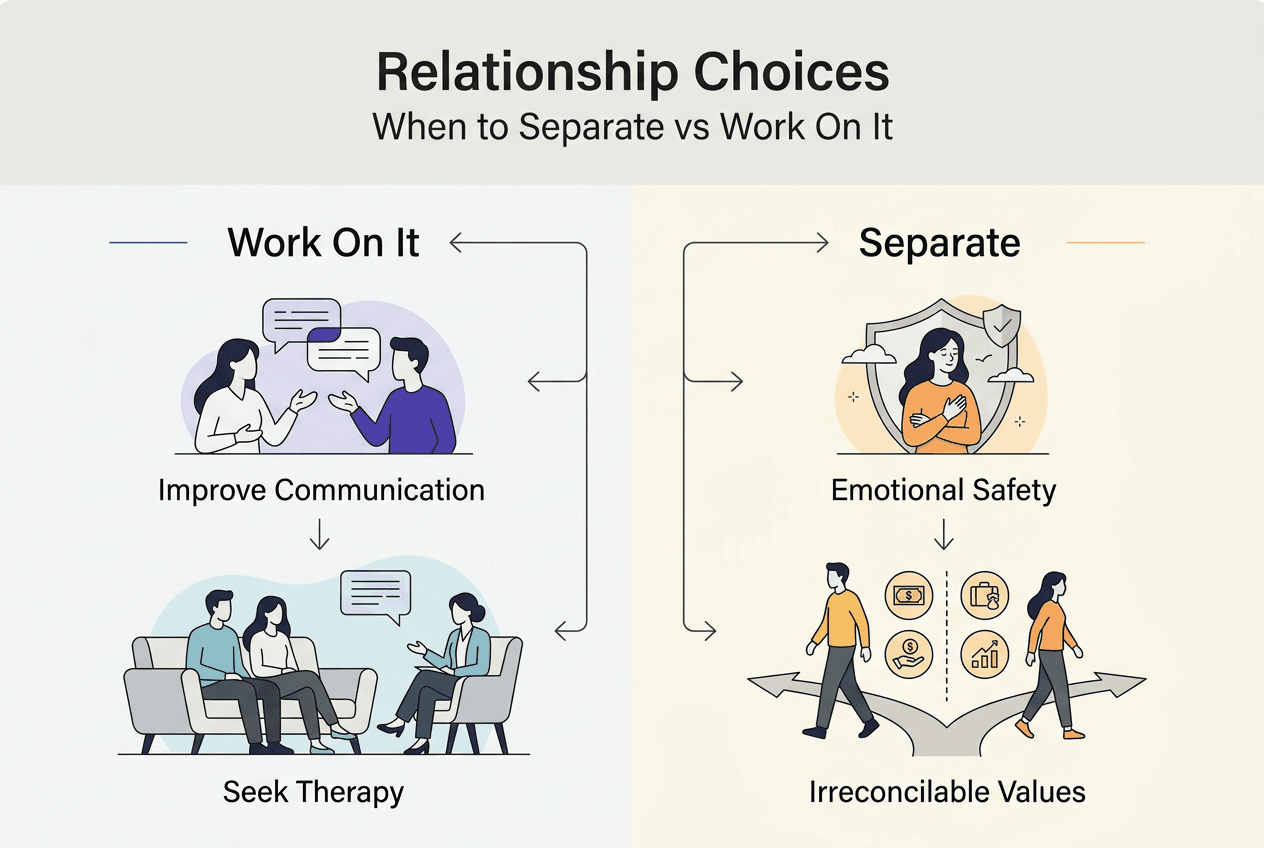
The following comparison outlines both paths:
| Aspect | Working on it | Separating amicably |
|---|---|---|
| Primary focus | Rebuilding connection and trust | Establishing healthy boundaries and co-parenting |
| Key actions | Attend therapy, improve communication, address core issues | Seek mediation, divide assets fairly, create parenting plan |
| Timeline | Commit to 6-12 months of focused effort | Allow 3-6 months for practical arrangements |
| Success markers | Reduced conflict, increased intimacy, mutual commitment | Respectful communication, fair agreements, child wellbeing |
| Main challenges | Requires both partners’ genuine effort | Managing grief whilst handling logistics |
If you’re working on your relationship, these steps create the best foundation:
- Commit to weekly therapy sessions for at least three months before evaluating progress
- Implement daily connection rituals like morning coffee together or evening walks
- Address practical stressors like childcare or finances that drain relationship energy
- Set clear boundaries around behaviours that damage trust or respect
- Celebrate small improvements rather than expecting instant transformation
If you’re moving toward separation, these actions support healthier outcomes:
- Engage a mediator before lawyers to reduce adversarial dynamics
- Prioritise children’s needs in all decisions about custody and living arrangements
- Seek individual therapy to process grief and prepare for single life
- Maintain respectful communication even when emotions run high
- Create detailed agreements about finances, property, and parenting to prevent future conflicts
Pro Tip: Regardless of which path you choose, maintain your own support network of friends, family, or support groups, relying solely on your partner or ex-partner for emotional support creates unhealthy dynamics that complicate both reconciliation and separation.
Both paths require emotional honesty, consistent effort, and external support. Working on your relationship demands that both partners genuinely want to change and invest in the process. Separation requires that both partners commit to treating each other with dignity despite hurt feelings. Exploring co-parent counselling support helps separated couples maintain healthy dynamics. Understanding types of therapy explained helps you choose appropriate support whether staying together or separating. Working with professionals who understand your specific situation, perhaps by learning how to find the right couples therapist, ensures you have expert guidance through this challenging transition.
How Interactive Counselling supports your relationship journey
Navigating the decision to work on your relationship or separate requires expert guidance tailored to your unique circumstances. Interactive Counselling offers comprehensive couples therapy across multiple Canadian locations including Kelowna, Vernon, Grande Prairie, and Penticton, with online services available nationwide. Our experienced therapists help you explore types of therapy explained to match your specific needs, whether you’re rebuilding connection or navigating separation respectfully. We provide flexible scheduling including evening appointments, making professional support accessible even with busy lives. Our team understands the complexities Canadian couples face and offers non-judgemental, compassionate care throughout your journey. Whether you need help improving communication, processing difficult emotions, or establishing healthy co-parenting patterns, we’re here to support you. Explore our services and rates and take the first step by finding the right couples therapist for your situation.
Frequently asked questions
How do I know if my marriage is truly over?
Multiple unresolved issues, complete emotional disconnection, and lack of willingness from either partner to work on problems suggest your marriage may be over. If you feel indifferent rather than angry or sad, or if the thought of staying together fills you with dread rather than hope, these are significant indicators. Professional guidance helps assess relationship viability objectively, exploring signs your marriage is over with a trained therapist who can help you gain clarity.
What if one partner wants to work on the relationship but the other wants to separate?
This common situation requires open communication about each person’s needs, fears, and non-negotiables. Therapy can bridge differing desires by helping both partners understand underlying concerns and explore whether compromise is possible. Sometimes the reluctant partner needs time and evidence of genuine change before committing to reconciliation. Patience combined with professional help improves understanding and expands options, and finding the right couples therapist creates space for both perspectives to be heard and validated.
When is the best time to seek couples therapy?
Seek therapy as soon as relationship problems become apparent, before patterns become entrenched and resentment builds. Couples who engage in therapy early in distress have higher success in improving their relationship compared to those who wait until crisis point. Early intervention addresses issues whilst both partners still have emotional investment and hope. Don’t wait until you’re considering separation, preventative therapy strengthens relationships before they reach breaking point.
Should I separate immediately if I feel unsafe in the relationship?
Yes, put your safety first and seek immediate separation if abuse occurs in any form, including physical violence, emotional abuse, threats, or controlling behaviour. Immediate separation is often safest in domestic violence or abuse scenarios, and attempting to work on an abusive relationship puts you at serious risk. Contact local support services, domestic violence hotlines, and authorities for help creating a safe exit plan. Your wellbeing and that of any children involved must take absolute priority over preserving the relationship.
Recommended
- Co-Parent Counselling: Essential Support for Separated Couples
- Should we get a divorce? a clear guide for Canadians
- How to Prepare for Couples Counseling for Lasting Change – Interactive Counselling
- Recognise signs your marriage is over and decide next steps