It can be an incredibly heavy and lonely experience to feel like you're never quite good enough. But there is a path forward, and it often begins with professional support right here in Grande Prairie. Counselling offers a safe, judgment-free space to unpack where these feelings come from and, more importantly, to start building the tools you need for a more self-accepting life. For more information, see our Grande Prairie counselling.
"Counselling helps you understand that feeling 'not good enough' is a learned pattern, not a permanent truth about who you are. It offers evidence-based strategies to gently rewrite that internal script."
The Weight of Never Feeling Good Enough
Living with the nagging sense that you’ll never measure up is exhausting. It's like carrying an invisible weight that shapes your thoughts, colours your emotions, and quietly steers your decisions, day in and day out.
This isn't just a fleeting moment of self-doubt. It's a constant, humming background noise—that relentless inner critic who always has something negative to say.
You might notice it in the way you constantly compare yourself to others, always feeling like you're a step behind. Or maybe it’s the paralyzing fear of failure that stops you from chasing a new opportunity or even celebrating the things you accomplish. It's a profoundly human struggle, and please know, you are not the only one going through this.
You Are Not Alone in This Feeling
That persistent feeling of inadequacy isn't a personal flaw or a sign that you're weak. Far from it. It's almost always a learned pattern, something picked up from past experiences, the impossible standards set by society, or the curated "perfect lives" we see on social media.
Simply understanding that these feelings have a source—that they didn't just appear out of nowhere—is the first real step toward ensuring they don't get to write your future.
Across Alberta, the need for mental health support has become more visible than ever. For example, recent data shows a significant increase in mental health-related emergency department visits among young people in the province, a reminder that many individuals and families in communities just like Grande Prairie are dealing with similar challenges.
The journey toward feeling better about yourself starts by acknowledging the weight you've been carrying. Recognizing that you're part of a shared human experience opens the door to compassionate, effective support—support that’s available right here in our community.
How That "Never Good Enough" Feeling Shows Up
That nagging feeling of not being good enough rarely stays in the background. It’s more like a constant, critical voice in your head, colouring your thoughts, influencing your actions, and shaping your relationships in ways you might not even realize.
For some, it looks like perfectionism so intense that it's paralyzing. You can't start a project because you're terrified of making a small mistake. For others, it shows up as social anxiety, where you replay conversations over and over, convinced you said the wrong thing.
This internal pressure doesn't just hijack the big moments; it quietly steals the joy from everyday life. You might find yourself unable to accept a simple compliment, immediately brushing it off because, deep down, you don’t believe you deserve it. Or perhaps you avoid trying new hobbies because your inner critic has already predicted you'll fail.
The Inner Dialogue of Inadequacy
This feeling of being "never good enough" is usually fueled by a relentless, self-sustaining cycle of judgment, comparison, and doubt.
This isn't just a random bad mood; it's a pattern. The inner critic points out a flaw, you compare yourself to someone who seems to have it all together, and self-doubt rushes in to confirm you’ll never measure up.
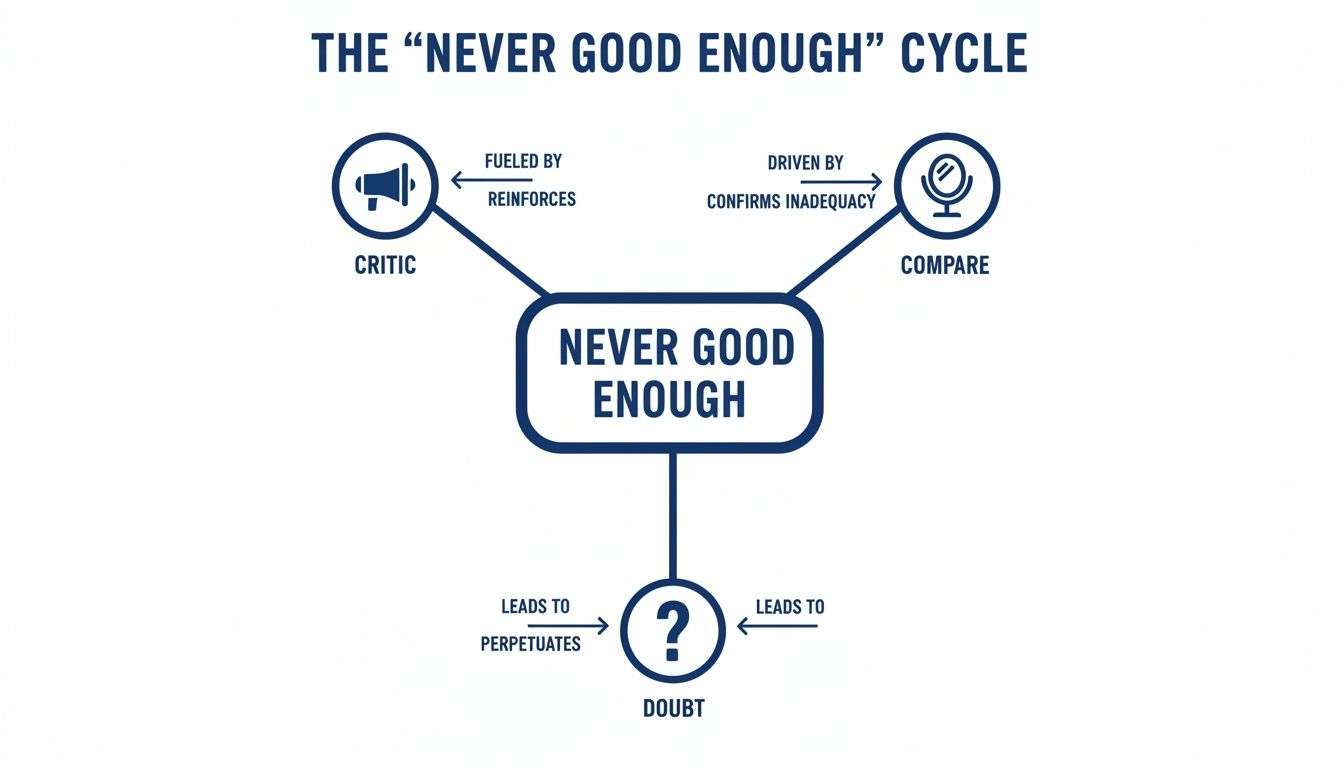
These elements feed each other, creating a powerful loop that can be incredibly difficult to break on your own. This constant state of high alert can also lead to very real emotional distress, like chronic anxiety, and has even been connected to physical health concerns.
Signs of Chronic Self-Criticism vs. Healthy Self-Reflection
It’s one thing to want to improve and grow, but it's another to live under the thumb of a harsh inner critic. Telling the difference is a crucial first step.
Here’s a breakdown of how these two mindsets compare:
| Area of Life | Chronic Self-Criticism (Never Good Enough) | Healthy Self-Reflection |
|---|---|---|
| Making a Mistake | "I'm such an idiot. I can't do anything right." This leads to feelings of shame and hopelessness. | "Okay, that didn't go as planned. What can I learn from this so I can approach it differently next time?" |
| Receiving Feedback | Immediately feels like a personal attack. Focuses only on the negative and dismisses any positives. | Listens with curiosity. Separates the feedback from personal worth and sees it as a tool for growth. |
| Successes & Goals | "It was just luck." or "The bar was too low." Immediately moves the goalposts, so nothing is ever satisfying. | Acknowledges the effort and feels genuine pride. Pauses to appreciate the accomplishment before moving on. |
| Comparing to Others | Constantly measures self against others and always comes up short, leading to feelings of envy and shame. | Is inspired by others' successes. Focuses on their own journey and progress without judgment. |
| Inner Voice | Harsh, punishing, and relentless. Often uses critical "should" and "must" statements. | Kind, encouraging, and balanced. Asks questions like, "What do I need right now?" |
Recognizing which column you live in most of the time is incredibly insightful. It's not about blaming yourself, but about understanding the patterns that are keeping you stuck.
Behaviours like procrastination, people-pleasing, or agonizing over small decisions are often just coping mechanisms—your brain's attempt to manage the pain of feeling inadequate. The goal of counselling is not to judge these habits but to help you find healthier, more compassionate ways to relate to yourself so you can finally quiet that harsh inner voice.
Where Do These Feelings Come From?
If you’re constantly battling feelings of inadequacy, it’s important to know they rarely just appear out of thin air. More often than not, they are learned patterns—habits of thought and feeling shaped by our experiences, our relationships, and the world around us.
Figuring out their origins isn’t about pointing fingers or placing blame. It's about gently understanding how these beliefs took root so you can start to see them for what they are: old stories, not unchangeable facts.
Think of your core beliefs about yourself like the operating system running in the background of your mind. This system quietly influences how you see the world and what you expect from yourself. If that system was programmed early on with messages of harsh criticism or conditional love, it’s no wonder it keeps running the "I'm not good enough" program.
The Seeds of Self-Doubt
Many of these foundational beliefs are formed when we’re young. Our earliest experiences, particularly within our families, play a massive role in building our sense of self. If praise was hard to come by but criticism was frequent, it's easy to internalize the idea that our worth is conditional—something we have to constantly earn.
Past traumas or painful events can also install a deep-seated belief that we are somehow flawed. A significant failure, a sharp rejection, or being bullied can leave an emotional echo that whispers, "See? You just don't have what it takes." This isn't a sign of weakness; it's how our brains try to make sense of painful moments. You can explore this connection more deeply in our guide on where your inner critic comes from.
That harsh inner critic is often a misguided bodyguard. The part of you that says you’re not good enough is usually just trying to keep you safe from failure or judgment by convincing you not to take any risks.
Modern Pressures Pouring Fuel on the Fire
While the roots of inadequacy often go deep, modern life has a knack for making things worse. We're bombarded with curated images of flawless success and perfect happiness that are simply not realistic.
- Societal Expectations: There's a silent script for life—career goals, relationship timelines, financial milestones. It’s easy to feel like you’re constantly falling behind.
- The Social Media Effect: We scroll through the highlight reels of everyone else's lives, which makes it incredibly easy to fall into the comparison trap. This creates a warped reality where it looks like everyone else has it all figured out.
Understanding these sources—both internal and external—is a game-changer. It helps you shift from self-blame ("What's wrong with me?") to compassionate curiosity ("Where did I learn to believe this about myself?"). That shift in perspective is the first step toward realizing that if these beliefs were learned, they can also be unlearned.
How Counselling Helps You Rebuild Your Sense of Self-Worth
When you’re caught in the loop of feeling like you’re never good enough, trying to break free on your own can feel impossible. This is where counselling offers a way forward. Think of it as a guided process where you can safely take apart those old, painful beliefs and build a new foundation of self-worth from the ground up.

It all starts with building a trusting relationship with your therapist. Creating that safe, non-judgmental space is so important because it gives you the freedom to explore your feelings without the fear of being criticized. A central goal is to help you finally quiet that constant internal chatter of self-doubt and learn how to overcome self doubt and build real confidence.
Practical Tools for Quieting Your Inner Critic
A skilled counsellor equips you with evidence-based approaches that are like a practical toolkit for your mind. These are actionable skills you can use every day.
Two of the most effective methods include:
- Cognitive Behavioural Therapy (CBT): This approach helps you become a detective of your own thoughts. Your therapist works alongside you to spot the automatic negative thought patterns that keep you feeling inadequate. Then, you learn how to gently challenge those thoughts and reframe them from a more balanced, realistic perspective.
- Acceptance and Commitment Therapy (ACT): Instead of getting into a battle with your inner critic, ACT teaches you how to step back from it. You learn how to notice those harsh thoughts without getting tangled up in them, freeing you up to focus your energy on what truly matters to you.
Building Self-Worth From the Inside Out
Therapy isn’t about having someone else convince you that you're "good enough." It's about guiding you to discover and truly believe it for yourself. A counsellor helps you practice self-compassion, which is about learning to treat yourself with the same kindness you’d offer a close friend.
Counselling helps you shift from a mindset of self-criticism to one of self-compassion. This change allows you to build a resilient sense of worth that isn't dependent on external achievements or others' approval.
Through this supportive process, you'll learn to set healthy boundaries, honour your own needs, and celebrate your progress. Slowly but surely, the volume of that harsh inner critic begins to fade, and a kinder, more encouraging voice takes its place. This is how you start building a genuine, lasting sense of self that can stand strong against life’s challenges.
Finding Compassionate Support in Grande Prairie
Reaching out for support is a significant step, and it's completely normal to want to find a professional you can trust and feel comfortable with. Counselling services in Grande Prairie are designed to be built around you and your needs, because everyone’s journey is different.
Whether you prefer meeting in person or talking from the comfort of your own home, there are options that fit your life.

The primary goal is to offer a safe, confidential space where you can unpack your feelings without any judgment. This is your time—time to be heard, understood, and gently guided toward a healthier relationship with yourself.
Support That Fits Your Life
Life gets busy, and therapy shouldn't add more stress to your plate. That’s why you can find help in a way that works for you.
- In-Person Sessions: A dedicated space away from everything else can provide a quiet, focused environment for a traditional face-to-face connection.
- Virtual Counselling: For convenience and privacy, secure online sessions can deliver the same high-quality support. You can connect from anywhere you feel comfortable.
This flexibility means that a busy schedule or transportation don't have to be barriers to getting help. No matter the format, building a trusting and compassionate therapeutic relationship is always the top priority.
A Space for Individuals, Youth, and Families
The feeling of "never being good enough" rarely stays with just one person; it can send ripples through an entire family. This is why counselling support is often available for adults, youth, and families, each with their own unique challenges.
A supportive therapeutic environment is a place where your experiences are treated as valid. It's a space where you can finally set down the heavy weight of self-criticism and start learning to see yourself through a kinder lens.
By offering a wide range of support, therapy services aim to build resilience and promote healing across our community. You can discover more about different therapeutic approaches by exploring the available counselling services.
Remember, deciding to reach out is the most important step. When you're ready, compassionate and professional support is here to walk alongside you.
Your Questions About Counselling for Self-Worth, Answered
Deciding to reach out for support is a big step, and it’s natural to have questions. Feeling uncertain or even nervous is part of the process. Below are answers to some of the most common questions from people thinking about counselling for feelings of inadequacy.
I’ve felt this way forever. Can therapy actually change anything?
That's a completely fair question. When a feeling has been with you for years, it's hard to imagine life without it. The goal of therapy isn't to pretend your past didn't happen, but to give you the tools and a new perspective to build a different future. With a therapist, you'll start to see where these feelings came from. Using proven methods, you'll learn how to quiet that harsh inner critic and, little by little, build a kinder relationship with yourself. It’s a process, but you’ll have someone supporting you the entire way.
What if I’m too anxious to talk about this face-to-face?
Feeling nervous about opening up is one of the most common hurdles. It makes perfect sense, and it’s why different ways to connect are so important. Virtual counselling is a wonderful option if you'd feel more comfortable talking from your own space. It lets you connect with a professional from the privacy and comfort of your home. The key is finding what feels right and safe for you. A good counsellor will understand and create a space where you can share at your own pace.
How do I know if what I’m feeling is “bad enough” for counselling?
There’s no "seriousness" test you need to pass. If these feelings of inadequacy are getting in the way of your happiness, your relationships, your work, or just how you feel day-to-day, that’s reason enough. Counselling isn’t just for major crises. Think of it as proactive care for your mind and heart. It's a powerful space for personal growth and for finally understanding yourself better.
A Gentle Path Forward
Walking through life with the persistent feeling of not being "good enough" is an exhausting burden, but it’s a journey you don't have to take by yourself. That harsh inner critic might feel like the truth, but it's important to remember it's usually just a learned voice from the past—it is not a measure of your real worth.
The path to self-acceptance isn’t about chasing some impossible standard of perfection. It’s about learning to treat yourself with the same warmth and kindness you'd offer a friend. It’s about taking small, manageable steps, one at a time, at a pace that feels right for you. Healing is not a race, and every single step forward, no matter how small, is a victory.
Feeling better isn't just a hopeful idea; it's genuinely achievable. When you feel ready to learn more, professional support can be a powerful act of self-care and a foundational step toward building a sense of worth that can support you for a lifetime.
Clinically Reviewed By
Amy Mosset, MCP, RCC-S
Amy Mosset is a Master Practitioner in Clinical Counselling, Clinical Supervisor, and the owner of Interactive Counselling. She provides trauma-informed, evidence-based care and clinical supervision to registered therapists, with a focus on ethical practice, client safety, and high-quality therapeutic outcomes.