When you're reeling from a profound loss, seeing any kind of path forward can feel impossible. Grief is one of the most universal human experiences, yet it's also one of the most isolating. It’s a completely natural response, and it’s so important to remember there is no right or wrong way to feel right now. For more information, see our grief counselling.
"To deal with grief, you must allow yourself to feel the pain, move with intention rather than speed, seek gentle support, and honour your unique journey with self-compassion."
The journey you're on will be as unique as the relationship you're mourning. This isn't a problem to be fixed or a series of stages you need to tick off a list. It's a process. It’s about learning to live in a world that has been permanently changed by your loss.
Your First Steps in Navigating Grief and Loss

There’s a common misconception that dealing with grief means "getting over it." That couldn't be further from the truth. It's really about learning how to carry the loss with you as you begin to move forward, one day—and sometimes one moment—at a time. It’s about being gentle with yourself and taking small steps to care for your well-being.
Give Your Pain Permission to Exist
The very first step, and often the hardest one, is simply to let yourself feel the pain. It’s so tempting to push those feelings away, to throw yourself into work, or to tell yourself you have to be the strong one for everyone else.
But real healing starts when you give yourself permission. Permission to be sad, angry, confused, or even completely numb. Allowing yourself to just sit with these emotions, without judging them, is a powerful act of self-compassion. Your feelings are valid. They are a testament to the love and connection you shared.
Move with Intention, Not with Speed
Our society often sends a subtle (or not-so-subtle) message that we should bounce back quickly. But grief doesn't work on a schedule. It has its own timeline, and the focus should never be on speed.
Think of it less like a race to a finish line and more like learning to navigate a new landscape. Some days will feel like a steep, uphill climb. Others might feel a bit flatter. The real goal is just to keep moving, not to move fast. This process involves:
- Honouring your experience: Acknowledging that your grief is a valid and necessary part of healing.
- Finding moments of peace: Looking for small pockets of calm in the emotional storm, whether it’s a walk in nature, listening to music, or just a few minutes of quiet.
- Seeking gentle support: Leaning on friends, family, or professionals who can just listen without trying to 'fix' how you feel. A professional can provide a safe, dedicated space for your journey, and you can learn more about how grief counselling can help.
This guide will walk you through practical ways to navigate this incredibly difficult time. Remember to be kind to yourself through it all. You are doing the best you can in a painful situation, and that is more than enough.
Understanding Your Unique Grief Journey
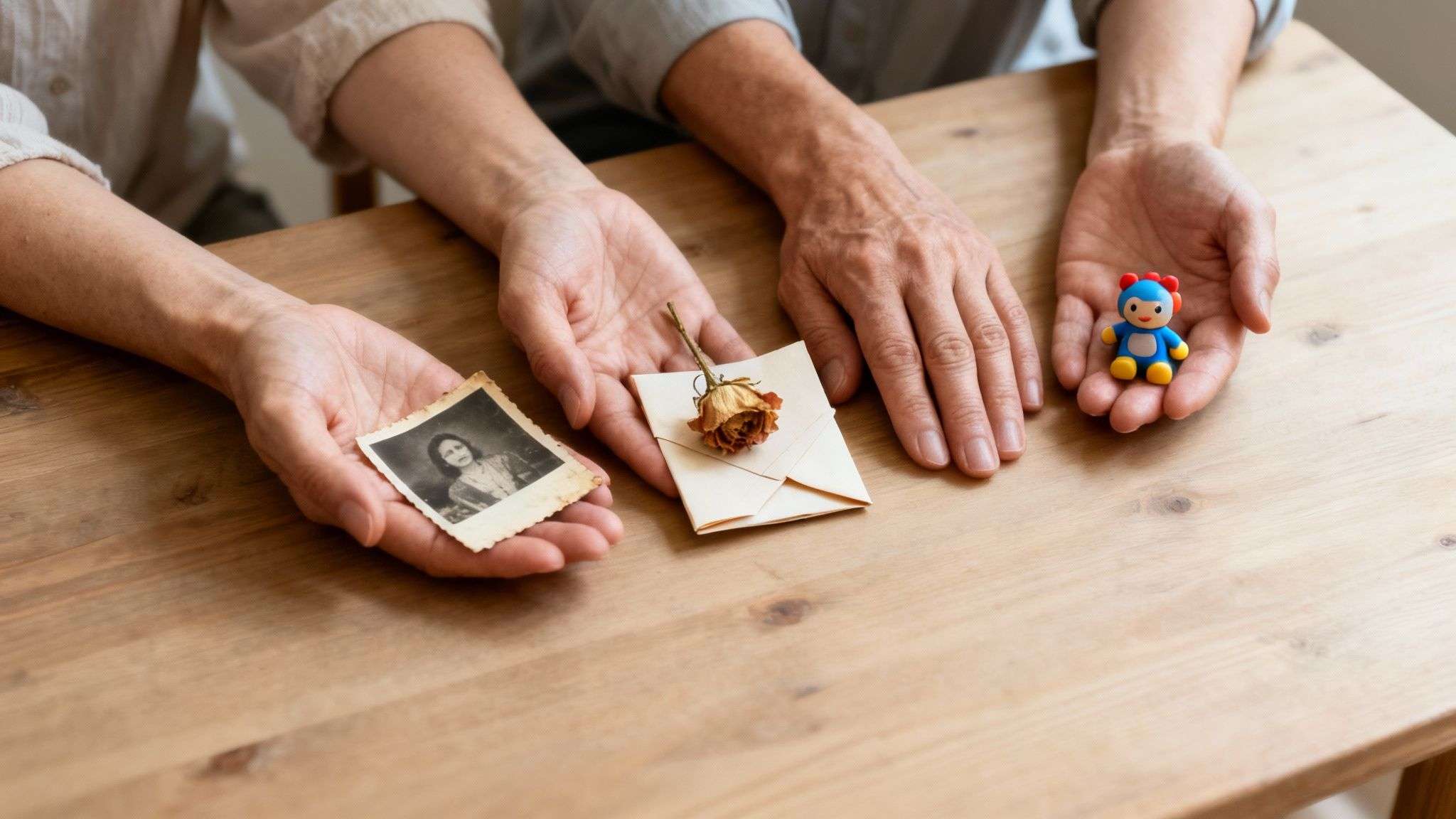
There’s a simple truth about grief that is both daunting and freeing: your grief is as unique as your fingerprint.
It’s shaped by the one-of-a-kind bond you had with the person, the pet, or the part of your life that you’ve lost. Forget any notion of neat stages or a predictable timeline. Real grief is often a messy, swirling collection of emotions that can crash over you in waves, sometimes when you least expect it.
Just knowing this can help you let go of the pressure to grieve in a certain “right” way. This journey is yours and yours alone. Every feeling that comes up is a valid part of that process.
Grief Shows Up in Many Forms
When we talk about dealing with grief, our minds usually go straight to the emotional side of things—the sadness, the anger, the guilt. And while those are absolutely central, grief is a whole-body, whole-mind experience. It can show up in ways that might completely surprise you.
Recognizing these different facets of grief can be incredibly validating. It helps you see that what you’re going through, however strange it feels, is normal.
Grief is a complex experience that touches every part of who we are. The table below outlines some of the common ways it can manifest, helping to normalize what you might be feeling in your own life.
| Domain | Common Experiences |
|---|---|
| Emotional | Overwhelming sadness, intense anger, deep loneliness, guilt, or even moments of relief. Feelings can change from one hour to the next. |
| Physical | Fatigue, aches and pains, a tight feeling in your chest, changes in appetite or sleep patterns, and even a weakened immune system. |
| Cognitive | "Grief brain" – a fog that makes it hard to concentrate, remember things, or make decisions. Disbelief and confusion are also common. |
| Spiritual | Questioning your foundational beliefs about the world, fairness, and your sense of purpose. Searching for new meaning in the wake of loss. |
Seeing these experiences laid out can be a relief. It reminds us that grief isn’t just an emotional event; it’s a seismic shift that reverberates through our entire being.
Not All Losses Look the Same
The nature of your loss has a huge impact on your grief. The slow, painful end of a long-term relationship brings a different kind of ache than the shocking, sudden death of a loved one. Both are profound and deeply felt, but the path forward will look very different.
Sometimes, the circumstances of a loss add another layer of complexity. Anticipatory grief, for instance, happens when you know a loss is coming, like with a terminal illness. You start grieving long before the person is actually gone, which can be an incredibly complicated and draining experience.
At other times, your grief can feel completely invisible to the outside world. This is known as disenfranchised grief. It might follow a miscarriage, the death of a cherished pet, or the end of a relationship that others didn't know about. When your loss isn't openly acknowledged by society, the sense of isolation can be crushing.
The COVID-19 pandemic reshaped our collective experience of loss in Canada. The disruption of traditional rituals and restricted access to loved ones in care amplified the pain for many. This shared and personal loss has deeply affected our communities, highlighting the importance of compassionate support systems.
The Role of Self-Compassion
As you figure out how to navigate your grief, the single most important tool you have is self-compassion. It’s simply the practice of treating yourself with the same kindness you would offer a dear friend who was hurting.
It means letting yourself have bad days without judging yourself for it. It means recognizing that you are doing the best you can in an impossibly difficult situation.
Self-compassion isn't about letting yourself off the hook. It’s about giving yourself the emotional space and support you need to actually heal. So, instead of asking, "Why am I not over this yet?" try shifting to a gentler question: "What do I need to feel supported right now?" That simple change in perspective can make all the difference in the world.
Practical Strategies for Coping Day by Day

When you're lost in the fog of grief, just getting through the next hour can feel like climbing a mountain. The key is to be incredibly gentle with yourself. Right now, it’s all about small, manageable actions that can give you a bit of solid ground when everything else feels like it's shifting beneath your feet.
Think of these strategies not as a to-do list for "getting over it," but as soft invitations to care for yourself when you're hurting most. Your only job is to breathe and take the next small step.
Allow Yourself to Feel Without Judgment
One of the kindest things you can do for yourself is to simply let your feelings be. It’s so easy to believe we need to be “strong” and push away the messy, painful emotions like sadness, anger, or guilt. But true strength in grief is found in the courage to be vulnerable.
This doesn't mean you have to let the feelings take over your life. It just means that when a wave of sadness crashes over you, you don't fight it. You acknowledge it. You can even name it: "Okay, anger is here right now," or "This sadness feels so heavy today." Just letting it exist without judging yourself for it can be a huge relief.
A few gentle ways to let those feelings move through you:
- Journaling: Let it all out on paper. Write a letter to the person you lost, scribble down your worries, or just let the jumbled thoughts flow. No one has to see it.
- Talking it out: Saying the words out loud to a friend, family member, or a counsellor can take away some of their power. You don't have to carry it all alone.
- Creative expression: Sometimes words aren’t enough. Try drawing, painting, or putting on a piece of music that matches your mood.
Create a Gentle Daily Structure
Grief can completely shatter your sense of routine, leaving you feeling untethered and lost. While a strict, rigid schedule is probably the last thing you need, creating a gentle, flexible rhythm for your day can be a lifeline. This isn't about being productive; it's about giving your mind and body a little predictability.
Just focus on the basics—small, consistent things that support your well-being. Think of it as building a soft container to hold you through the day, one that offers support without feeling restrictive.
A simple, supportive structure could be built around these core elements:
- Nourishment: Try to have small, regular meals, even if you have no appetite. Stick to simple, comforting foods that don’t require a lot of effort.
- Movement: Gentle movement can help release some of the tension grief stores in your body. It could be as simple as a slow walk around the block, a few easy stretches, or even just sitting by an open window for some fresh air.
- Rest: Grief is exhausting, physically and emotionally. Give yourself permission to rest whenever you need it, and don't feel guilty about it. Naps are okay. Quiet, do-nothing time is okay.
This basic framework helps make sure your fundamental needs are met, creating a stable base from which you can begin to navigate the emotional work of grieving.
Honour Your Loss with Small Rituals
Rituals can be incredibly grounding when you feel adrift. They offer a tangible way to honour the person you lost, maintain a sense of connection, and make dedicated space for your memories. These don't have to be big, formal gestures. In fact, it's often the small, personal rituals that hold the most meaning.
A ritual is simply a way to create a deliberate moment to remember and to feel. It’s a way of saying, "This mattered. You mattered." It helps you integrate the reality of the loss while keeping the love you shared alive.
Think about what might feel comforting or right for you. It could be anything:
- Lighting a special candle each evening in their memory.
- Playing their favourite album while you make your morning coffee.
- Creating a "memory box" filled with photos, ticket stubs, and small objects that remind you of them.
- Continuing a simple tradition you once shared, like going for a walk in a particular park.
These small acts become touchstones of comfort. They are your private, personal way of tending to your grief and carrying your loved one's memory forward. The goal isn't to live in the past, but to build a bridge between the life you had and the one you are now learning to live. Choosing what feels supportive is an empowering part of learning how to deal with grief.
Grieving at Work and in Your Community
Grief isn’t something you can neatly pack away and leave at home. It follows you into the office, sits with you at the dinner table with friends, and changes how you exist in the world. If you’re finding it impossible to focus on a spreadsheet or feeling a million miles away during a party, that’s not a sign you’re failing. It’s a sign you’re human, and you’re grieving.
It’s completely unrealistic to expect yourself to just switch off a profound loss the moment you clock in or show up for a social event. Giving yourself permission to see this ripple effect for what it is can be a huge relief. It normalizes what you're going through and makes the whole experience feel a little less lonely.
The Reality of Grieving at Work
Trying to do your job while carrying the weight of grief can feel like swimming through molasses. That "grief brain" we talked about—the fog that makes it hard to string a thought together—doesn't politely vanish between nine and five. You might find yourself staring at a deadline with zero motivation, making simple mistakes, or feeling utterly drained by tasks that used to be easy.
This isn't just in your head; it's a real, measurable phenomenon. In Canada, the economic toll of unsupported grief can be significant. Research from 2021 showed that productivity loss due to grief resulted in major economic costs, fueling issues like absenteeism and presenteeism (where you're at work but not fully functional). To grasp the full scale of this, you can read the full research about these findings.
Knowing this validates your experience. If work feels harder right now, it’s because it is harder. You’re processing one of life’s most demanding events, and that takes a tremendous amount of energy.
Building Communities That Understand Grief
Just as grief walks into our workplaces, it also reshapes our social circles. A truly supportive community is one that has what we call grief literacy—a genuine understanding of what grief actually looks like and how to respond with compassion instead of awkward platitudes.
A grief-literate community doesn't try to rush you through the process or tell you to "get over it." It holds space for the messiness.
So, what does that look like in the real world?
- Flexible Support: It’s friends and colleagues who get that grief isn't a straight line. They don't expect you to be "back to normal" in a few weeks.
- Real Talk: It’s people who are willing to just listen without jumping in with unsolicited advice. They might say, "This must be so hard," instead of, "I know exactly how you feel."
- Practical Help: It’s the neighbour who drops off a lasagna, no questions asked. The coworker who offers to take a meeting for you. The friend who is content to just sit with you in silence.
- Better Systems: It’s workplaces that have flexible bereavement policies that recognize that loss comes in many forms and that families don't all look the same.
Asking for What You Need
Understanding that grief touches every part of your life can empower you to advocate for yourself. It reframes your struggles not as a personal weakness, but as a legitimate response to loss that deserves support.
Take a moment to think about what might actually help right now. Could you talk to your manager about shifting your deadlines for a bit? Maybe you need to tell your friends that big parties are out for a while, but you’d love for them to check in with a text.
Learning to navigate grief involves recognizing its reach. When you see your experience as part of a larger social and professional picture, it can give you the confidence to ask for the understanding and accommodations you need. Whether that support comes from your boss, your best friend, or a compassionate professional, asking for it is a courageous step forward.
Supporting Grieving Children and Young People

When your family is grieving, helping your children through it can feel like one of the most overwhelming challenges you’ll ever face. It’s completely natural to want to shield them from pain. But guiding them through loss with honesty and age-appropriate support is one of the most profound acts of love you can offer. You are their safe place, and figuring this out together is what will help them heal.
It's also so important to remember that you're not just a caregiver right now; you're grieving, too. Trying to support your child while carrying your own heartbreak is incredibly hard. Please be gentle with yourself. You don’t need to have all the perfect words. Your presence, your honesty, and your reassurance are what they’ll remember most.
How Children Show Their Grief
Unlike adults who might experience sadness as a constant, heavy blanket, children often grieve in bursts. One minute they might be overcome with tears, and the next, they're running around the garden playing. This is completely normal. It doesn't mean they aren't feeling the loss just as deeply.
A young person's grief often comes out through their behaviour, not their words. You might notice things like:
- Regression: A younger child who was potty-trained might start having accidents or wanting to suck their thumb again.
- Physical Symptoms: Complaints about stomach aches or headaches with no clear medical cause are very common.
- Changes in Play: They might start acting out themes of death, loss, or being left alone in their games with dolls or action figures.
- Emotional Outbursts: A sudden increase in irritability, anger, or clinginess can all be signs of a deep sadness they don't know how to express.
Recognizing these behaviours as signals of grief can help you respond with empathy instead of frustration. Their entire world has been shaken, and their actions are often just their way of trying to make sense of feelings that are too big to put into words. For caregivers, understanding the nuances of a child’s inner world is essential, and you can explore more about supporting children's emotional development in our related resources.
Talking About Loss Honestly and Gently
When you talk about what’s happened, using clear, simple, and honest language is key. Euphemisms like "went to sleep" or "we lost them" can be incredibly confusing and even frightening for a young child. It's much clearer and kinder in the long run to use direct words like "died," and then explain in simple terms that their body stopped working and they can’t come back.
This conversation will naturally look different for a four-year-old than for a teenager, but the foundation is the same: be honest, answer their questions as simply as you can, and shower them with reassurance that they are safe and loved.
Age-Appropriate Ways to Support Grieving Children
| Age Group | Understanding of Loss | Supportive Actions |
|---|---|---|
| 0–2 Years | Senses changes in routines and caregiver's emotions. | Maintain routines. Provide lots of physical comfort like hugs and cuddles. Use a soothing tone of voice. |
| 3–5 Years | Sees death as temporary and reversible. May ask repetitive questions about when the person is coming back. | Use simple, concrete language (e.g., "Grandma died. Her body stopped working."). Be patient with repeated questions. Reassure them they are not to blame. |
| 6–9 Years | Begins to understand death is final but may personify it (e.g., as a monster). Can develop fears about others dying. | Encourage them to draw or write about their feelings. Answer questions about what happens after death honestly and based on your family's beliefs. Reassure them of their own safety. |
| 10–12 Years | Understands the finality of death. May show interest in the biological process and rituals around death. | Allow them to participate in memorials or rituals if they wish. Create a memory box. Encourage them to talk to trusted adults. |
| Teens (13+) | Has an adult understanding of death. May struggle with existential questions and feel intense, complex emotions. | Respect their need for space but keep lines of communication open. Don't be afraid to share your own feelings. Encourage peer support and creative outlets. Validate their anger or sadness. |
Remember, these are just guidelines. The most important thing is to follow your child’s lead, listen more than you talk, and create a safe space for any and all feelings to be expressed.
Creating Stability and Rituals of Remembrance
In the middle of so much chaos, routines are an anchor. Sticking to regular schedules for meals, school, and bedtime as much as possible can help a child feel secure when their world has been turned upside down.
Involving children in rituals can also be a powerful way to help them process their grief, giving them a tangible way to remember and say goodbye. You could try things like:
- Creating a memory box together, filling it with photos, ticket stubs, and other special objects.
- Planting a tree or a special flower in the person’s honour.
- Looking through photo albums and sharing your favourite stories.
- Lighting a candle on special anniversary dates.
These simple acts give children a sense of agency and a way to maintain a connection to the person they’ve lost. The need for strong bereavement support for young people is a growing concern in Canada, highlighting the importance of accessible resources for grieving families across the country.
When to Seek Professional Support for Your Grief
Grief is a deeply personal journey, and for the most part, we navigate its rough terrain with the support of friends, family, and our own resilience. But sometimes, the weight of a loss feels too heavy to carry alone.
Reaching out for professional help isn't a sign of weakness—far from it. It's a courageous act of self-care. It’s a testament to your strength and your desire to heal.
Knowing when to make that call can be confusing, especially when you’re already feeling overwhelmed. There’s no timeline for grief, and it’s not about judging your pain. It’s about recognizing when that pain has become so constant that it gets in the way of your ability to function and find even small moments of peace.
Signs It Might Be Time to Talk to Someone
If your grief feels stuck on a loop, relentlessly affecting your daily life for months on end, it might be what some experts call prolonged or complicated grief. This isn't a label to be afraid of; it’s just a way of recognizing that you deserve extra, specialized support.
You might be experiencing this if, several months after your loss, you still feel:
- Stuck in Intense Pain: The raw, acute pain of the early days hasn’t softened or changed at all.
- Persistent Numbness: You feel emotionally cut off from others and can’t seem to access positive feelings.
- Difficulty with Daily Life: Simple things like getting out of bed, going to work, or caring for your family feel impossible most days.
- Intense Longing: The yearning for the person you lost is so powerful that it completely overshadows everything else.
- Social Withdrawal: You’re actively avoiding friends, family, and the activities you used to enjoy.
- Feelings of Worthlessness: You’ve started to believe life isn’t worth living without your loved one, or you're consumed by guilt about the loss.
If these points resonate, it doesn't mean you're grieving "wrong." It simply means a compassionate, trained professional could offer the tools and the safe space you need to start processing your loss in a new way.
What to Expect from Grief Counselling
The idea of starting therapy can feel daunting, but a grief counsellor’s job is to walk alongside you, not to push you or rush you through your pain. They provide a confidential, non-judgmental space where you can untangle the complexities of your loss. Modern therapy uses gentle, evidence-based approaches to help you learn to live with your grief.
Here are a couple of common therapeutic approaches you might encounter:
- Cognitive Behavioural Therapy (CBT): This approach helps you gently notice and reframe thought patterns that might be keeping you stuck. For instance, a counsellor could help you explore persistent feelings of guilt or self-blame that are tied to the loss, giving you new perspectives to consider.
- Acceptance and Commitment Therapy (ACT): Instead of trying to get rid of painful feelings, ACT helps you learn to acknowledge them without letting them run your life. The focus is on clarifying what truly matters to you now and taking small, meaningful steps toward a life that honours both your loss and your future.
A therapist can offer strategies tailored to your unique experience. By exploring the support available through grief counselling, you can find a dedicated space to heal and learn to carry your loss with greater peace.
Common Questions About Grief and Healing
When you're navigating the landscape of grief, a lot of questions can surface that feel urgent and confusing. Having clear, compassionate answers can be a small comfort when you feel completely lost. Here, we'll walk through some of the most common questions that come up as you heal.
How Long Does the Grieving Process Last?
This is probably the question we hear most often, and the honest answer is there’s no set timeline. Grief isn't something you get over, like a cold. It's not a linear process with a finish line; it’s a lifelong journey of integrating this loss into who you are now.
The intense, all-consuming pain you feel at the beginning will soften. It will change. But the loss will always be a part of your story. Healing isn’t about leaving the loss behind; it’s about learning how to carry it with you.
Is It Normal to Feel Angry at the Person I Lost?
Yes, it is completely and totally normal. Anger is a common—and often very confusing—part of grieving.
You might feel angry about things that were left unsaid, choices they made, or simply for the fact that they left you behind. This anger doesn't cancel out your love. In fact, it's often a reflection of the depth of your connection and the searing pain of their absence. Acknowledging that anger, without judging yourself for it, is a healthy and necessary part of working through your loss.
What Is the Best Way to Support Someone Who Is Grieving?
The most valuable thing you can offer is your consistent, non-judgmental presence. Most people mean well, but a vague "Let me know if you need anything" can feel like another task for the grieving person to manage.
Instead, try offering specific, practical help. Think: "I'm dropping off dinner for you on Tuesday," or "Can I walk the dog for you this afternoon?"
More than anything, just listen. Give them the space to share stories and feelings without you trying to fix their pain or offer empty platitudes. Simply being a safe place for their grief to land is an incredible gift.
How Can I Navigate Holidays and Anniversaries After a Loss?
Special occasions can feel like walking through a minefield. The key is to be intentional and give yourself permission to do whatever feels right for you—and know that what feels right might change from one year to the next.
- Plan Ahead: Talk with your family and decide if you want to honour old traditions, create new ones, or even skip the occasion altogether this year. There are no rules.
- Communicate Your Needs: Be honest with family and friends about what you can and cannot handle. It's okay to set boundaries.
- Create a Ritual: Find a small way to honour their presence in your life. You could light a candle, share a favourite memory, or make their favourite meal.
Why Does My Grief Sometimes Feel Worse Months or Years Later?
Grief isn't a straight line; it comes in waves. Sometimes, months or even years after a loss, a wave of grief can hit that feels just as intense as it did in the beginning.
This can be triggered by anything—a new life milestone they aren’t here to see, a song on the radio, or sometimes for no clear reason at all. This resurgence isn't a step backward. It's a testament to the enduring love and connection you shared.
At Interactive Counselling, our compassionate team is here to provide a safe space where you can explore your grief without judgment. We offer gentle, evidence-based support to help you navigate your unique healing journey. Learn more about our approach to counselling.
Clinically Reviewed By
Amy Mosset, MCP, RCC-S
Amy Mosset is a Master Practitioner in Clinical Counselling, Clinical Supervisor, and the owner of Interactive Counselling. She provides trauma-informed, evidence-based care and clinical supervision to registered therapists, with a focus on ethical practice, client safety, and high-quality therapeutic outcomes.