It’s an exhausting way to live—feeling like you're constantly on trial inside your own head. If you're navigating both a harsh inner critic and persistent anxiety, you know this internal courtroom drama all too well. One part of you acts as the prosecutor, endlessly scrutinizing your past actions, while another part of you nervously anticipates future failures. This creates a relentless cycle of self-judgment, fear, and the draining feeling that you can never quite measure up. For more information, see our anxiety counselling.
While the inner critic judges your past actions and worth, anxiety focuses on future threats, creating a painful cycle where your mind feels perpetually on trial.
Defining the Key Players: Your Inner Critic and Your Anxiety
To start untangling that tight knot of self-judgment and worry, it’s helpful to get a clear picture of who’s talking. While they often feel like they’re working together, your inner critic and your anxiety are actually two distinct players in your mind’s inner courtroom. Each has its own motivations and tactics. Learning to tell which one is speaking is a huge first step toward finding some relief.
The Harsh Judge: Your Inner Critic
Think of the inner critic as the voice of judgment you’ve internalized over years. It’s the part of you that has absorbed every piece of criticism, every societal expectation, and every perceived failure, and now it plays those messages back to you on a loop. This voice sounds absolute, deeply personal, and often quite cruel.
Its primary function is a misguided attempt to push you toward self-improvement through harshness. It operates on the flawed belief that if it points out your flaws relentlessly, you'll finally be motivated to fix them.
Here are some of its signature traits:
- Focus on the Past: The critic is an expert historian of your every mistake. It loves digging up old embarrassments or failures as "evidence" of your inherent inadequacy.
- Harsh, Absolute Language: It speaks in definitive, black-and-white terms like “always,” “never,” and “should.” You might hear thoughts like, "You always mess things up," or "You're just not good enough."
- Emotions Triggered: Its primary emotional weapons are shame, guilt, and a feeling of worthlessness. It wants you to feel bad about who you are based on things you’ve done.
This framework helps visualize the mind on trial, where the inner critic delivers a harsh judgment while anxiety relentlessly cross-examines every possible outcome.
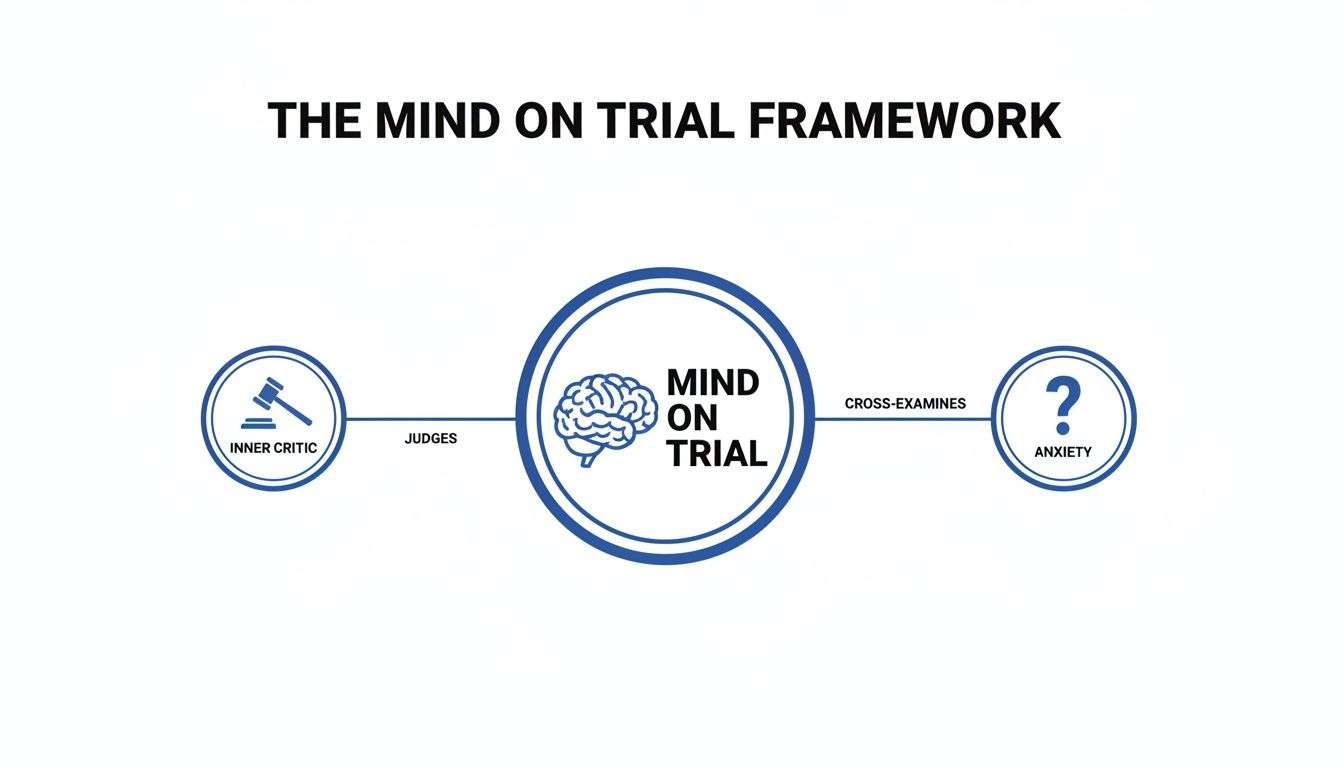
The Overprotective Alarm System: Your Anxiety
In contrast, anxiety is fundamentally a future-focused survival mechanism. Its entire job is to keep you safe by scanning for potential threats. The problem is, it often becomes overactive, treating everyday uncertainties as if they were life-or-death situations. It’s less about judging who you are and more about worrying what might happen to you.
Anxiety’s main characteristics include:
- Focus on the Future: It lives in the land of "what if?" It generates an endless stream of worst-case scenarios about upcoming events, from a simple work presentation to a casual social gathering.
- Questioning, Uncertain Language: Anxiety’s voice is filled with doubt and catastrophic questions. It sounds like, "What if I make a fool of myself?" or "What if something terrible happens?"
- Emotions Triggered: It produces feelings of fear, dread, and a powerful physical unease (think racing heart, tense muscles, or a knot in your stomach). Its goal is to keep you safe through constant hyper-vigilance.
Comparing the Inner Critic and Anxiety
| Characteristic | The Inner Critic | Anxiety |
|---|---|---|
| Primary Focus | The past (mistakes, failures) | The future (threats, uncertainties) |
| Core Message | "You are flawed/not good enough." | "You are in danger/unsafe." |
| Language Style | Declarative, absolute, judgmental ("You always…") | Questioning, catastrophic, uncertain ("What if…") |
| Key Emotions | Shame, guilt, worthlessness | Fear, dread, panic, unease |
| Main Goal | To "fix" you through harsh criticism | To protect you through avoidance and worry |
Recognizing these key differences is incredibly powerful. The critic attacks your character based on the past, while anxiety attacks your sense of safety based on the future. Pinpointing the unique symptoms of an anxiety disorder can offer even more clarity.
Once you learn to distinguish these voices, you can start to challenge their narratives and begin the work of reclaiming your inner peace.
The Vicious Cycle: How the Critic and Anxiety Fuel Each Other
Your inner critic and anxiety are rarely solo acts. More often than not, they form a destructive partnership, creating a powerful feedback loop that can leave you feeling trapped and completely drained. The first step to breaking free is understanding how they work together to keep you stuck.

This cycle usually kicks off with something small—an event that your inner critic, acting as the prosecutor in your mind’s courtroom, latches onto.
The Critic Delivers the Opening Statement
Let’s say you get some constructive feedback at work. It’s not a huge deal, but your inner critic immediately seizes the moment. It doesn’t just hear feedback; it hears proof of your deepest fears about yourself.
Right on cue, a critical thought pops up: “This just proves you’re incompetent. You can’t do anything right.”
That initial judgment is harsh, absolute, and usually digs into old insecurities. It’s a direct hit on your character, meant to trigger shame and feelings of inadequacy. This is the first domino to fall.
Anxiety Takes the Stand with Catastrophic Predictions
That one sharp thought is all the fuel anxiety needs. It grabs the critic’s verdict and spins it into a dozen terrifying future scenarios.
Suddenly, the anxiety voice joins in with a flood of "what-ifs":
- “What if my boss thinks I’m a total fraud?”
- “What if everyone on the team is talking about my mistake?”
- “What if I get fired over this?”
And just like that, a minor piece of feedback has spiralled into a full-blown career catastrophe inside your head. This is anxiety's job in the cycle—to take a present-moment judgment and project it onto a future filled with danger and dread.
As these thoughts ramp up, your body gets in on the act. Your heart might start racing, your palms get sweaty, and your muscles tense up. This is your body’s alarm system, preparing you for a threat that, in this case, exists only in your mind.
The Critic Uses Anxiety as New Evidence
This is where the cycle really gets vicious. Your inner critic observes your physical and emotional reaction—the racing heart, the panic—and takes it as more evidence of your incompetence.
It then delivers its closing argument: “See? You can’t even handle a little stress. You’re weak and falling apart. This just proves you’re not cut out for this.”
This toxic feedback loop becomes self-sustaining. The critic’s judgments create anxiety, and the physical symptoms of anxiety then seem to validate the critic’s harsh beliefs. You’re trapped in a courtroom where you’re the prosecutor, the defendant, and the panicked witness, all at once.
Psychological Mechanisms That Lock the Cycle in Place
Two key psychological patterns act like glue, holding this destructive cycle together and making it feel almost impossible to escape. Recognizing them is your first step toward breaking their hold.
1. Rumination
This is the mental habit of repetitively replaying negative thoughts and worries. When the critic lands a harsh judgment, rumination is what keeps that thought on a loop in your mind. It’s like a stuck record, preventing you from ever moving on.
2. Confirmation Bias
This is our natural tendency to look for information that confirms what we already believe. If your inner critic tells you you’re a failure, confirmation bias sends you on a mission to find any shred of evidence that supports this, while completely ignoring anything that contradicts it. You'll fixate on the one negative comment in a sea of praise because it fits the critic's narrative.
By understanding how the critic’s judgment triggers anxiety’s predictions—and how anxiety’s physical symptoms then reinforce the critic’s beliefs—you can start to see this pattern for what it is. It’s not a reflection of your true worth, but a learned cycle of thought. The next step is learning how to gently interrupt it.
The Real-World Fallout: How This Internal Trial Shapes Your Life
When your mind feels like it's perpetually on trial, the consequences aren't just in your head. This constant internal battle—the inner critic as prosecutor and anxiety as the panicked witness—spills over into every corner of your life, from your career and relationships to your basic sense of well-being.
Living this way is like trying to run a marathon with a low-grade fever. It's a constant drain on your mental and emotional energy, leaving you too exhausted to show up for your own life.
Your Confidence Takes a Beating
Perhaps the most damaging outcome is the slow, steady erosion of your self-esteem. Your inner critic’s relentless barrage of judgments chips away at your sense of self-worth, making it almost impossible to recognise your own strengths or celebrate your wins.
Soon enough, you’re plagued by chronic self-doubt. You second-guess every decision, not because you're indecisive, but because you're terrified of the critic's brutal verdict if you choose "wrong." Over time, this can cement a deep-seated belief that you're just not good enough, a belief that often becomes a self-fulfilling prophecy.
This internal dynamic is especially tough for young people. According to Statistics Canada, the rate of diagnosed anxiety disorders among adolescents more than doubled between 2011 and 2018. This sharp increase highlights how the inner critic and anxiety can team up, making young people feel constantly judged. It's a snapshot of a growing mental health crisis where negative self-talk fuels worries about school, friendships, and the future, trapping them in a cycle of self-doubt.
Why You Procrastinate and Avoid Opportunities
The fear of judgment is a powerful de-motivator. When every potential move is scrutinized by your inner critic and met with a storm of anxious "what-ifs," doing nothing often feels like the safest option.
This is the root of so much procrastination and avoidance.
- Saying "no" to new challenges: You might pass on a promotion or avoid learning a new skill because the critic whispers, "You'll fail," while anxiety shows you a full-colour movie of the public humiliation to follow.
- Hiding behind perfectionism: You spend hours agonizing over a simple email, trying to make it flawless. This isn't about maintaining high standards; it's a desperate attempt to shield yourself from any possible criticism.
- Staying in your comfort zone: The world outside your safe zone feels like a courtroom filled with potential judges. Staying small and avoiding risks feels safer, but it also means sacrificing growth and fulfillment.
The Toll on Your Relationships
This internal trial doesn't happen in a vacuum—it absolutely affects how you connect with others. In your relationships, it often shows up as deep insecurity. You might find yourself constantly needing reassurance, asking your partner if they're upset or if they still love you, because your inner critic is screaming that you're unlovable.
Socially, the fear of being judged can be paralyzing. You might start ducking out of plans with friends or avoiding parties altogether, convinced that everyone is secretly picking you apart. This social anxiety is really just the external symptom of an internal trial, where you assume everyone else is on the prosecution's side.
Ultimately, living with a mind on trial is an exhausting and deeply isolating way to go through life. By understanding how these internal battles create real-world consequences, you can see why it’s so crucial to find a way to silence the court and build a more compassionate inner world.
Strategies to Adjourn the Court and Find Peace
Feeling like your mind is constantly on trial is exhausting. But the good news? You don't have to live in that courtroom forever. The goal isn’t to banish your inner critic or erase anxiety completely—they’re often deeply ingrained parts of us. Instead, it’s about changing your relationship with them. You can learn to step out of the defendant’s box and become a compassionate observer of your own mind.

This process isn't about fighting a battle but learning practical, evidence-based ways to gently question the critic’s harsh judgments and soothe anxiety’s frantic alarms. By doing this, you can start to bring a real sense of balance and peace back into your life.
Challenge the Prosecution with Cognitive Reframing
The arguments from your inner critic often sound like cold, hard facts. In reality, they're usually built on a foundation of cognitive distortions—thought patterns that twist reality until it’s barely recognisable. Just learning to spot these distortions is the first, crucial step toward dismantling the critic’s case.
Here are a few common culprits:
- All-or-Nothing Thinking: Seeing everything in black and white. If your performance wasn't perfect, you immediately label it a total failure.
- Overgeneralisation: You take one negative event and spin it into a never-ending pattern of defeat. You spill your coffee and think, "Typical. I ruin everything."
- Personalisation: This is when you blame yourself for things that aren't entirely your fault. A friend seems distant, and your first thought is, "What did I do wrong?"
Once you can put a name to the distortion, you can start to question it. Ask yourself, "Okay, where's the actual evidence for this thought? Is there a more balanced way of looking at this?" It’s not about getting into an argument with yourself, but about introducing a more reasonable voice into the courtroom.
Use Mindfulness to Calm the Panicked Witness
When anxiety floods your system, trying to think rationally feels like trying to have a calm conversation in the middle of a hurricane. The key isn't to fight the feeling, but to anchor yourself in the present moment. That's where mindfulness and grounding come in. These practices help calm your nervous system, sending a powerful signal to your brain that you are, in fact, safe.
Here’s a simple but incredibly effective exercise to try the next time you feel overwhelmed:
The 5-4-3-2-1 Grounding Technique
Take a slow, deep breath, and then gently notice:
- 5 things you can see: Look around and name five objects without judging them (e.g., a lamp, a blue mug, a scuff on the floor).
- 4 things you can feel: Bring your attention to the physical sensations right now (e.g., the texture of your jeans, the solid chair beneath you, the cool air on your skin).
- 3 things you can hear: Listen for three distinct sounds (e.g., the hum of the fridge, birds outside, your own quiet breathing).
- 2 things you can smell: Notice any scents in your environment (e.g., old coffee, a nearby plant, the pages of a book).
- 1 thing you can taste: Focus on the taste in your mouth or take a slow sip of water.
This simple act can interrupt the frantic spin cycle of anxious thoughts. It brings your focus back to the here and now, which often has a wonderful side effect of quieting that persistent inner critic. If you want to explore this further, you can learn more about these kinds of therapist-backed strategies that work.
Cultivate Self-Compassion as Your Defence Attorney
If the inner critic is the harsh prosecutor, self-compassion is your expert defence attorney. It's probably the most powerful antidote we have. It means treating yourself with the same kindness and understanding you would offer a good friend who was going through a tough time. It isn't about letting yourself off the hook; it’s about acknowledging that being imperfect is simply part of being human.
You can start practicing self-compassion by focusing on its three core components:
- Mindfulness: First, just acknowledge your painful thoughts without judgment. Instead of fighting them, you can gently say to yourself, "This is a moment of suffering."
- Common Humanity: Remind yourself that you aren't alone in this. Everyone makes mistakes. Everyone feels inadequate sometimes. It's a shared experience that connects you to others, rather than isolating you.
- Self-Kindness: Actively soothe yourself with gentle words. Instead of, "You're so stupid," try something like, "You did the best you could, and it's okay to feel upset about this."
Exploring the power of journaling is another highly effective way to manage these internal dialogues. Simply writing down your critical thoughts and then responding to them on the page with compassionate words can fundamentally shift your inner world.
When you consistently practice these strategies, you start to change the entire atmosphere of your mind. The courtroom quiets down, the judge becomes kinder, and you can finally find the peace you deserve.
When to Seek Professional Support for Your Mental Health
Self-help strategies can be incredibly powerful for quietening that internal courtroom, but sometimes the trial feels too overwhelming to manage on your own. Deciding to seek professional support isn't a sign of failure—it's a profound act of strength and self-care. It’s an admission that you deserve a dedicated space and an experienced guide to help you find your way back to a sense of peace.
If the constant battle between your inner critic and anxiety is making it difficult to just get through the day, it might be time to reach out.
Recognizing the Signs
It can be tough to know when to ask for help, especially when you're already feeling swamped by it all. If you start to notice any of the following patterns, it’s a good signal that speaking with a professional could make a real difference:
- Significant Disruption to Daily Life: Your internal struggles are consistently getting in the way of your work, relationships, or even basic things like sleeping and eating.
- Feeling Stuck or Hopeless: You've tried different strategies, but you still feel trapped in a cycle of worry and self-criticism with no clear way out.
- Over-reliance on Unhealthy Coping Mechanisms: You find yourself turning to substances or just avoiding situations more and more to numb the internal noise. It's also worth understanding how external factors might be making things worse—for example, looking into whether can alcohol cause panic attacks can be a crucial piece of the puzzle.
- Your Relationships are Suffering: You notice that your constant need for reassurance or your tendency to withdraw from social events is creating a strain with the people you care about most.
According to recent mental healthcare findings from CIHI, major gaps in mental health access mean that a significant portion of Canadian adults with diagnosed disorders face unmet needs. This reality can make it feel like the inner critic and anxiety truly have us perpetually on trial, highlighting how important it is to find evidence-based support to quiet that inner critic and get your real-life needs met.
How Therapy Can Help
Evidence-based therapies offer a structured, compassionate way to dismantle that internal courtroom. Approaches like Cognitive Behavioural Therapy (CBT), for instance, give you practical tools to spot and challenge the distorted thoughts fuelling both your critic and your anxiety. On the other hand, Acceptance and Commitment Therapy (ACT) helps you change your relationship with these difficult thoughts, which takes away a lot of their power over you.
Reaching out for professional counselling is about finding a collaborative path forward. It gives you a safe, non-judgmental space to explore these patterns and build lasting resilience, so you can finally adjourn the court for good.
Your Questions, Answered
When you're trying to untangle the inner critic from anxiety, it's natural to have questions. Let's walk through some of the most common ones with clear, supportive answers.
Can I Get Rid of My Inner Critic for Good?
It's a common wish, but the goal isn't really to silence that voice forever. Believe it or not, the inner critic often starts as a clumsy, misguided attempt to protect you or push you to be better. A much more effective—and gentler—approach is to change your relationship with it. Think of it less like an enemy to be defeated and more like a harsh judge you can learn to reason with. The aim is to lower its volume and help it become a more discerning, genuinely helpful part of you, not to get rid of it entirely.
Is My Self-Criticism Helpful or Just Hurtful?
There's a big difference between healthy self-reflection and harmful self-criticism. It really comes down to focus and feeling. Helpful feedback is specific, kind, and focuses on your actions—things you can actually change. It sounds like, “I wish I’d prepared more for that meeting. Next time, I’ll block out some time the day before.” It inspires you to solve a problem. Harmful criticism is the opposite: it's vague, personal, and feels final. It attacks who you are, not what you did. It's the voice that says, "I'm a total failure." All it does is leave you feeling stuck and ashamed.
What's the Very First Thing to Do When I Feel Overwhelmed?
When your mind is racing with criticism and anxiety, the most powerful first step is also the simplest: just pause and take a conscious breath. It sounds small, but that single action can interrupt the downward spiral and give your nervous system a moment to reset. Once you have that tiny bit of space, try a grounding technique. The 5-4-3-2-1 method is a great one for pulling your attention back to the present moment. Noticing your surroundings helps you see your thoughts for what they are—just thoughts, not facts.
Can You Have Anxiety Without an Inner Critic?
Absolutely. Anxiety is a fundamental human response to what we perceive as a threat. It’s wired into our survival instincts. You can feel anxious about an upcoming presentation or a strange physical symptom without any critical self-talk at all. That said, the two often work hand in hand. Your inner critic can easily trigger a wave of anxiety, and in turn, the shaky hands or racing heart that come with anxiety can feel like "proof" to your inner critic that you really aren't good enough. It’s a tough cycle.
Finding your way to a calmer, kinder inner world is a personal journey. If you feel like you could use some professional, compassionate guidance to navigate these patterns, we invite you to learn more about how we can help.
Clinically Reviewed By
Amy Mosset, MCP, RCC-S
Amy Mosset is a Master Practitioner in Clinical Counselling, Clinical Supervisor, and the owner of Interactive Counselling. She provides trauma-informed, evidence-based care and clinical supervision to registered therapists, with a focus on ethical practice, client safety, and high-quality therapeutic outcomes.