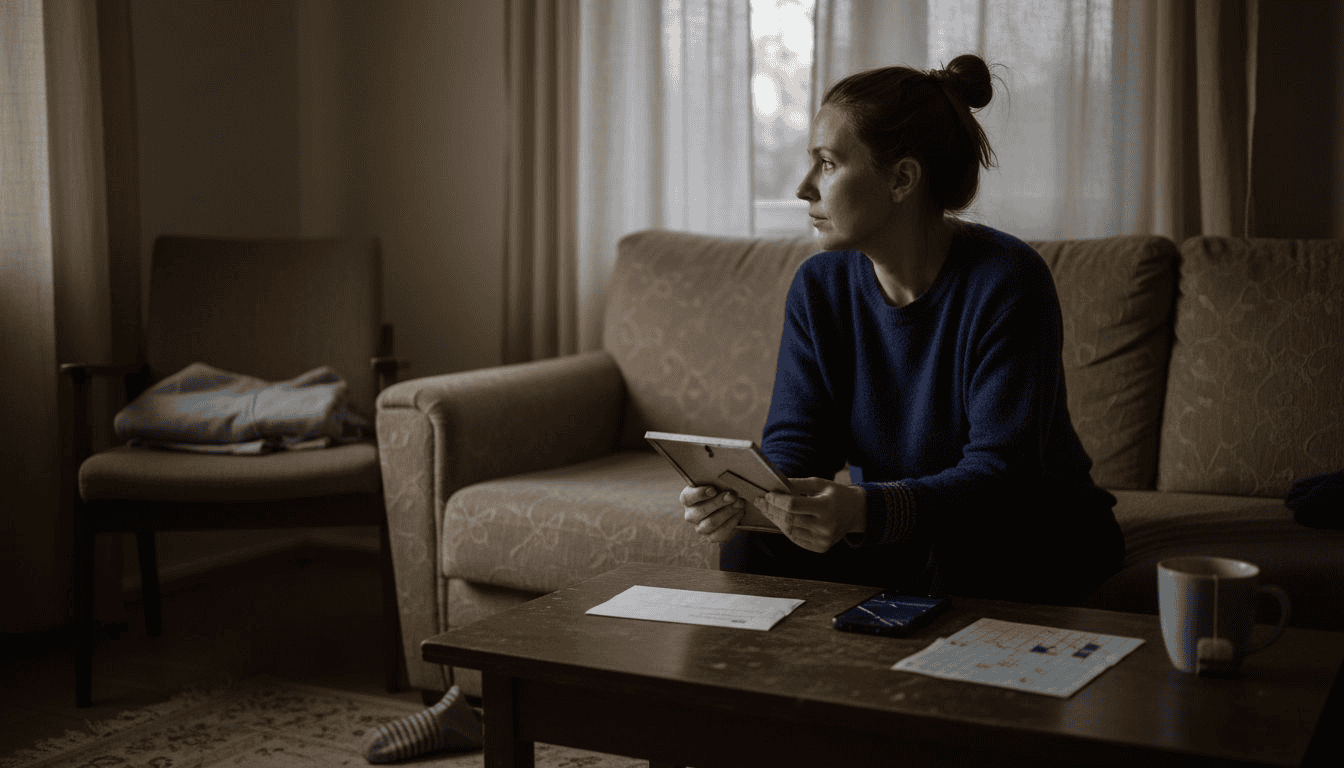
Grieving a loss that few people recognize can leave you feeling unseen and alone. Many adults across Canada experience heartache when the end of a relationship, the loss of a pet, or other life changes are not met with the same compassion as more socially accepted losses. Disenfranchised grief is real and often misunderstood, making it difficult to find meaningful support. Understanding this kind of hidden sorrow is the first step toward finding healing resources and reclaiming your right to mourn. For more information, see our grief counselling.
Table of Contents
- Defining Disenfranchised Grief In Canada
- Types Of Losses Often Unrecognised
- Why Society Minimizes Certain Grief
- Signs And Emotional Impact Of Invalidated Grief
- Healthy Coping And Paths To Healing
- How Grief Counselling Provides Validation
- Common Questions About Disenfranchised Grief
Key Takeaways
| Point | Details |
|---|---|
| Understanding Disenfranchised Grief | Disenfranchised grief is experienced when a loss is not socially recognised or validated, leading to isolation and compounded pain. |
| Recognising Various Losses | Losses such as estranged relationships, pet deaths, and miscarriages are often minimised, yet they hold significant emotional weight. |
| Seeking Validation and Support | Connecting with supportive communities and professionals helps individuals process their grief and reduces feelings of isolation. |
| Engaging in Rituals | Creating personal rituals or finding creative outlets can provide meaningful ways to acknowledge and express grief. |
Defining disenfranchised grief in Canada
Grief is often portrayed as a straightforward process. Someone dies, people mourn, life gradually continues. But not all losses fit this neat narrative, and not all grief receives social acknowledgment. Disenfranchised grief is the pain you feel when your loss is not openly recognised or socially supported by those around you. It’s grief that happens without permission, without witnesses, and often without the compassion that typically surrounds loss.
The concept describes a specific experience where survivors are denied the right to grieve openly in ways they choose. This type of grief occurs when others in your life do not consider your loss legitimate enough to warrant mourning. Your loss might be real, significant, and devastating to you, yet the world around you treats it as insignificant or something you should move past quickly. You may hear comments like “It was just a pet,” “You barely knew them,” or “You should be over this by now.” These dismissals don’t erase your pain; they layer it with shame and isolation.
In the Canadian context, disenfranchised grief takes on additional dimensions shaped by our multicultural society. Research on disenfranchised grief among migrants in Canada shows how cultural displacement and systemic exclusion contribute to the invisibility of grief experiences. Immigrants and refugees grieve not only individual losses but also the loss of their homeland, language, status, and sense of belonging, yet these experiences often go unrecognised within mainstream Canadian frameworks of acceptable grief. Similarly, individuals from different cultural backgrounds may have mourning practices that conflict with dominant Western expectations, making their grief feel even more alienated and unsupported.
Common examples of disenfranchised grief include loss of an estranged relationship, the death of a pet, miscarriage, infertility, job loss, or loss due to stigmatised circumstances. You might grieve a relationship that ended badly, someone you weren’t close to but cared about anyway, or a life direction that will never happen. Your grief might stem from a loss that others see as a relief (such as the death of an abusive family member) or one that carries social shame. Whatever form your loss takes, if society has not formally recognised it as worthy of grief, you may find yourself grieving alone. That isolation intensifies the pain. When you combine the weight of your actual loss with the burden of feeling your loss doesn’t matter to anyone else, grief becomes something you hide rather than something you process.
Pro tip: If your grief feels invalidated by others, recognising it as disenfranchised grief is itself a form of validation. Write down what you’ve lost and why it matters to you, independent of what others think. This anchors your grief in your own truth, which is the first step toward healing with or without external support.
Types of losses often unrecognised
Not all significant losses involve death. In fact, some of the most painful experiences people face never appear in an obituary or prompt a funeral service. Yet the grief they produce is entirely real. Understanding the different categories of loss that society often fails to recognise is crucial because it helps you name your own experience and realise you are not alone in feeling this way.
Relationship losses that lack recognition
You might grieve the end of a friendship that was more meaningful than your marriage, or mourn an ex-partner you still cared about deeply. Losses among unrecognised or socially disapproved relationships such as affairs, estrangements, or relationships that others judged as inappropriate are rarely honoured with bereavement space. An estranged family member’s death can trigger complex grief: you never had the chance to reconcile, yet people assume you should feel relief rather than loss. Similarly, when a friendship ends without dramatic conflict, simply drifting apart over years, there is no formal moment to grieve it. The relationship dies silently, and so does your opportunity to mourn it publicly.
Pregnancy and fertility losses
Miscarriage, stillbirth, and infertility represent profound losses that many people minimise with statements like “You can try again” or “At least you didn’t know the baby.” These dismissals ignore the fact that attachment begins long before birth, and the loss of a future child is real regardless of how far along the pregnancy progressed. Infertility itself carries a unique grief because it involves the loss of an imagined future, of parenthood, of genetic continuity. People rarely acknowledge this type of loss in the same way they might acknowledge the death of a living child, yet the dreams attached to it are equally powerful.
Pet loss and non-human grief
The death of a beloved pet is frequently dismissed as “just an animal,” yet pets occupy genuine places in our lives and families. You may have spent more time with your dog than with some family members. Your cat may have been your primary source of comfort during difficult periods. The relationship was real, the loss is real, and the grief is valid, even if mainstream culture treats it as minor. This gap between how much the pet mattered to you and how much others believe it should matter creates a painful isolation.
Job loss and identity disruption
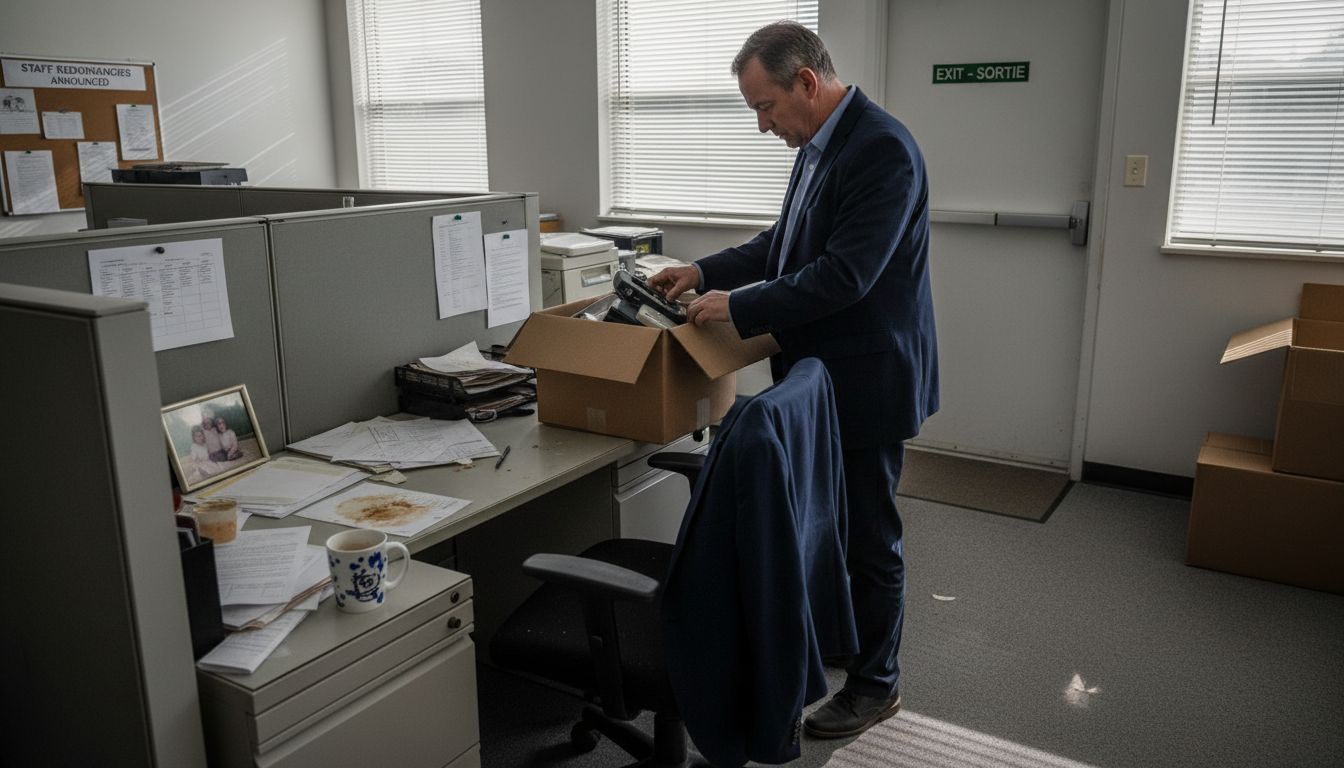
When you lose your job, you lose far more than income. You lose daily structure, social connection, purpose, and part of your identity. Career losses, especially after decades of work or sudden termination, involve grief that extends far beyond financial concern. Yet people often respond with practical advice rather than emotional validation, treating job loss as a logistical problem rather than a legitimate life transition worthy of mourning.
Deaths surrounded by stigma or controversy
Stigmatised deaths like suicide or related to illness carry additional layers of unrecognised grief. Families often hide the cause of death to avoid judgment, which means they cannot openly grieve or receive community support. The grief becomes secret, shameful, and isolating. The same applies to deaths related to addiction, overdose, accidents involving substance use, or any circumstance others might view as the deceased person’s fault.
Other significant losses
Disability or chronic illness can involve grief for your former abilities, independence, or the life you expected to live. Loss of status, immigration experiences involving displacement, loss of cultural identity, or the realisation that a dream will never happen all constitute real losses deserving acknowledgment. Some people grieve the loss of a version of themselves, such as after trauma or major life changes.
The common thread across all these losses is that society has not created formal space for mourning them. There are no standard rituals, no cards people send, no time off work expected. Your loss happens quietly, often while you continue appearing functional to everyone around you.
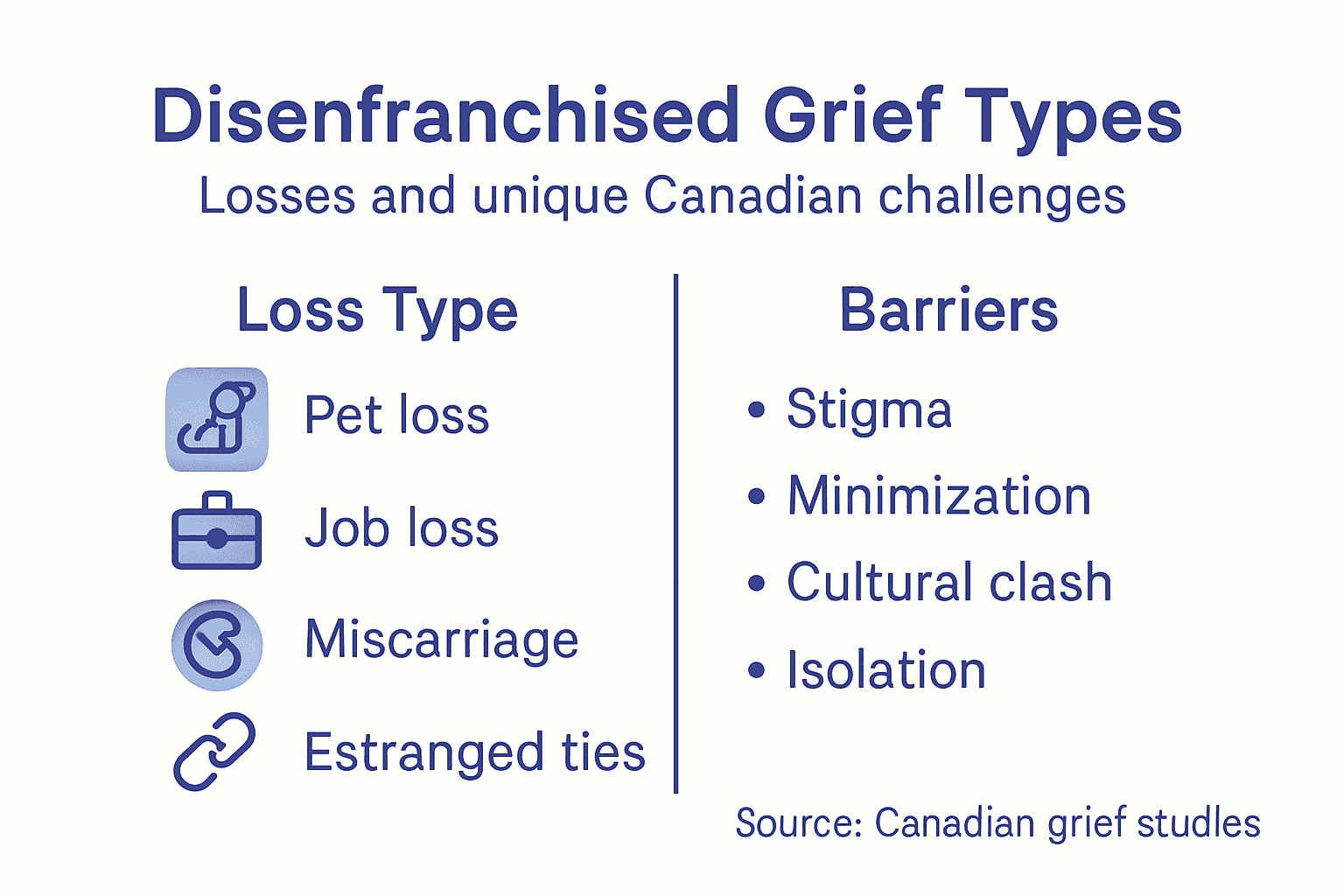
Here is a summary of common types of disenfranchised grief and why they often go unrecognised in Canada:
| Type of Loss | Why It Is Often Minimized | Unique Challenges in Canada |
|---|---|---|
| Estranged relationship | Assumed relief or irrelevance | Lack of formal mourning rituals |
| Pregnancy/fertility loss | Viewed as less “real” without a baby | Limited public sympathy and workplace policies |
| Pet death | Dismissed as minor by society | Few support services, cultural undervaluing |
| Job loss | Seen as financial, not emotional | Work-centric identity, loss of status |
| Stigmatised deaths | Social judgment and secrecy | Stigma around suicide, addiction |
| Immigration/cultural loss | Overlooked as grief at all | Cultural displacement in a diverse society |
| Loss of ability or health | Focus on “moving forward” instead of grieving | Barriers in disability acknowledgment |
These distinctions highlight the varying social and cultural barriers that impact grief validation in the Canadian context.
Pro tip: Categorise your specific loss by identifying which type best describes it, then seek communities of people experiencing the same type of loss. Online support groups, therapy, or books by others who have experienced your specific type of unrecognised loss can help you feel less alone and provide language for what you are experiencing.
Why society minimizes certain grief
Grief doesn’t exist in a vacuum. It exists within a cultural context, shaped by unwritten rules about which losses matter and which don’t. The reason your grief feels invisible is not because your loss is insignificant. It is because your loss falls outside the boundaries of what your culture has decided is acceptable to mourn openly. Understanding why this happens is the first step toward refusing to internalise the message that your pain doesn’t count.
Every culture has specific rules about acceptable grieving practices. These rules determine whose losses are honoured with funerals, flowers, and time off work, and whose losses are expected to be processed quietly and alone. Cultures have specific rules about acceptable grieving, which directly exclude some types of grief from social recognition. When a loss falls outside these cultural boundaries, it becomes disenfranchised not because the loss is less real, but because it challenges the cultural narrative about who deserves to grieve and how. A death following a long illness receives sympathy. A death by suicide often receives silence. A pet’s death receives dismissal. A relationship’s end receives the message that you should have “seen it coming.” None of these exclusions reflect the actual significance of the loss; they reflect the culture’s comfort level with the loss.
The following table outlines key differences between socially recognised grief and disenfranchised grief in Canada:
| Aspect | Socially Recognised Grief | Disenfranchised Grief |
|---|---|---|
| Social Support | High: rituals, condolences | Low: silence, minimisation |
| Mourning Space | Public and accepted | Private and hidden |
| Workplace Policy | Formal leave, flexibility | Rarely acknowledged |
| Emotional Response | Validated and expected | Often shamed or doubted |
| Community Acknowledgment | Cards, meals, sympathy | Assumptions, avoidance |
This comparison helps clarify why disenfranchised grief can feel especially isolating and complicated.
The role of assumptions and judgment
Society minimizes certain grief based on unfounded assumptions. People make judgments about your relationship to the person who died, the circumstances of the death, or the “appropriate” way you should be expressing your grief. When someone dies by suicide, people often assume the family must feel relieved or blame themselves, rather than asking what the family actually feels. When you grieve a pet, people assume you are sentimentalising an animal rather than acknowledging that this creature shared your home, your routine, and sometimes your deepest moments. When you grieve a miscarriage, people assume the loss is smaller because the baby was not yet born, ignoring that you already held the future in your mind.
Losses like pet death, miscarriage, suicide, or disenfranchised relationships are often dismissed because they do not fit into society’s expectations. These assumptions become barriers to support. People do not send cards. They do not bring meals. They do not ask how you are coping. They change the subject. They offer platitudes. They suggest you move on. The absence of these rituals and acknowledgments sends a clear message: this loss is not one we, as a society, have agreed to validate.
Why marginalisation persists
Cultural rules about grief are not universal or timeless. They change. Yet change happens slowly, and marginalisation persists because it is reinforced constantly through what we see (and don’t see) around us. Funeral announcements in newspapers rarely mention pet deaths. Workplaces do not grant bereavement leave for miscarriage. Movies and books rarely portray grief from job loss or estrangement as legitimate trauma. The absence of these representations means many people never see their own experience reflected back to them. They begin to believe their grief is unusual, excessive, or invalid.
There is also a darker dimension to minimisation. Sometimes society minimises grief because the loss reveals uncomfortable truths. A death by suicide raises questions about mental health support and societal pressure. A death from addiction raises questions about systemic failures and judgment. A loss of a relationship reveals that not all connections are worth maintaining. An estrangement from a family member contradicts the cultural ideal of unconditional family bonds. By minimising these griefs, society protects itself from having to examine these uncomfortable realities.
The cost of minimisation
When grief is minimised, the person experiencing it pays the price. Without social acknowledgment and support, unrecognised grief becomes more complicated. You may experience increased isolation, depression, and what professionals call complicated grief reactions. You may also internalise the message that your feelings are wrong or excessive, adding shame to your pain. This is why minimisation is not merely an inconvenience; it is a barrier to healing.
Pro tip: When someone dismisses your grief, recognise it as a failure of their understanding, not a reflection of your loss’s validity. Actively seek out people, communities, or professionals who do understand your specific type of loss; this external validation can counteract internalised shame while you work toward accepting your grief regardless of society’s recognition.
Signs and emotional impact of invalidated grief
Invalidated grief does not announce itself with a clear diagnosis. It often masquerades as other problems: depression that won’t lift, anxiety that has no obvious trigger, or a persistent numbness that makes you feel disconnected from life. Learning to recognise the signs of unacknowledged grief is essential because what you are experiencing may not be what you think it is. You may be treating the symptom rather than addressing the root cause.
Emotional and psychological signs
When your grief is not acknowledged by others, you may experience prolonged sorrow, depression, and difficulty coping with the loss effectively. This is not because your grief is excessive or pathological. It is because without social validation, your brain continues to process the loss as if it is still an active threat that no one has agreed to help you bear. The lack of external support means you must manage the full weight of your grief alone, without the collective acknowledgment that typically helps people integrate loss into their lives.
You may experience:
- Prolonged sadness or numbness that feels disproportionate to what others believe you should be feeling
- Intense guilt or shame about your feelings, with internal messages like “I shouldn’t still be this upset” or “Other people have real problems”
- Anxiety about expressing your grief, leading you to hide your pain or minimise your loss when talking to others
- Anger that surfaces unexpectedly, often directed at yourself or at the people who minimised your loss
- Difficulty concentrating or making decisions, as your mental energy is consumed by unprocessed grief
- Physical symptoms including sleep disturbance, appetite changes, fatigue, or chronic tension in your body
- Social withdrawal, choosing isolation over the pain of being around people who do not understand
The psychological burden of silence
One of the most damaging aspects of invalidated grief is the message you internalise: that your loss should remain private and unspoken. This silence compounds the original loss. You lose the opportunity to have your experience reflected back to you by others. You lose the chance to hear “I’m sorry” or “That must be really hard.” You lose the collective acknowledgment that helps your brain categorise the loss as something that happened to you, rather than something that is still happening.
Being silenced by others’ dismissive remarks creates a secondary grief layer. On top of your original loss, you now grieve the loss of permission to mourn. You may feel disloyal for moving forward with your life or embarrassed about any growth or healing that occurs after your loss. These feelings arise because invalidation teaches you that mourning is the only acceptable response; anything else feels like betrayal. You may find yourself staying stuck in acute grief specifically because moving toward acceptance feels like admitting your loss did not matter.
Behavioural and relational signs
Invalidated grief often shows up in how you behave and relate to others. You may:
- Avoid talking about your loss entirely, even with people who might be sympathetic, because you have internalised the message that it is not worth discussing
- Overexplain or justify your grief to others, trying to convince them your loss was legitimate enough to warrant sadness
- Seek validation from unlikely sources, such as online communities of strangers experiencing similar losses, because at least these strangers understand
- Feel resentful toward people who experienced socially recognised losses while you grieve silently, creating distance in relationships
- Display emotional dysregulation, where small disappointments trigger disproportionate reactions because your grief capacity is already overwhelmed
- Engage in avoidance behaviours such as overworking, overusing substances, or staying perpetually busy to prevent yourself from feeling the pain
The impact on long-term healing
Without validation and support, invalidated grief can become what mental health professionals call complicated grief. This is not because there is anything wrong with your grief response; it is because grief without witnesses and without permission to mourn tends to stagnate rather than evolve. You may find yourself stuck in the same intensity of pain months or years after the loss, unable to integrate it into your life story because you never had the chance to tell that story to anyone who acknowledged its importance.
The longer grief remains unacknowledged, the more shame accumulates around it. Shame is particularly damaging to healing because it keeps you isolated precisely when you need connection most. When you believe your grief is something to be embarrassed about, you stop seeking support. You stop talking about it. You stop allowing yourself to feel it fully. This suppression of grief does not make it go away; it makes it fester.
Pro tip: Track your emotional patterns in a private journal for two weeks, noting when sadness, anger, or numbness emerges and what triggers it. This creates an external record of your grief that validates it, even if no one else does. When you see the pattern documented, you can begin to understand that your response is neither excessive nor unusual; it is your specific grief process trying to happen.
Healthy coping and paths to healing
Healing from disenfranchised grief begins with a single, radical act: believing that your loss matters. Not because anyone else has validated it. Not because society has created space for it. But because you know, in the deepest part of yourself, that what you lost was real and that your grief is legitimate. This self-validation is the foundation upon which all other healing rests. Once you stop waiting for external permission to grieve, you can begin the actual work of moving through your loss.
Self-validation and internal acknowledgment
The first step toward healing is recognising that you do not need anyone else’s approval to claim your grief. You lost something. You feel pain. That is enough. Write this down if you need to. Tell yourself explicitly: “My loss is real. My grief is valid. I deserve to mourn this.” This may feel simple, but for people whose grief has been repeatedly minimised, self-validation is often revolutionary. You are essentially giving yourself permission that others refused to give.
Building your support network
Healing from unrecognised grief requires connection, even when the world around you does not seem to understand. Seek out people who do understand. Seeking supportive communities or peer groups with shared experiences is essential for reducing isolation and building a sense of belonging within your grief. This might mean:
- Joining online support groups for people experiencing your specific type of loss (pet loss groups, infertility communities, estrangement support networks)
- Finding a therapist or counsellor who specialises in grief and disenfranchised loss
- Connecting with even one or two trusted people who listen without judgment
- Participating in communities where your experience is the norm rather than an anomaly
The difference between being around people who minimise your grief and being around people who validate it is profound. When someone says “I understand how that feels” rather than “You should be over it by now,” something shifts internally. Your nervous system recognises that you are safe to grieve openly. This safety is what allows grief to move and transform rather than becoming stuck.
Creative and ritual expression
Grief needs an outlet. When society does not provide rituals to mark your loss, you must create them yourself. Finding meaningful personal rituals or creative outlets for grief expression helps your brain process the loss and gives your emotions a container. These rituals do not need to be elaborate or conventional. They need only be meaningful to you.
Consider:
- Journaling about your loss, your relationship to the person or thing you lost, and what you wish you could have said or done
- Creating art without any expectation of skill or outcome; the process matters more than the product
- Writing a letter to the person who died, the relationship that ended, or the version of yourself you lost, then deciding what to do with it
- Planting something to mark the loss, creating a living memorial that grows and changes
- Cooking a favourite meal associated with the person you lost and eating it mindfully, honouring the connection
- Creating a small altar or memorial in your home where you can place objects that remind you of what you lost
- Recording your voice telling the story of your relationship and the loss, preserving it for yourself
These rituals serve multiple purposes. They acknowledge the loss formally, they give your grief a defined moment or space, and they create a tangible expression of something that might otherwise remain invisible and internal.
Professional support and counselling
Expressing grief through journaling, art, or counselling helps reduce isolation and promotes emotional processing and recovery. Professional counselling is particularly valuable for disenfranchised grief because a trained counsellor understands the specific dynamics at play. They can help you process not only your original loss but also the secondary trauma of having that loss invalidated by others.
A counsellor who specialises in grief can help you:
- Understand what you are experiencing and name it accurately
- Separate your grief response from mental health conditions like depression or anxiety that may overlap with it
- Develop strategies for coping with others’ dismissiveness without internalising their judgments
- Process both the loss itself and the isolation surrounding it
- Build resilience while honouring your grief
Counselling is not about “getting over” your loss quickly. It is about learning to integrate the loss into your life in a way that allows you to move forward while still honoring what you lost. When grief has been minimised externally, counselling provides the witnessing and validation that your internal experience deserves.
Self-care as an act of self-respect
Engaging in self-care activities is not indulgent when you are grieving. It is a statement that your wellbeing matters. Grief is exhausting, both emotionally and physically. Without deliberate self-care, your body and mind become depleted, which intensifies the pain. Self-care during grief might include:
- Moving your body in ways that feel good (walking, dancing, stretching, any form of gentle movement)
- Getting adequate sleep and treating sleep disruption as a symptom that needs addressing
- Eating nourishing food consistently, even when you lack appetite
- Spending time in nature or in environments that feel calming
- Limiting exposure to people or situations that trigger invalidation
- Saying no to social obligations that drain you
Pro tip: Create a “grief care plan” that lists three activities you can do immediately when grief feels overwhelming, three people you can reach out to for support, and three professional resources you can access if needed. Keep this written list accessible so you do not have to think creatively when you are in acute pain; you can simply follow the plan you created when you were clearer.
How grief counselling provides validation
Validation is not a luxury in grief work. It is a necessity. When your grief has been minimised, dismissed, or outright denied by the people around you, a counsellor who validates your experience can fundamentally shift how you relate to your own pain. This validation does not erase what others have said or done. It does not retroactively make your loss socially acceptable. What it does is create a space where your grief is treated as real, legitimate, and deserving of attention and care. This experience of being truly witnessed can be transformative.
The power of professional witnessing
One of the most profound gifts a grief counsellor offers is their willingness to listen without judgment, without trying to fix your grief, and without offering platitudes. When a counsellor sits with you and says “I hear you. This loss matters. Your grief makes sense,” they are doing something simple yet revolutionary. They are affirming that your experience is valid. In a world that has told you to move on, to be grateful, to see the silver lining, a counsellor’s unconditional acceptance of your grief becomes a refuge.
This witnessing has measurable effects. Your nervous system begins to relax when it recognises you are in a safe space to express pain. Your shame diminishes because you are no longer hiding your grief. Your isolation decreases because someone now knows, fully and without reservation, what you are experiencing. The counsellor does not need to have experienced your exact loss to validate it. They need only to understand that loss is loss, that grief is grief, and that your specific experience deserves respect.
Culturally informed and trauma-aware validation
Grief counselling focuses on acknowledging and validating hidden sorrow, especially among culturally diverse and immigrant populations. If you are grieving from a cultural background where your mourning practices differ from dominant Canadian norms, a skilled counsellor recognises these differences as valid expressions of grief, not as problems to be corrected. Your way of grieving is not wrong because it does not match what your neighbours expect.
For immigrant and refugee clients, disenfranchised grief often involves multiple, layered losses that are rarely acknowledged together. You may grieve a person who died while simultaneously grieving your homeland, your status, your language, your sense of belonging. A culturally informed counsellor understands these compounded losses and helps you process them not as separate events but as interconnected experiences. They create what researchers call a “culturally safe space” where your specific context is understood and honoured.
Trauma-informed counselling is also essential for disenfranchised grief because invalidation itself becomes a form of secondary trauma. When others have actively minimised your loss, when you have been made to feel ashamed of your grief, when you have learned that your pain is not welcome, these experiences wound you further. A trauma-informed counsellor recognises this secondary wounding and works carefully to help you process not only your original loss but also the invalidation that followed.
How counsellors reframe grief narratives
Counsellors help you reframe the story you have internalised about your grief. If you have absorbed messages like “My grief is excessive,” “I should be over this by now,” or “This loss did not really matter,” a counsellor works with you to challenge and revise these beliefs. They help you understand that your grief intensity is not a measure of weakness or excessive attachment; it is a measure of how much this person, relationship, or opportunity meant to you.
Through conversation and guided reflection, counsellors help you separate your grief response from shame. They might ask questions like “What would you say to a friend who was experiencing this exact loss?” This often reveals the disconnect between how harshly you judge yourself and how compassionately you would treat someone else. Over time, you begin to extend that same compassion to yourself.
Counsellors also help you articulate your loss in language that honours its significance. Instead of minimising descriptions like “It was just a pet” or “It was only a job,” you learn to speak your truth: “This was my companion for fifteen years,” or “This career defined my identity and sense of purpose.” Language matters because it shapes how you understand your experience. When you use language that reflects the true importance of what you lost, you begin to feel entitled to your grief.
The role of counsellors in Interactive Counselling
At Interactive Counselling, grief counsellors across Canadian locations including Kelowna, Vernon, Grande Prairie, and Penticton are trained to recognise and address the specific dynamics of disenfranchised grief. Our approach combines evidence-based grief therapy with client-centred care that prioritises your unique experience. Whether you access grief counselling services in person, by phone, or online, you work with a professional who understands that your loss deserves validation and support.
Our counsellors create a non-judgmental space where you can express your grief fully, without fear of being told you should move on or that your loss was insignificant. They help you process both the loss itself and the isolation that often accompanies unrecognised grief. Over time, counselling helps you integrate your loss into your life in a way that allows you to honour what you lost while gradually rebuilding meaning and connection.
Pro tip: When beginning grief counselling, explicitly tell your counsellor about the invalidation you have experienced. Describe the comments that hurt most, the relationships where you could not openly grieve, and the shame you have internalised. This gives your counsellor the full context needed to provide the most relevant validation and support for your specific situation.
Common questions about disenfranchised grief
People often have questions about disenfranchised grief because it exists in the gap between what they feel and what others acknowledge. They wonder if their experience truly qualifies as disenfranchised grief, whether they are overreacting, or if they will ever feel normal again. These questions arise because disenfranchised grief is, by definition, something that lacks a clear social framework. You are trying to understand your own experience in a culture that does not provide language or validation for it. Below are answers to the questions people ask most frequently.
Is my loss really disenfranchised grief?
This is perhaps the most common question, and it often reflects the internalised doubt that comes from living in a world where your loss is not socially recognised. The answer is straightforward: if you experienced a significant loss and the people around you have not acknowledged it as worthy of grief, then yes, you are experiencing disenfranchised grief. Your loss does not need to fit into socially recognised categories to be valid. Your loss does not need others’ permission to matter.
Disenfranchised grief can apply to the death of a pet, the end of a relationship, miscarriage, infertility, job loss, estrangement from family, loss of status, loss of a dream, loss of abilities due to illness or disability, or any other loss that has caused you pain but has been met with silence or dismissal by the people around you. Some people experience disenfranchised grief around deaths that others consider a relief, such as the death of an abusive family member. Others grieve losses that most people do not see as losses at all. The common factor is not the type of loss; it is the lack of social acknowledgment.
Why do some losses receive support while others do not?
Clarifying why some grief is not socially recognised helps us understand that this disparity is not about the loss itself but about cultural norms and assumptions. A death receives rituals, time off work, and community meals. A job loss receives practical advice and perhaps some brief sympathy. A miscarriage at eight weeks often receives awkward silence. A relationship ending receives comments like “You will find someone better.” A pet’s death receives “It was just an animal.”
These differences in response reveal cultural priorities and discomfort levels rather than any actual difference in the significance of the loss. Your culture has created rituals and language for deaths but not for all losses. It has created space for grieving certain relationships but not others. These decisions are arbitrary and culturally specific. They reflect what your culture is comfortable acknowledging, not what actually deserves acknowledgment.
How long should grief last?
There is no timeline for grief, whether it is recognised or disenfranchised. Grief does not follow stages that happen in order and then end. It ebbs and flows. It returns unexpectedly. It softens over time but does not disappear. The difference with disenfranchised grief is that without social acknowledgment, the process of integration may take longer. You are essentially grieving alone, which slows the healing process not because your grief is excessive but because healing requires witnesses and support.
If you feel your grief intensifying rather than gradually softening after months or years, or if it is preventing you from functioning in basic ways, that may indicate complicated grief, which is worth discussing with a mental health professional. But normal, healthy grief from a significant loss can last years. You are not broken if you still feel sadness about a loss that society has told you was insignificant.
Can disenfranchised grief turn into complicated grief?
Yes. When grief is not acknowledged and processed, it can become what mental health professionals call complicated grief. This does not mean your grief response was wrong; it means grief without witnesses and validation can stagnate rather than evolve. Without the social rituals and support that typically help people integrate loss, unprocessed grief can intensify into prolonged, debilitating pain. This is why seeking support, even when others do not validate your loss, is important. Talking to a counsellor who understands disenfranchised grief can help prevent your grief from becoming complicated by isolation and shame.
How do I support someone experiencing disenfranchised grief?
If someone you care about is grieving a loss that others have minimised, the most important thing you can offer is validation. Listen without judgment. Acknowledge that their loss matters. Say things like “I can see how much this meant to you” or “Your grief makes sense.” Do not compare their loss to other losses. Do not suggest they should be over it. Do not offer platitudes. Simply witness their pain and affirm that it is real.
Take their grief seriously whether or not you understand why the loss was so significant to them. If they want to talk about what they lost, listen. If they want support accessing counselling, help them find it. Most importantly, do not contribute to the invalidation they are already experiencing from the broader culture. Be the one person who says, “Your loss matters.”
Should I seek professional help?
Yes, if your grief is affecting your ability to function, if you are experiencing prolonged depression or anxiety, if you are isolating yourself severely, or if you simply feel you need support processing your loss. Distinguishing disenfranchised grief from mainstream grief and learning effective ways to support affected individuals often requires professional guidance. A counsellor who specialises in grief can validate your experience, help you process the loss itself and the invalidation surrounding it, and support you in building resilience.
At Interactive Counselling, grief counselling services are available in multiple Canadian locations and online, offering flexible scheduling to accommodate your needs. Seeking help is not a sign of weakness; it is a sign that you value your own healing enough to reach out for it.
Pro tip: Write your own FAQ about your specific loss, answering the questions you most wish people would ask. Questions like “What was your relationship to this person?” or “How are you coping?” or “What can I do to support you?” Writing these answers helps you clarify your experience and may reveal what kind of support you actually need from others.
Finding Support for Disenfranchised Grief You are not alone when your grief feels unseen or unsupported. Disenfranchised grief can leave you feeling isolated and disconnected because society may not recognise the loss you carry. Whether you are mourning a pet, an estranged relationship, pregnancy loss, or other unacknowledged grief, your pain is valid. At Interactive Counselling, we understand that your grief deserves validation, compassionate care, and a safe space to express your feelings.
Our licensed therapists across Kelowna, Vernon, Grande Prairie, Penticton, and through online sessions provide personalized support tailored to your experience of disenfranchised grief. Take the vital step to reclaim your healing journey today. Visit Interactive Counselling to explore grief counselling options and connect with professionals who respect the significance of your loss. Don’t wait for society’s permission to mourn – find the understanding and support you deserve now through grief counselling services designed for your unique needs.
Frequently Asked Questions
Is my loss really disenfranchised grief?
If you have experienced a significant loss that has not been acknowledged by those around you, then yes, you are experiencing disenfranchised grief. Your loss does not need to fit societal norms to be valid.
Why do some losses receive support while others do not?
Some losses are socially recognised based on cultural assumptions and norms. For example, deaths often receive more acknowledgment compared to losses like miscarriage or job termination, even if their emotional impact is equally profound.
How long should grief last?
There is no set timeline for grief. It can last for years and may ebb and flow over time. Disenfranchised grief may take longer to heal because it lacks social acknowledgment and support.
Can disenfranchised grief turn into complicated grief?
Yes, when disenfranchised grief is not processed or acknowledged, it can become complicated grief, leading to prolonged pain and isolation. Seeking support from a professional can help address these feelings.
Recommended
- Grief Counselling | Interactive Counselling Grande Prairie
- Grief & Loss During the Holidays: Why Christmas Can Feel Especially Heavy
- Vernon Grief Counselling | Interactive Counselling
- Kelowna Grief Counselling | Interactive Counselling