Relationships where one or both partners are autistic are built on the same foundations as any other: love, respect, and mutual understanding. But the path to that understanding often looks different, and that’s more than okay. The journey toward strong autism and relationships: communication and connection is about learning to honour each other’s unique ways of experiencing the world, not trying to change them. For more information, see our couples counselling.
This guide offers a compassionate look at the dynamics of neurodivergent partnerships, focusing on practical communication strategies for friendships, dating, and long-term relationships.
The Unique Beauty of Neurodivergent Relationships

Welcome to a space that honours the unique dynamics of neurodivergent partnerships. This guide steps away from outdated narratives that often frame autism as a barrier to love. Instead, we’ll celebrate the strengths and address the genuine challenges that can arise when partners process the world differently.
Thinking of these differences as "different wiring" rather than flaws is the first and most important step. One partner might need direct, literal communication, while the other might rely more on unspoken cues. Neither approach is wrong; they are simply different operating systems.
The real work isn't about one person learning to act neurotypical. It's about both partners co-creating a shared language built on a new set of principles. Neurodivergent relationships often thrive because of their distinct qualities, including:
Deep Honesty: A preference for directness can eliminate guesswork and build a powerful foundation of trust.
Passionate Loyalty: When an autistic person shares their life with you, it often comes with a profound and unwavering sense of loyalty.
Unique Perspectives: Seeing the world from different angles can make life richer, more interesting, and problem-solving more creative.
Building a Shared Understanding
Success in a neurodivergent relationship isn’t about fixing someone—it’s about embracing curiosity and empathy. It’s about asking, “What does this feel like for you?” and truly listening to the answer. This creates a safe space where both people feel seen and valued for who they are.
Connection thrives on acceptance, not correction. The goal is to build a bridge between two worlds, creating a shared space where both partners feel at home.
This journey involves learning to translate for each other. It means the non-autistic partner might learn to be more explicit with their needs, and the autistic partner might explain the 'why' behind their routines or sensory sensitivities. It is a collaborative effort built on patience and kindness.
If navigating these conversations feels challenging, remember that support is available. Exploring professional guidance through relationship counselling can provide a neutral space to develop these skills together. Ultimately, your connection is a unique partnership with its own rules, rhythms, and beautiful strengths worth nurturing.
Understanding Different Communication Styles
Before we can improve how we communicate, we first need to understand the why behind our different styles. This isn't about finding fault; it's about building a bridge of empathy. When you understand how an autistic person processes language and social cues, you lay the groundwork for a much stronger connection.
Many autistic people are direct and literal communicators. For them, words mean precisely what they say. This can be a massive asset in a relationship—it cuts through the noise and builds a foundation of honesty.
Where things can get tricky is when this direct style meets the often-unspoken, subtext-heavy communication that many neurotypical people use. Sarcasm, idioms, or subtle hints might not just fly over their head—they can create genuine confusion and frustration.
Many couples we support in Kelowna, Vernon, Penticton, and Grande Prairie find that understanding neurodivergent communication styles brings more clarity, reduces conflict, and strengthens connection in their relationships.
The Challenge of Non-Verbal Cues
It's not just about the words we say. Non-verbal signals add another layer of complexity. Neurotypical people often lean heavily on body language, tone of voice, and eye contact to figure out what someone really means. For some autistic people, this can be tough for a couple of reasons:
Reading the signals: It can be hard to accurately interpret a subtle shift in someone's facial expression or a slight change in their posture.
Producing the signals: Things like holding eye contact or nodding along in a conversation can feel unnatural, uncomfortable, or take so much concentration that it's hard to focus on what's being said.
This isn't about a lack of interest or empathy. It's simply a difference in neurological wiring. An autistic partner might show they're deeply engaged by looking away to better process your words, not by staring into your eyes.
The Hidden Energy Drain of Social Masking
To get by in a world largely built for neurotypical communication, many autistic individuals learn to socially mask (also called camouflaging). This is the exhausting, often subconscious, effort of hiding their natural instincts and mimicking the social behaviours they see in others just to fit in. It's a survival tactic, but it comes at a huge cost.
Think of it like running a complex translation app in your head for every single conversation, all day long. By the time you get home, your mental battery is completely empty. That's the reality of masking for many.
This emotional and mental exhaustion directly impacts a relationship. An autistic partner who has been "on" all day at work might not have energy left for deep conversation at home. It’s important for a non-autistic partner to understand this isn't personal—it's the fallout from navigating a world that isn't built for them.
Communication is often one of the biggest hurdles for people on the autism spectrum. Even for those who are verbal, it’s pragmatic language—the social side of things—that can be the most challenging. This might look like difficulty using tone of voice to show sarcasm, knowing when it's your turn to talk, or staying on topic. As you work to understand these differences, exploring attachment styles in relationships can also offer powerful insights into the ways you and your partner give and receive connection.
Practical Strategies for Clearer Communication
Understanding that you and your partner communicate differently is a huge first step. The real magic happens when you start putting that understanding into practice with intentional, practical tools that work for both of you. This is about bridging the gap with strategies that build clarity and take the stress out of miscommunication.
Think of these less as rigid rules and more as a shared playbook you create together. The goal is to stop the guessing games and build a partnership where you can both express your needs and have them met with kindness.
Ditch the Hints and Be Direct
One of the most powerful shifts a couple can make is to drop the subtle hints and start communicating explicitly. For many autistic people who are literal thinkers, a hint like, "Wow, the garbage is really starting to smell," is just an observation about the garbage. It's not a request to take it out.
This isn't about being difficult; it's a fundamental difference in how language is processed. When you state your need directly—"Could you please take the garbage out?"—you eliminate ambiguity. This one simple change can prevent countless tiny frustrations from piling up, making your home life feel more peaceful.
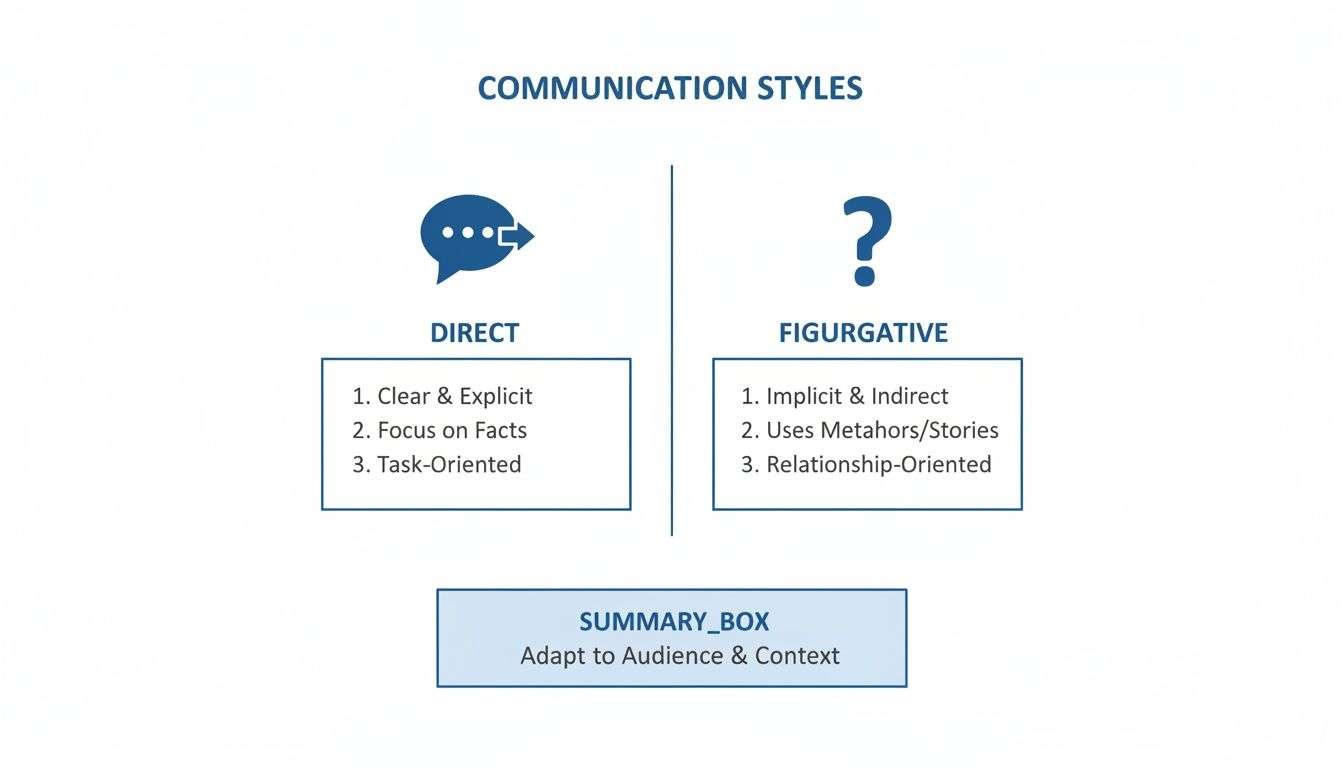
As you can see, being direct is all about clarity. Figurative or indirect speech often creates a guessing game that can easily lead to confusion and hurt feelings.
A Communication Playbook for Neurodivergent Couples
To make this even more practical, let's look at some common friction points and pair them with supportive, actionable strategies. This isn't about one person changing for the other, but about finding a "third way" that honours both partners' needs.
| Common Challenge | Supportive Strategy |
|---|---|
| Important conversations feel overwhelming. | Schedule check-ins. Set aside a few minutes daily to connect. Keeping it brief and routine lowers the stakes. |
| Processing thoughts and feelings in real-time is difficult. | Use written communication. For bigger topics, try a shared document or text. This gives you both space to think and respond thoughtfully. |
| Emotions escalate quickly during disagreements. | Create a "pause" signal. Agree on a neutral word ("pause") or gesture to signal a needed break. |
| You feel unheard or misunderstood. | Use "I feel…" statements. Frame feelings from your perspective (e.g., "I feel overwhelmed when…") to avoid blame and invite empathy. |
Adopting these strategies takes time and a shared commitment. The key is to see them as tools to protect your connection, not as criticisms of how either of you naturally communicates.
Create Space for Connection and Processing
Sometimes, the biggest obstacle to good communication is the pressure of the conversation itself. After a long day of sensory overload or social masking, a serious, face-to-face talk can feel overwhelming. That’s why building in low-pressure alternatives can be a game-changer.
Here are a few gentle approaches that work wonders:
Scheduled Check-ins: That daily check-in isn't just for logistics. It creates a predictable, safe container for sharing what's on your mind without the pressure of a "big talk."
Written Communication: Don't underestimate the power of a text or a shared document. It allows both partners to process information and craft a response without the immediate pressure of a verbal back-and-forth. It’s perfect for complex, emotionally charged topics.
A "Pause" Signal: This one is crucial. Agree on a simple, neutral signal that either of you can use when a conversation feels too intense. This isn't about shutting down the conversation; it's about taking a needed break to self-regulate before coming back together.
A "pause" is a tool for self-regulation, not a weapon for avoidance. It's a mutual agreement to protect the relationship from escalating emotions, allowing both partners to return to the conversation with clearer minds.
These proactive strategies empower you both to manage communication in a way that feels safe and respectful. If you're finding it tough to implement these ideas on your own, exploring more about how to communicate better in relationships can offer even more tools and support. Building these new habits is a process, but it’s a powerful testament to your commitment to understanding each other.
Building Connection Beyond Words

We're often told that deep, face-to-face conversations are the bedrock of a meaningful relationship. But what if connection looks different? For many neurodivergent couples, intimacy and closeness flourish in the quiet moments and shared experiences that don't rely on words at all.
Learning to see and celebrate these non-verbal forms of connection is essential for a strong partnership. It can be as simple as preparing a meal together, going for a quiet walk, or tackling a puzzle. The goal isn't perfect communication; it's the shared experience itself.
The Comfort of Parallel Play
One of the most beautiful and underrated ways to connect is through parallel play. This is simply being in the same space, engaged in your own separate activities. Imagine one person reading a book while the other sketches or plays a video game.
There's no pressure to talk or interact. Instead, the shared presence creates a powerful sense of comfort, safety, and quiet companionship. It’s an incredibly low-demand way to be together that honours individual interests and energy levels, reinforcing that you're a team even when you aren’t actively engaging.
Reframing Love Languages
The popular concept of the five "love languages" can be a helpful starting point, but it often needs to be viewed through a neurodivergent lens. For an autistic partner, expressions of love and care might not look conventional, but they are just as profound.
Think about how these actions can be powerful signs of affection:
Acts of Service: This could mean tidying a shared space to reduce a partner's sensory overwhelm or making their favourite comfort food after a tough day.
Supporting Special Interests: Taking the time to actively listen when your partner talks about their passion shows you truly value what brings them joy.
Quiet Companionship: Just sitting together in comfortable silence can be a deep expression of presence. It says "I'm here with you" without a single word.
In a neurodivergent relationship, love is often demonstrated through thoughtful actions that create a calm, predictable, and supportive environment where your partner can truly thrive.
Understanding and respecting sensory needs is another huge part of this. Creating a home with dimmable lights, soft textures, or designated quiet zones is a tangible act of love that shows you're attuned to your partner’s well-being.
To build on this, you might explore techniques like the power of sustained shared thinking, which encourages a mutual exploration of ideas. Learning to see and appreciate these unique expressions of love strengthens the very foundation of your autism and relationships: communication and connection.
Navigating Your Social World as a Couple
Your relationship isn't just the two of you; it's also about how you fit into a world of friends, family, and social events. When you learn to tackle these situations as a team, they can go from being a source of stress to a chance to connect. It all comes down to working together and having each other's back.
A great place to start is by getting on the same page about social energy before you even leave the house. Before a party or family dinner, have a quick chat. Agreeing on when you'll arrive and when you'll head home can make the whole thing feel manageable instead of like an endless obligation. That little bit of planning adds predictability and puts you both back in control.
Strategies for Social Success as a Team
For many autistic people, small talk can be completely exhausting. Coming up with a few simple conversation starters or a couple of polite exit phrases ahead of time can be a game-changer. Think of it as having a toolkit ready to go—it takes the pressure off having to come up with something on the spot in an already overstimulating room.
Another fantastic strategy is for one partner to act as a gentle "social buffer." This isn't about speaking for your partner. It's about subtly helping to guide conversations or creating an opportunity for a quick break. For instance, if you see your partner getting overwhelmed, you could jump in with something like, "That's a great point. You know, Sarah and I were just going to grab a drink, we'll be right back."
It's a move that offers an escape hatch without making a scene, and it shows you're paying attention to each other's cues. The trick is to talk about these signals and strategies beforehand so it feels like supportive teamwork.
Setting Boundaries and Honouring Individual Needs
Being upfront with each other about your social limits is essential. It's more than okay for one of you to go to an event while the other stays home to recharge. Protecting your own well-being is one of the best things you can do for the health of your relationship.
This honesty extends to friends and family, too. Saying something as simple as, "We'd love to come, but we can only stay for about an hour," is a powerful way to set a clear, respectful boundary.
It's also so important to remember that both partners need their own support systems. Keeping up with individual friendships gives you both vital emotional outlets and fresh perspectives, which ultimately makes your bond as a couple even stronger.
Other factors can shape these social dynamics. For example, women have historically been underdiagnosed with autism because they may be more skilled at masking their social difficulties. This can add a hidden layer of profound exhaustion to every social outing. Learn more about the research into gender differences in autism. This is one of many reasons why open conversations about what you both need socially, perhaps guided by a framework from specialized support like Autism Counselling, can be so critical to building a social life that works for both of you.
A Journey, Not a Destination
Building your neurodivergent relationship is less like solving a puzzle and more like embarking on a shared journey. There isn't a final destination or a "correct" way to do things. This guide is simply a map to help you get started on improving communication and connection in your autistic relationship.
The most important thing is to remember the unique strengths you both bring. Celebrate them. Be patient—with your partner, but also with yourself. This process is about learning and growing together, not getting it perfect on day one.
Your connection is valuable and deserves to be nurtured. Keep in mind that constant miscommunication can quietly build up, leading to profound exhaustion. Learning to spot the early warning signs is crucial. Taking some time to understand autism burnout and its causes can be a powerful step in protecting not just your individual well-being, but the health of your relationship, too.
If you hit a roadblock or feel like you could use a guide for the next leg of your journey, please know that support is out there. What matters most is that you keep moving forward—together, with kindness, empathy, and curiosity leading the way.
Frequently Asked Questions
Navigating a relationship where one or both partners are autistic can bring up unique questions. It’s completely normal. Let's tackle some of the most common ones with practical, compassionate advice.
My autistic partner says they love me but rarely shows it in traditional ways. How can I feel more secure?
This is a common and understandable feeling. Love in a neurodivergent relationship often looks different from what we're taught to expect. The key is to become a detective of your partner's unique love language. Maybe it’s not flowers, but it is them making sure your car always has fuel. Perhaps it’s not spontaneous compliments, but it is the way they eagerly share a deep interest with you. A gentle conversation can work wonders here. Talk about specific actions. You could ask, "What are some things I do that make you feel cared for?" and share what makes you feel loved in return.
As a non-autistic partner, I feel like I am always guessing what my partner needs. How can I get it right?
Trying to be a mind-reader is exhausting and a recipe for burnout. It’s time to trade guesswork for teamwork. The goal isn't to magically "get it right" every time, but to create a space where it's safe for both of you to just ask. Open, direct questions are your best friend. Something as simple as, "I want to support you right now, but I'm not sure what would help. Can you tell me what you need?" can change everything. It’s an act of partnership that builds trust.
We keep having the same argument because of a misunderstanding. How do we break this frustrating cycle?
Getting stuck in the same fight on a loop is incredibly draining. The first step is often to hit the pause button. When you feel that familiar tension rising, agree to take a break—even just 20 minutes can be enough to let your nervous systems settle. When you reconnect, try a different approach. Instead of talking past each other, write down your main points. This can strip away some of the emotional charge and help you both clarify what you're actually trying to say. The breakthrough often comes when you can both agree that the misunderstanding is the problem, not each other.
How can we better manage social events as a couple?
Teamwork is everything. Before you go, decide on a departure time together to create a predictable endpoint. During the event, have a subtle signal if one of you needs a break or wants to leave. It’s also perfectly okay for one partner to act as a "social buffer," gently guiding conversations or creating an escape. Most importantly, honour each other’s energy levels. It’s fine for one person to attend an event while the other stays home to recharge.
With autism diagnoses on the rise in Canada—now affecting 1 in 50 children and youth—we're seeing a shift in how we talk about neurodiversity. It's not a rare disorder; it's a natural part of the human experience. You can learn more about this evolving understanding by reading the Public Health Agency of Canada's findings and seeing how this new awareness is reshaping our conversations about connection.
Building a relationship that honours both of your needs is a journey of continuous learning and deep empathy. By embracing direct communication, celebrating unique forms of connection, and always approaching each other with curiosity, you can create a partnership that is not only strong but also profoundly enriching. If you ever feel you need guidance on this path, know that learning more about your communication styles is a brave and valuable step.