For many families, figuring out school catchments and transfers is one of the first big logistical puzzles of their child's education. It's about understanding the school zone you live in, which schools are assigned to you, and, if needed, how to apply for a spot somewhere else. While the process can feel a bit complex, it all starts with one simple thing: your home address. For more information, see our Kelowna counselling.
Decoding the School Catchment System

If you're new to the Kelowna area or just getting ready for your child’s first day of school, the term "catchment" might sound a little technical. In simple terms, it's a geographic boundary line drawn by the school district. Your home address falls inside a specific boundary, and that determines which public elementary, middle, and secondary schools your child has a guaranteed spot at.
A common misconception is that your catchment school is simply the one closest to your house. While that's often the case, the zones are designed to balance enrolment numbers and distribute students and resources fairly across the entire community.
How School Boundaries Work
The primary purpose of catchment areas is to create a predictable and organized system for placing students. In a growing district, managing this growth is a huge priority. This structure helps prevent popular schools from becoming overcrowded and ensures all school buildings are used efficiently.
Occasionally, when certain schools become too full, the district might need to adjust the boundaries to direct new students to nearby schools with more capacity. It's a constant balancing act driven by enrolment pressures and community development.
Finding Your Designated School
The most accurate way to find your catchment school is by using the official online tool provided by the local school district. It’s typically an interactive map where you type in your address and it shows you the schools assigned to your home. This eliminates any guesswork.
Knowing your designated school is the official first step. It gives you a clear starting point, whether you plan to register there or explore other options.
This planning stage can feel like a lot to take on, especially while juggling work and family life. Periods of uncertainty or major transitions can be overwhelming for any family as you try to establish new routines and make crucial decisions for your children.
Common Reasons Families Seek a School Transfer
Life rarely fits neatly into the zones drawn on a map. While the catchment system provides structure, countless real-world scenarios lead families to look at schooling options outside their designated neighbourhood. For most parents, exploring a school transfer isn't about preference—it's driven by the practical, everyday needs of their family.
These requests are deeply personal and tied to a family’s unique circumstances. The reasons for seeking a transfer are as varied as the families themselves, but a few common themes emerge.
Aligning School with Real-Life Logistics
For many, it all comes down to daily logistics. A family’s routine is a delicate balance of work schedules, childcare arrangements, and commuting. Sometimes the assigned school just doesn't fit into that puzzle.
Here are some of the most common practical reasons for transfer requests:
- Moving Homes: A move to a new neighbourhood, especially mid-year, often prompts families to request that their child stay at their current school. This provides stability during a major family upheaval.
- Sibling Alignment: Juggling two different school schedules with two different bell times can be a major challenge. Many parents apply for a transfer simply to have all their children at one school, which makes drop-offs, pick-ups, and parent-teacher nights much simpler.
- Childcare and Work Logistics: Sometimes, a school outside the catchment is closer to a parent's workplace or a grandparent's home, which can be the deciding factor for managing before-and-after-school care.
Accessing Specialized Programs
Another major driver for looking beyond the neighbourhood school is the need for specific educational programming. Not every school offers every option, so a transfer might be the only way for a child to access a program that fits their learning needs or interests.
This could be anything from French Immersion or a nature-based kindergarten to a secondary school with a specialized trades or arts curriculum. These programs are often concentrated in just a few schools across the district.
In these cases, the request is not about being unhappy with the catchment school; it’s about finding the best educational fit for a child's specific path. The entire process—researching schools, gathering documents, and waiting for a decision—can add another layer of stress to an already busy family life. It's completely normal to feel the pressure during these periods of change and uncertainty, especially when you're managing important life transitions.
The Out-of-Catchment Request Process
Once you've decided to apply for a school outside your designated catchment area, the next step is the application itself. It’s a very structured process, and understanding the steps and timing can help you navigate it with confidence.
The single most important piece of advice is to be ready for the early application window, which is often in February for the upcoming school year. Submitting your application during this period is key, as it places you in the main group for consideration.
The Timeline and How It Works
First, it’s important to manage expectations. A transfer is never guaranteed. The entire system hinges on one critical factor: space and resource availability. If your preferred school is already full with students from its own neighbourhood, there simply won't be spots available for out-of-catchment students.
The school district uses a clear, priority-based system to review requests, ensuring fairness and transparency.
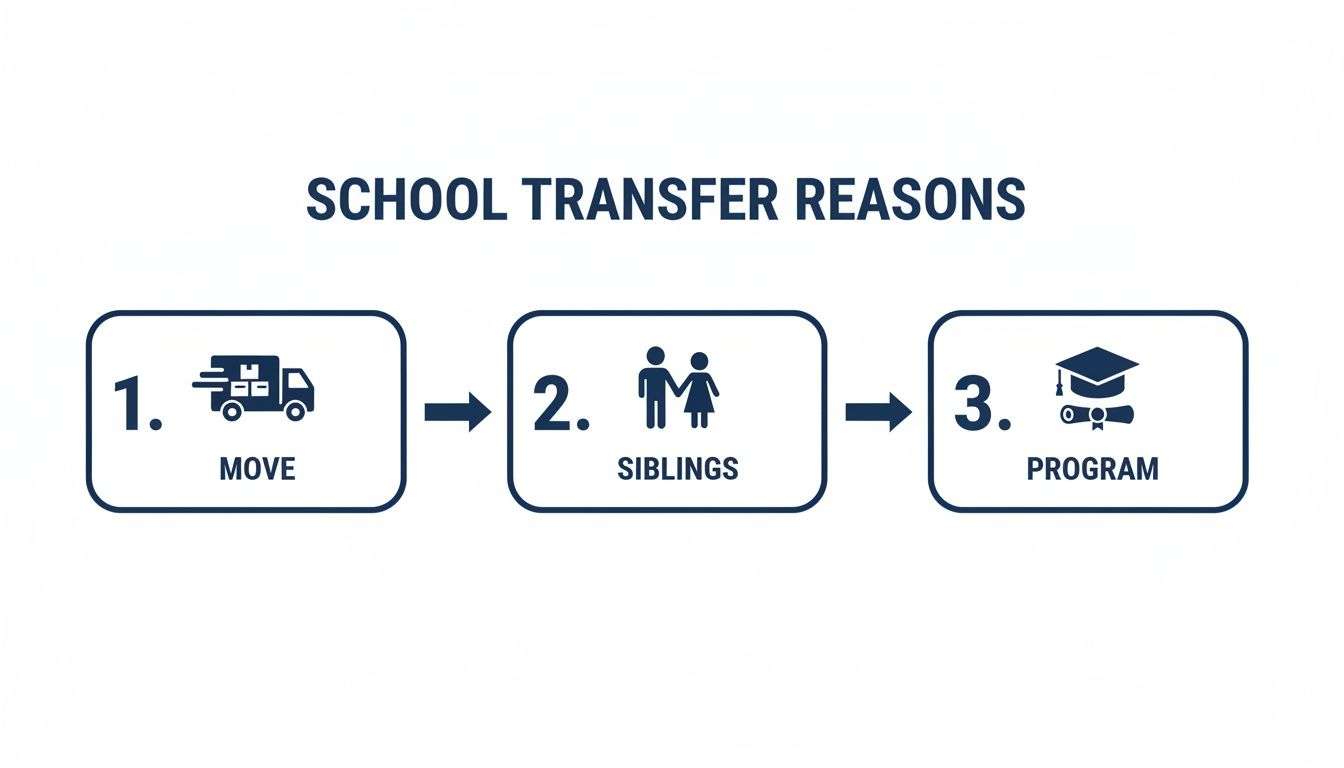
As you can see, the common reasons families apply—like moving, keeping siblings together, or accessing a specific program—often align with the district’s priority categories.
Getting Your Paperwork in Order
Before you submit anything, you’ll need to gather a few documents. Your go-to resource for the most up-to-date forms and instructions should always be the official School District 23 (Central Okanagan) website. Their "Registration" or "Student Enrolment" pages will have exactly what you need.
Here’s a quick overview of what you'll likely need to provide:
- Proof of Your Address: A recent utility bill or a signed tenancy agreement to confirm you live within the district.
- Your Child’s Birth Certificate: Standard for verifying their age and identity.
- The Official Transfer Request Form: This is the core of your application. Be clear and concise when explaining your reasons for the request.
Being organized will save you stress. Having everything scanned and ready makes the online submission process much smoother.
How Decisions Are Made: Understanding Priorities
The district reviews applications based on a well-defined hierarchy.
The highest priority almost always goes to students who already have a sibling attending the requested school. After that, other factors like specific program needs or childcare arrangements can come into play—but always after in-catchment students and siblings are placed.
Knowing this helps set realistic expectations. Your role is to submit a complete and clear application that gives your family the best possible chance within the established framework.
The Decision: What Happens After You Apply
You’ve submitted the paperwork, and now comes the waiting period. This can be a stressful time, but knowing the possible outcomes can help. The school district will provide one of three answers: your request is approved, it's denied, or your child has been placed on a waitlist. An approval is the goal, while a denial provides a clear, though often disappointing, answer. The waitlist is the grey area that can cause the most uncertainty.
What Being on a Waitlist Really Means
Being waitlisted means the school you chose is currently full, but your application is kept on file in case a spot opens up. It’s not a "no," but it's also not a "yes." Waitlists are dynamic, and movement can happen throughout the spring and summer, sometimes right up until the first day of school.
A spot might open up if:
- A family living in the catchment moves away.
- Another family who received a transfer spot decides not to take it.
- Final enrolment numbers in late summer reveal an unexpected opening.
Your child's position on the waitlist is still determined by the district's priority system. A child with a sibling at the school will have a higher priority than one without, even if they were added to the list later.
When Your Request Is Denied
Receiving a denial is disappointing. Most of the time, the reason is simple: there isn’t any room. Popular schools in sought-after neighbourhoods are often at or over capacity with students who live within the catchment boundaries. They physically don't have a desk to spare.
If your request is denied, you may have the option to appeal. The district's appeal process is typically reserved for very specific situations, such as if there were exceptional compassionate grounds or a procedural error. You’ll need to check the district's policy to see if your situation qualifies. No matter the outcome, staying informed and having a backup plan is the best way to navigate this process.
Helping Your Child Through a School Change
Changing schools is a significant event for a child. While you manage the paperwork and logistics, your child is facing the emotional challenge of leaving behind friends, teachers, and a familiar environment. Your support is just as critical as getting the forms filled out correctly.
The key is to give them a sense of predictability when things feel uncertain. Let them know it's okay to feel whatever they're feeling—excited, nervous, sad, or all three at once. Simply listening without judgment gives them the space they need to process the change.

Making the New School Feel Familiar
One of the best ways to calm first-day nerves is to make the new school less of a mystery. Replacing the unknown with something familiar can turn anxiety into curiosity.
A few proactive steps can help:
- Visit the School Grounds: Swing by the school on a weekend. Walk around the outside, check out the playground, and find the main entrance. This helps your child create a mental map of the place.
- Talk About the Positives: Frame the move as an adventure. You could point out, "Look, that playground has a great slide," or "I heard this school has an amazing library we can explore together."
- Practice the New Route: Drive or walk the new morning commute a couple of times. This little ritual helps build a routine before the first bell even rings.
You're not trying to pretend this isn't a big change. The goal is to acknowledge their feelings while building a bridge of positive, tangible experiences that leads to their new school.
Keeping Home Life Consistent
When a big part of your child's world is changing, the stability of home becomes their anchor. Their school life might feel a bit chaotic for a while, but keeping things predictable at home provides a much-needed sense of security. As much as possible, stick to your regular schedules for meals, homework, and bedtime.
Your calm and reassuring presence is the most important support you can offer. By listening to their worries and gently focusing on the exciting things to come, you help give them the confidence to walk into that new school ready for what’s next.
Frequently Asked Questions
Navigating school transfers can bring up many questions, especially when your family’s circumstances don't fit a standard scenario. Here are answers to a few common queries.
What if we move after the transfer deadline?
If you move to a new neighbourhood after the application window has closed, your first step is to register your child at your new catchment school. Do this as soon as you have proof of your new address. This secures their spot. Once they are registered, you can apply for an out-of-catchment transfer to keep them at their previous school for the remainder of the year. However, these late applications are considered after all on-time requests and depend entirely on space availability.
Does having a sibling at a school guarantee a spot?
Having an older sibling at a school gives a younger child priority status for a transfer, but it is not an absolute guarantee. The sibling priority is a major advantage, but it is still contingent on available space. If your younger child’s grade level is already full with in-catchment students, the school may not be able to accept them, despite the family connection.
Are there transportation options for out-of-catchment students?
Generally, no. When you accept a spot at a school outside your designated catchment, transportation becomes the family's responsibility. School bus routes are designed to serve students living within those specific catchment boundaries. While it is rare, if an existing bus route to that school happens to pass through your neighbourhood and has empty seats, a spot may be available, but this cannot be counted on. Before accepting a transfer, ensure you have a reliable plan for the daily commute.
How often do school boundaries change?
School catchment boundaries are not redrawn every year, but they are not permanent. A boundary review process is typically only undertaken for key reasons, such as the construction of a new school or a significant population shift that has made some schools overcrowded while others are under-utilized. These reviews are major projects and are always announced well in advance on the school district's website, often with opportunities for community input.
Navigating big family decisions and transitions can be challenging. Taking the time to understand the process and prepare for the changes ahead can make a significant difference for everyone. If you would like to learn more about managing family stress during periods of change, support is available.
Looking for support? Learn more about Kelowna counselling.