It can feel like a sudden, violent thunderstorm erupting on a calm day. One minute everything is fine, and the next you're overwhelmed, terrified, and feel completely exposed. That’s what a panic attack is like: a sudden, intense episode of fear that sets off severe physical reactions even when there’s no real danger or apparent cause. For more information, see our anxiety counselling.
"A panic attack is a sudden surge of overwhelming fear that comes without warning and without any obvious reason. Counselling helps by providing evidence-based tools to understand this response, manage the symptoms, and regain a sense of safety and control."
If you've had a panic attack, you know how terrifying it can be. You could be doing something completely ordinary—driving, shopping, or sitting in a meeting—when a tidal wave of physical and emotional sensations hits you. It can feel life-threatening. Your heart might start pounding, your chest could tighten, and a dizzying sense of unreality can wash over you. It's common to feel like you're losing your mind, having a heart attack, or even dying.
The experience is profoundly disorienting, mainly because it often strikes without any warning. This can make the world feel unpredictable and unsafe. After the storm passes, a lingering fear of it happening again can settle in, creating a cycle of anxiety where you start to dread the very feeling of fear itself. It's a lonely, isolating place to be, but please hear this: you are not alone, and what you are experiencing is a real and understood medical event.
This guide will walk you through this experience with compassion. We'll explore what a panic attack feels like in simple terms, demystify why it happens, and explain how counselling offers a safe, supportive path toward turning off that false alarm for good. It’s about reclaiming your sense of calm and confidence.
The Three Dimensions of a Panic Attack
Trying to explain what a panic attack feels like can be difficult. It’s often described as a single, overwhelming wave of terror that comes out of nowhere. But if we look closer, that wave is actually made up of three distinct but interconnected parts: intense physical sensations, racing thoughts, and a powerful emotional surge. Understanding these dimensions is the first step toward seeing that these feelings, as frightening as they are, are temporary and manageable.
This concept map breaks down the experience, showing how that initial feeling of a 'sudden storm' is really the body's alarm system getting triggered—and how that alarm can be understood and managed.
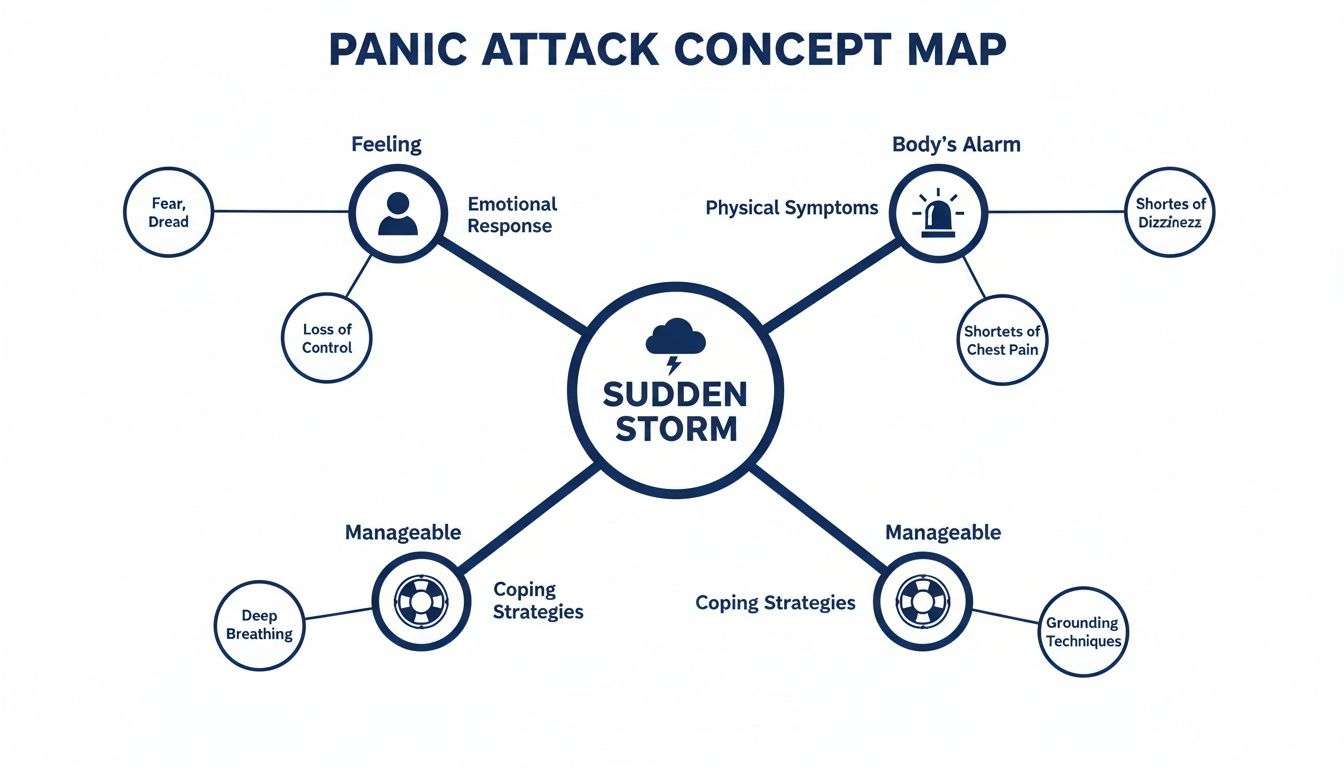
The map helps visualize that while the experience feels chaotic and dangerous, it's a process that can be navigated with the right support. To get a clearer picture, let's break down the complex experience of a panic attack into its core components. The table below outlines what you might feel in your body, your mind, and your emotions. Recognizing these individual symptoms can help you ground yourself when they happen.
| Symptom Category | What You Might Experience |
|---|---|
| Physical | A pounding heart, feeling short of breath, trembling or shaking, sweating, chills, dizziness, or a feeling of being choked. |
| Cognitive | Thoughts of "I'm going to die," "I'm losing control," or "I'm going crazy." Feeling detached from yourself or your surroundings. |
| Emotional | A sudden and intense wave of fear or dread, a sense of impending doom, or feeling terrified that something awful is about to happen. |
Seeing these symptoms laid out like this helps to demystify the experience. It shows that what feels like a catastrophic event is actually a set of recognizable, albeit distressing, responses.
Physical Sensations: The Body's False Alarm
The physical symptoms are often the most alarming part of a panic attack because they feel so much like a real medical emergency. Your body, mistakenly believing you're in life-or-death danger, hits the emergency button and floods your system with adrenaline. This adrenaline rush is what triggers all those powerful physical reactions. It's your body's "fight-or-flight" response kicking into high gear, preparing you to face a threat—even when there isn't one.
- Racing Heart: It feels like your heart is trying to pound its way out of your chest.
- Shortness of Breath: You might gasp for air or feel a suffocating tightness, as if your chest is being squeezed.
- Dizziness or Light-headedness: The world can start to spin, making you feel unsteady and afraid you’re about to faint.
- Trembling or Shaking: Your hands, legs, or even your whole body might shake uncontrollably as adrenaline surges through you.
- Sweating or Chills: You could suddenly break out in a cold sweat or feel a wave of chills, no matter the temperature in the room.
Though they feel incredibly intense, these symptoms are just your body's direct physiological response to adrenaline. They are not in themselves harmful.
Cognitive Distortions: Thoughts in Overdrive
While your body is sounding the alarm, your mind is racing to figure out why. During a panic attack, your thoughts become just as chaotic as your physical symptoms, often jumping to the most terrifying conclusions possible. A panic attack convinces you that your thoughts are facts. It tells you that feeling like you're in danger is the same as being in danger. A core part of how counselling helps is by teaching you to see the difference.
Your mind might be flooded with thoughts like:
- Fear of Losing Control: A deep-seated terror that you’re “going crazy” or about to lose your grip on reality.
- Fear of Dying: The chest pain and shortness of breath are easily mistaken for a heart attack, leading to a conviction that this is the end.
- Sense of Unreality (Derealization): The world around you can feel strange and distorted, as if you’re watching everything through a fog.
- Feeling Detached (Depersonalization): You might feel disconnected from your own body, like you’re an outside observer watching yourself.
These thought patterns are a hallmark of panic, and they pour fuel on the fire. For a deeper dive, you can learn more about anxiety attacks and their symptoms in our detailed guide.
Emotional Overload: The Wave of Fear
At its heart, a panic attack is an overwhelming wave of pure, primal fear. This isn't just worry or nervousness; it’s a profound sense of impending doom that feels absolutely real and immediate.
The sudden, peaking terror of an attack—which can last from a few minutes to half an hour but feel like an eternity—is often described as the most frightening thing a person has ever gone through. This intense emotional response is what can create the vicious cycle of panic. The fear makes you notice the physical symptoms more, which then feeds your catastrophic thoughts, which in turn amps up the fear. This feedback loop keeps the attack going until the adrenaline finally begins to subside.
By understanding that these three dimensions—physical, cognitive, and emotional—are all parts of a single event, you can start to take away its power. You begin to transform it from a terrifying unknown into a recognizable pattern you can learn to manage and, ultimately, overcome.
Why Your Body's Alarm System Misfires
To understand what’s happening during a panic attack, picture your body's built-in security system. We’re all equipped with a “fight-or-flight” response, a primal survival mechanism hardwired into our brains to protect us from legitimate danger. When a real threat appears, this system sounds the alarm and floods your body with adrenaline, preparing you to either confront the danger or escape.
It’s a brilliant system when you actually need it. But a panic attack is what happens when that system gets its wires crossed. It’s like a smoke detector that’s so sensitive it shrieks every time you make toast. There’s no fire, but the alarm is blaring, and your body reacts with the full force of a five-alarm emergency.
The Vicious Cycle of Panic
Once that false alarm goes off, it can kickstart a self-feeding loop that therapists often call the panic cycle. This is where the fear of the physical symptoms of panic actually makes those symptoms worse.
Here’s how that cycle usually works:
- A Random Body Sensation: It starts with something harmless—a little dizziness, a flutter in your chest, or feeling a bit breathless.
- Catastrophic Thinking: Your brain, perhaps already on edge, latches onto that harmless sensation and misinterprets it as a sign of catastrophe. "Is this a heart attack?" or "Am I about to lose control?"
- The Fear Response: That terrifying thought instantly triggers a jolt of pure fear, which is the "on" switch for your fight-or-flight response.
- Symptoms on Overdrive: Now the adrenaline hits. That initial flutter in your chest becomes a pounding heartbeat. The slight breathlessness turns into gasping for air.
- "Proof" That Something's Wrong: These ramped-up symptoms feel like solid proof that your original fear was right. This just reinforces the fear, sending you right back to step two, and the cycle spirals until the adrenaline finally burns off.
This loop is precisely why panic attacks feel so terrifyingly real. Your body isn't broken; it's just doing exactly what your brain is telling it to do—reacting to a perceived threat.
Common Triggers for an Overwhelmed System
While it might feel like panic attacks strike completely out of the blue, they often happen when our nervous systems are already running on fumes. Think of your ability to handle stress like a bucket. Everyday worries and pressures are constantly adding a little water. If that bucket is already full, it only takes one more tiny drop to make it overflow. That overflow is the panic attack. This isn't a sign of weakness; it's your body's way of signalling that you've been carrying too much for too long.
Here are some of the common things that can fill up that "stress bucket":
- Chronic Stress: Juggling nonstop pressure from work, finances, or relationship issues can keep your nervous system stuck in high-alert mode.
- Major Life Changes: Big life events—even good ones—can be destabilizing, such as moving, starting a new job, or losing a loved one.
- Past Trauma: If you've been through a deeply distressing event, your nervous system can become hyper-vigilant, always on the lookout for danger.
- Health Anxiety: Constantly worrying about your own health or the health of a family member can also keep your stress levels high.
Getting to know these triggers and understanding the panic cycle is the first step toward taking your power back. It helps you shift your thinking from, "What's wrong with me?" to a much more helpful question: "How can I start supporting my overwhelmed system?" Knowing what panic attacks feel like and how counselling helps demystifies the whole experience, and that knowledge is what opens the door to healing.
How Counselling Helps You Reclaim Your Calm
When you’re constantly worried about the next panic attack, it can feel like you're walking on eggshells. It's an exhausting way to live. But you don't have to go through this alone. Professional counselling offers a structured, safe space to understand, manage, and finally break free from the cycle of panic.

Think of a therapist as a guide. They know the terrain of anxiety, they have the map, and they walk right beside you, helping you build the strength to navigate the path with confidence. Their job is to equip you with the tools and insight to eventually walk that trail on your own, knowing you can handle any rough patches you encounter.
A Toolkit for Your Mind: Cognitive Behavioural Therapy
One of the most effective and well-researched methods for tackling panic is Cognitive Behavioural Therapy (CBT). The name might sound clinical, but the approach is incredibly practical. CBT isn't about digging endlessly into your past; it's about giving you a functional toolkit you can use right now.
The idea behind CBT is simple: our thoughts, feelings, and behaviours are all linked. A frightening thought triggers the physical feelings of panic, which leads to avoidance behaviours, which in turn strengthens the original scary thought. CBT helps you step in and gently interrupt that loop. In essence, counselling helps you become a detective of your own mind. You learn to spot the catastrophic thoughts that fuel panic, examine the evidence, and develop more balanced, realistic ways of thinking.
This isn't just "thinking positive." It's about learning to see the thought, "My heart is racing, I must be having a heart attack," as a feeling, not a fact. A therapist helps you create a bit of space between yourself and that thought, so you can respond with calm awareness instead of instant fear.
Gently Facing the Fear
A huge part of getting your life back is teaching your brain that the physical sensations you've come to dread are not actually dangerous. This is often done with a technique called exposure therapy, which is always handled in a controlled, gradual, and completely supportive way.
It works by gently and systematically reintroducing you to the physical sensations you fear. In the safety of a session, your counsellor might guide you through a brief exercise that intentionally brings on a mild physical sensation, like feeling slightly light-headed after spinning in a chair or getting your heart beating a bit faster by walking quickly in place.
The goal here is profound. By experiencing these sensations in a safe environment—without them spiralling into a full-blown panic attack—you are actively retraining your brain. You’re giving it new, concrete proof that a racing heart is just a racing heart. It might be uncomfortable, but it's not a catastrophe. This process, called interoceptive exposure, systematically dismantles the fear at its very root.
Building Your Foundation for Calm
Counselling goes beyond just managing the intense moments; it’s also about building a stronger foundation of well-being to make panic less likely to happen in the first place. Your therapist works with you to identify the underlying stressors that might be contributing to your anxiety.
This could involve developing skills in areas like:
- Stress Management: Learning to spot your personal stress signals and using healthy coping strategies before you feel overwhelmed.
- Emotional Regulation: Building the capacity to sit with uncomfortable emotions without needing to react, which fosters a deep sense of inner stability.
- Mindfulness Practices: Using techniques to anchor yourself in the present moment—a powerful antidote to the future-focused worry that often kicks off panic.
Incorporating other practices that promote mental relaxation, such as exploring a Signature Mind Unwind service, can also make a significant difference. Every new skill you learn is another tool in your kit, empowering you to handle life's challenges with greater resilience.
Ultimately, understanding what panic attacks feel like and how counselling helps is about realizing recovery isn't about never feeling anxiety again. It’s about building the confidence that when anxiety shows up, you have the skills and self-trust to manage it without it turning into panic. It’s about getting back in the driver’s seat of your own life.
Practical Skills You Can Learn in Therapy
It's normal to wonder what actually happens in a therapy session. Modern counselling for panic is active and empowering. It’s a collaborative process where you and your therapist work together to build a practical toolkit for managing anxiety in your daily life. A counsellor creates a safe, non-judgmental space where you can be completely honest—a place where you're met with empathy, not criticism. This trust is what makes it possible to start learning new ways of handling panic.
Learning to Calm Your Body
One of the first things you'll work on is how to manage the intense physical rush of a panic attack. When panic strikes, your nervous system kicks into high gear. Learning how to intentionally apply the brakes is a game-changer. A therapist will walk you through proven techniques that directly soothe your body’s stress response.
You'll likely learn skills like these:
- Diaphragmatic Breathing: Also called "belly breathing," this is a specific technique of taking slow, deep breaths that engages your diaphragm. This simple action stimulates the vagus nerve, which tells your brain to switch off the "fight-or-flight" alarm and turn on the "rest-and-digest" system, bringing a wave of calm.
- Progressive Muscle Relaxation (PMR): This is a straightforward exercise where you systematically tense and then release different muscle groups. PMR makes you aware of where you’re holding tension and teaches your body how to consciously let that tension go.
Learning to Work with Your Thoughts
Calming your body is half the battle; the other half is learning how to deal with the catastrophic thoughts that fuel the fire. In therapy, you learn to become an observer of your thoughts instead of getting swept away by them. The goal isn't to force yourself to stop thinking scary thoughts. It's about learning to see them for what they are: just thoughts, not proven facts. This strips them of their power.
A core skill here is cognitive reframing. This is the practice of catching a frightening thought, looking at the actual evidence for and against it, and then coming up with a more balanced and realistic alternative. For instance, you learn to shift from, "My heart is pounding, I'm having a heart attack!" to a more grounded thought like, "This is just an adrenaline rush. My heart is healthy, and this feeling will pass."
Learning to Anchor Yourself in the Present
Panic has a way of yanking your mind into a terrifying future. The most powerful antidote to this is mindfulness—the simple practice of pulling your awareness back to the present moment. Your therapist can guide you through simple grounding exercises that help you connect with your five senses, anchoring you in the here and now. This reminds you that in this specific moment, you are okay. Understanding what panic attacks feel like and how counselling helps is realizing that these practical skills build real resilience.
Grounding Techniques for Immediate Relief
When you're caught in the whirlwind of a panic attack, you need something that works right now. While counselling is where you'll build a long-term toolkit, here are a few evidence-based techniques you can use immediately to interrupt your body's "fight-or-flight" response.

The goal of grounding is to shift your focus away from the terrifying internal spiral of thoughts and symptoms and redirect it to the tangible world around you.
The 5-4-3-2-1 Sensory Method
This is a classic for a reason: it's easy to remember and it works. It methodically forces your brain to engage with your senses and your immediate environment.
- 5: Look around and name five separate things you can see.
- 4: Notice four things you can physically feel.
- 3: Tune in to three distinct sounds.
- 2: Identify two things you can smell.
- 1: Focus on one thing you can taste.
Box Breathing for Regulation
Panic makes your breathing short and fast, which amps up the anxiety. Box breathing is a straightforward technique that slows everything down, calming your nervous system.
- Gently breathe in through your nose for a count of four.
- Hold your breath for a count of four.
- Slowly exhale through your mouth for a count of four.
- Pause and hold your breath again for a count of four.
- Repeat this pattern until you feel yourself settling.
This rhythmic breathing sends a direct message to your brain that the perceived threat is gone, actively countering the fight-or-flight response. You're using your body to tell your mind that you're safe.
Having immediate access to science-backed methods to calm down fast is crucial when dealing with the physical intensity of a panic attack. For more strategies on managing anxiety in general, you may find our guide on how to cope with anxiety helpful.
Using Cold to Shock the System
Sometimes, you need a hard reset. A sudden, sharp change in temperature can be just the jolt your brain needs to break out of a panicked loop. Try splashing cold water on your face or holding an ice cube in your hand. The intense physical sensation demands your brain's immediate attention, pulling your focus away from the panic and back into your body in the present moment.
Frequently Asked Questions About Panic Attacks
It's completely normal to have questions when you're dealing with something as frightening as a panic attack. Getting clear, straightforward answers can be one of the most reassuring steps you take. Here are a few of the most common questions people ask.
Can a panic attack hurt me?
This is often the most pressing fear during an attack. The physical symptoms—a pounding heart, chest tightness, shortness of breath—feel so severe that it’s natural to worry you are in real physical danger. While it’s always wise to consult a doctor to rule out any underlying health conditions, it's crucial to know that a panic attack itself, while intensely uncomfortable, is not dangerous or life-threatening. The sensations are caused by a rush of adrenaline, not a medical emergency.
Will these panic attacks ever go away?
Yes, they can. With the right support and strategies, it is absolutely possible to significantly reduce the frequency and intensity of panic attacks, and for many people, to stop them entirely. The goal of therapy is not just to "cope" but to build lasting resilience. By learning to understand your body's alarm system, challenge the thoughts that fuel panic, and regulate your nervous system, you can regain control and confidence.
How can I support a loved one during an attack?
Watching someone you care about experience a panic attack can be distressing. The most helpful thing you can do is remain calm and present. Your steady presence can be a powerful anchor for them. Speak in a gentle, reassuring tone. Instead of saying "just calm down," which can feel dismissive, you could say, "You are safe. I'm right here with you. This feeling will pass." You can also gently guide them through a grounding exercise, like naming five things they see in the room.
What's the difference between a panic attack and an anxiety attack?
While the terms are often used interchangeably, they are different. According to clinical definitions, a panic attack is a sudden, intense surge of fear that peaks within minutes and often occurs without an obvious trigger. An "anxiety attack" is not a formal clinical term but is often used to describe a period of intense anxiety that builds up gradually in response to a specific stressor. Panic attacks are typically more severe and abrupt.
If these experiences feel familiar, please know that effective, compassionate support is available. You don't have to navigate this alone. Learning more about evidence-based approach to anxiety and panic can be a hopeful first step on the path to feeling better.
Clinically Reviewed By
Amy Mosset, MCP, RCC-S
Amy Mosset is a Master Practitioner in Clinical Counselling, Clinical Supervisor, and the owner of Interactive Counselling. She provides trauma-informed, evidence-based care and clinical supervision to registered therapists, with a focus on ethical practice, client safety, and high-quality therapeutic outcomes.