You may understand exactly why you feel anxious, yet still wake with a tight chest, tense shoulders, restless sleep, or a startle response that seems out of proportion to the moment. You might have talked through the difficult memory many times and still feel as if your body hasn't received the message that you're safe now.
That experience can be confusing, but it isn't a personal failure. Stress and trauma can affect thoughts, emotions, behaviour, and physical sensations at the same time. Somatic therapy counselling in Grande Prairie offers one way to include the body in the therapeutic conversation, alongside approaches that work with thoughts, memories, and relationships.
This guide explains what body-based therapy is, what the research can and can't tell us, what a session may feel like, how somatic work can fit with trauma-focused CBT or EMDR-informed care, and what accessing support in Grande Prairie may involve. You don't need prior knowledge of therapy, and you don't need to decide immediately whether this approach is right for you. Even learning to notice your body's signals with care can be a meaningful first step. For more information, see our trauma counselling.
Why Your Body Might Be Asking for Attention
A person might finish a stressful workday, settle at home, and notice that their jaw is clenched. Another may understand that a past event is over but still scan every room, flinch at sudden sounds, or feel uneasy when someone stands too close. Someone else may describe anxiety as a racing mind, while their body is already showing the first signs through shallow breathing, stomach tension, or a heavy feeling in the limbs.
These responses often develop because the nervous system learned to prepare for danger. After trauma or prolonged stress, the body can continue reacting to reminders, conflict, uncertainty, or sensations that resemble an earlier threat. The reaction may arrive before you have time to form a clear thought. That doesn't mean you're imagining it. It means your protective system is working hard, sometimes long after the original danger has passed.
The mind and body don't always recover at the same pace
Talk therapy can help you understand patterns, name emotions, and make sense of what happened. Those forms of insight matter. Still, insight alone doesn't always change a startle response or release the tension that appears whenever you try to rest.
Somatic therapy begins with curiosity rather than judgement. Instead of treating a tight chest or restless body as an inconvenience to suppress, you and your counsellor may explore what happens just before the sensation, how intense it feels, and what helps it settle. The work remains collaborative. You aren't expected to force a sensation away or explain it perfectly.
Your body isn't evidence that you're broken. It may be communicating that it still needs safety, choice, and time.
Grande Prairie's regional role also matters. The city is a mid-sized service hub in northwestern Alberta, and people seeking specialized counselling may come from nearby rural communities as well as within the city. That can make accessible explanations especially important. You deserve to know what body-based support involves before deciding whether to enquire.
What Somatic Therapy Actually Is
Somatic therapy is a body-based approach to counselling. It pays attention to physical sensations and nervous-system responses while also making room for thoughts, emotions, memories, and the circumstances around you.
A simple analogy is a smoke alarm. The alarm is useful when there's a fire. It may become exhausting when it stays on high alert because burnt toast, steam, or a harmless noise resembles danger. Trauma and chronic stress can leave the body's alarm responding quickly through fight, flight, freeze, shutdown, or heightened vigilance, even when the present situation is different.
How the approach works
A counsellor may invite you to notice a sensation without becoming immersed in it. You might observe pressure in your chest, warmth in your hands, a change in posture, or the urge to look toward the door. You may then experiment with a slower breath, a small movement, contact between your feet and the floor, or an orientation exercise that helps you notice the room around you.
These practices relate to interoception, which means sensing what is happening inside your body. They may also involve posture, breath, movement, and sensorimotor cues. The purpose isn't to perform a perfect exercise. It's to develop a greater ability to notice activation and return toward steadiness without feeling overwhelmed.
Talk therapy often works directly with meaning, beliefs, and language. Somatic therapy adds another route into the same therapeutic process. A client might talk about feeling unsafe in relationships while also learning to identify the shoulder tension and breath-holding that appear during conflict. Neither route has to replace the other.
The term window of tolerance describes the range in which you can experience emotion while staying connected to the present. When activation moves outside that range, you may feel panicked and agitated, or numb and disconnected. A counsellor can help you practise staying within a manageable range before approaching more difficult material.

Core idea: The body holds a story worth listening to, but it doesn't have to tell that story all at once.
Body-based work is commonly considered for trauma, anxiety, PTSD, chronic stress, and difficulties with emotional regulation. It can also support people who feel disconnected from their physical cues or who have found that talking about a problem hasn't fully changed how they respond. A qualified counsellor should still assess the approach with you rather than assuming it fits every concern.
What the Research Says About Body-Based Therapy
Somatic therapies have attracted growing interest, but their research base is smaller than the evidence base for established first-line trauma treatments. That distinction matters. A promising approach can be useful without having enough evidence to support every claim sometimes made about it.
One randomized controlled trial of Somatic Experiencing reported about a 44% reduction in PTSD symptom severity. That finding is meaningful, but one study can't establish that every person will experience the same result, or that every body-based method works in the same way.
Other research summaries add useful context. A 2021 scoping review examined 16 Somatic Experiencing studies, while a meta-analysis of 18 body-oriented psychotherapy trials found medium improvements in distress. These findings suggest potential, but reviews also describe the overall evidence as limited and emerging.
What that means for a treatment decision
A careful interpretation sounds like this: somatic therapy may be a valuable complement to evidence-based trauma care, particularly when physical activation, shutdown, or difficulty staying present is part of the problem. It shouldn't be presented as a guaranteed cure or as a replacement for treatments with a more established evidence base.
Your counsellor may discuss trauma-focused CBT, EMDR-informed work, medication consultation with a physician, or other supports depending on your symptoms and circumstances. Somatic techniques can sometimes be included to help you build stability before, during, or after work with distressing memories.
The research also doesn't prove that every somatic method will help every person. Fit depends on the practitioner, the specific approach, your goals, your health, your level of safety, and whether you can remain sufficiently connected to the present during body-focused exercises.

The most responsible conclusion is neither dismissive nor exaggerated. The evidence is promising, and it remains incomplete. An informed counsellor should be comfortable saying both things, explaining alternatives, and revisiting the plan if the work isn't helping or feels too activating.
What a Somatic Session Feels Like
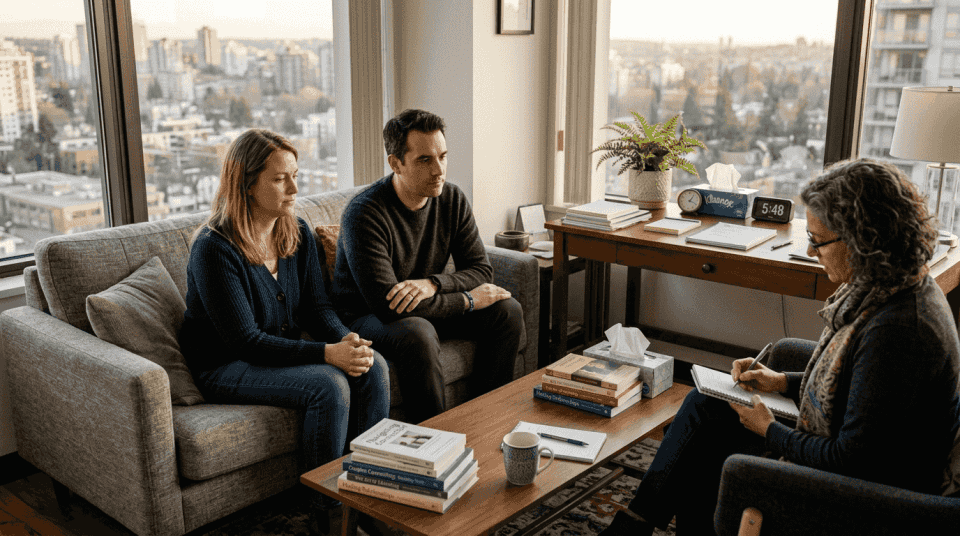
A first session usually begins with conversation. You may discuss what brought you to counselling, what you hope will change, relevant history, current supports, and anything that helps the counsellor understand your needs. You don't have to provide every detail of a traumatic event before you know whether the relationship feels safe.
The counsellor may ask questions such as:
- Body signals: What do you notice when anxiety begins?
- Safety: What helps you feel more settled or in control?
- Pacing: How will you know when an exercise is becoming too much?
- Preferences: Would you rather talk, sit, move slightly, or focus on the room?
- Goals: What would you like to be able to do differently in daily life?
Consent stays active
Body-based counselling should never involve surprise. Before any exercise, your counsellor can explain what they are suggesting, why it may be relevant, and what alternatives are available. You can decline, modify, pause, or stop. The CCPA's ethics guidance says counsellors must explain confidentiality and its limits before counselling begins and continue discussing them throughout the therapeutic relationship. Clear consent and privacy conversations are part of responsible care, not administrative details.
You can pause, ask a question, change direction, or say no at any point. Your agreement matters throughout the session.
A session might include noticing where your body makes contact with a chair, looking around the room to identify signs of present safety, or tracking a breath without trying to change it. It could involve a small movement, such as turning your head slowly or pressing your feet gently into the floor. These exercises are invitations, not tests.
Somatic therapy doesn't require physical touch. It doesn't require you to relive an event in graphic detail, and it shouldn't depend on you breaking down in front of a counsellor. Some clients work with body sensations while talking about a current problem. Others begin with grounding and only later decide whether memory processing is appropriate.

Changes are often gradual rather than dramatic. Over time, a person may notice that sleep feels less restless, a startle response settles sooner, or they can recognise activation before it takes over. Progress may also mean recovering more quickly after a difficult conversation or feeling more able to choose what to do next.
How Somatic Work Fits With Other Therapies
Somatic work doesn't have to stand alone. A counsellor may combine body awareness with talk therapy, trauma-focused cognitive behavioural therapy, EMDR-informed work, or approaches for anxiety, depression, grief, and relationship concerns.
The approaches differ in emphasis, although real therapy often overlaps:
| Approach | Primary focus | Often used for |
|---|---|---|
| Somatic therapy | Physical sensations, nervous-system regulation, posture, breath, and movement | Trauma-related activation, anxiety, stress regulation, and feeling disconnected from the body |
| Trauma-focused CBT | Thoughts, beliefs, avoidance patterns, and behaviours | Anxiety, trauma symptoms, fear-based thinking, and coping patterns |
| EMDR-informed work | Distressing memories, present triggers, and adaptive beliefs | PTSD and specific traumatic experiences when readiness and stability are established |
| Talk therapy | Language, emotions, relationships, meaning, and current concerns | Anxiety, depression, grief, life transitions, and relationship difficulties |
A client recovering from a frightening event may first need grounding skills before memory-focused work feels manageable. Someone who understands their thoughts but feels persistent physical alarm may benefit from adding somatic tracking. Another person may prefer a primarily cognitive or conversation-based approach. The right plan is individual rather than ideological.
When the approach needs adjustment
Body-focused exercises can intensify emotional or physical reactions for some people. This deserves direct discussion, particularly if you experience significant dissociation, have a medical condition that affects body awareness, or are in acute crisis. A qualified counsellor can slow the pace, adapt an exercise, focus on external grounding, or recommend additional support when necessary.
Professional accountability matters here. The CCPA Code of Ethics calls for ethical attunement and practice consistent with professional standards. That supports a careful approach in which a counsellor monitors your response, explains options, and doesn't frame somatic therapy as a quick fix.
Choosing one approach doesn't lock you into it. You and your counsellor can review what's helping, what feels difficult, and whether another method should be added or prioritised.
Accessing Somatic Therapy in Grande Prairie
You might begin by searching for a counsellor after noticing that talk therapy has not fully settled your physical alarm. In Grande Prairie, the city serves as a regional hub in northwestern Alberta, with 64,141 residents in the 2021 Census. Statistics Canada recorded 24,816 occupied dwellings out of 27,551 total private dwellings, while people in nearby rural communities may also travel to the city for specialized counselling. These local details are available through the Grande Prairie community and census information.
Mental-health needs also extend beyond the city itself. In Alberta's North Zone, which includes Grande Prairie, outpatient community mental-health treatment accounted for 15,518 service instances, or 92.9% of North Zone community mental-health treatment volume. Alberta overall recorded 136,992 services, or 93.0%. The same Alberta Health profile reported that 15,838 patients had accessed Community Mental Health services in the relevant reporting period as of March 31, 2018. The Alberta community profile and regional reporting gives added regional context.
What the first practical step can look like
Start with a short enquiry. Ask whether the counsellor provides somatic or body-based support, how trauma is addressed, and how exercises can be adjusted if body awareness feels uncomfortable. You can also ask about registration, privacy, cancellations, fees, and what happens if your needs change.
Interactive Counselling provides Grande Prairie appointments in person, by phone, and through secure virtual care, with daytime, evening, and weekend availability. Its services include trauma-informed and evidence-informed counselling. Details are available on our trauma counselling in Grande Prairie page.
That first conversation does not commit you to somatic therapy. It lets you describe what you are experiencing, ask whether body-based work seems appropriate, and notice whether the counsellor listens without pressure. If you live outside the city, ask whether phone or virtual appointments could make regular care easier.
Grande Prairie Mental Health Services at 10014 99 St. is one community mental-health access point within Alberta's North Zone network. Somatic therapy may form one part of a broader plan that includes medical care, community services, crisis resources, or trauma-focused CBT or EMDR. If you are in immediate danger or cannot keep yourself safe, contact local emergency or crisis services rather than waiting for a routine appointment.
Gentle Answers to Common Questions
Can virtual somatic sessions work?
They can be useful for some people, especially when seeing a counsellor from home feels more private or accessible. A virtual session can include guided breathing, orientation, grounding, noticing contact with a chair, and small movements that you can practise safely in your own space. Your counsellor should confirm that the setting is appropriate and help you make a plan if you become distressed.
Is somatic therapy suitable for children and youth?
It may be adapted for children and youth, but the approach should match their age, communication style, developmental needs, and safety. A counsellor might use play, movement, drawing, sensory awareness, or simple language rather than expecting a young person to describe complex internal experiences. Caregivers may also be involved when appropriate and with attention to the young person's privacy.
Can it help after a car accident?
Body-based support may help someone notice and regulate fear responses connected with driving, traffic sounds, physical tension, or reminders of the collision. It may be combined with trauma-focused CBT, EMDR-informed work, gradual confidence-building, or medical care. If your recovery involves an Alberta auto insurance claim, extended health benefits or an employee assistance program, you can ask about receipts and funding options when you enquire.
How long does it take to notice change?
There isn't one reliable timeline. Some people notice small changes in awareness or recovery from activation early on, while others need more time to establish safety, address ongoing stressors, or work through complex trauma. Your counsellor should review progress with you rather than promise a fixed result.
Exploring support takes courage, especially if your body has learned to stay watchful. You can move at a pace that respects your history, your health, and your choices. Help is available when you're ready to learn more.
Clinically Reviewed By
Amy Mosset, MPCC, RQS
Amy Mosset is a Master Practitioner in Clinical Counselling, Clinical Supervisor, and the owner of Interactive Counselling. She provides trauma-informed, evidence-based care and clinical supervision to registered therapists, with a focus on ethical practice, client safety, and high-quality therapeutic outcomes.
Interactive Counselling offers trauma-informed counselling with somatic and body-based support through in-person, phone, and secure virtual sessions in Grande Prairie. If you'd like to discuss whether this approach fits your needs, visit our Grande Prairie counselling page to learn more and take the first step at your own pace.