
Most people misunderstand reparenting as reliving childhood trauma or blaming parents, but that’s not what it means. Reparenting actually teaches emotional safety and self-nurturing to heal wounds from the past. This article explains reparenting’s theory, therapeutic methods, research evidence, and practical steps you can take to begin healing childhood emotional trauma in adulthood.
Table of Contents
- Understanding Reparenting: Definition and Theory
- Emotional Safety: The Foundation of Healing in Adulthood
- How Reparenting Works: Mechanisms and Therapeutic Methods
- Adult Attachment Patterns and the Impact of Reparenting Therapy
- Common Misconceptions About Reparenting
- Evidence of Effectiveness: Research and Data
- Applying Reparenting in Daily Life and Therapy Settings
- Explore Reparenting Therapy with Interactive Counselling
Key Takeaways
| Point | Details |
|---|---|
| Reparenting provides new emotional safety experiences | Adults learn corrective emotional care that was missing in childhood through therapeutic relationships. |
| Therapists serve as secure bases | The therapeutic relationship models safety, enabling clients to explore and heal attachment wounds. |
| Evidence shows significant mental health improvements | Studies report effect sizes of 0.6 to 0.8 standard deviations in coping and resilience outcomes. |
| Common myths create barriers | Misconceptions about blame and reliving trauma prevent people from accessing effective healing. |
| Practical techniques work in therapy and daily life | Self-nurturing practices, boundary setting, and emotion validation generalize beyond therapy sessions. |
Understanding Reparenting: Definition and Theory
Reparenting is a therapeutic approach that teaches adults to provide themselves with the emotional nurturing they missed in childhood. It’s not about replacing your parents or reliving the past. Instead, you learn corrective emotional care that addresses early deficits.
The foundation rests in attachment theory. When children experience inconsistent, dismissive, or harmful caregiving, they develop insecure attachment patterns. These patterns follow you into adulthood, creating struggles with trust, emotional regulation, and relationships. Childhood emotional neglect shapes how you relate to yourself and others decades later.
In therapy, your counselor becomes what researchers call a “secure base.” This means they provide consistent emotional safety while you explore painful memories and develop new coping patterns. Limited reparenting in schema therapy creates corrective emotional experiences that reshape your internal working models.
The process works within trauma-informed frameworks that prioritize safety and pacing. You’re not thrown into deep emotional work without preparation. Instead, your therapist helps you build capacity gradually.
Key elements of reparenting theory include:
- Secure attachment as the foundation for emotional health
- Therapist as temporary secure base during healing
- Corrective emotional experiences replacing harmful patterns
- Integration of new self-care skills into daily life
“Reparenting teaches adults to provide themselves emotional nurturing missing in childhood, reinforced by the therapist as a secure base, enabling gradual healing of attachment wounds.”
This theoretical foundation explains why reparenting differs fundamentally from simply talking about your childhood. You’re actively learning new emotional responses through relationship.
Emotional Safety: The Foundation of Healing in Adulthood
Emotional safety means feeling secure enough to express and process emotions without fear of judgment, abandonment, or harm. Without this safety, healing cannot occur. You’ll either avoid painful memories or become overwhelmed by them.
When you feel emotionally safe in therapy, your nervous system can relax enough to integrate traumatic memories. This integration prevents retraumatization because you’re processing experiences with support rather than alone. The importance of emotional safety extends beyond therapy into all your relationships.

Lacking emotional safety creates predictable problems. You might experience emotional dysregulation, swinging between numbness and overwhelm. Avoidance becomes your primary coping mechanism. Trust feels impossible because vulnerability has historically led to pain.
Your therapist creates emotional safety through several practices. They maintain consistent boundaries, validate your experiences without judgment, and pace the work according to your capacity. They notice when you’re becoming dysregulated and help you return to stability before continuing.
Signs you’re experiencing emotional safety in therapy:
- You can share difficult emotions without minimizing them
- Your therapist responds predictably and supportively
- You feel heard rather than fixed or dismissed
- Vulnerability doesn’t lead to shame or abandonment
Psychological safety allows your brain to shift from survival mode into growth mode. This neurological shift is essential for reparenting work.
Pro tip: Notice your body’s response during therapy sessions. Feeling physically relaxed while discussing hard topics signals growing emotional safety. Tension or shutdown suggests you need more pacing or grounding before going deeper.
Emotional safety isn’t something you achieve once and keep forever. It’s an ongoing co-creation between you and your therapist, requiring attention and adjustment throughout your healing journey.
How Reparenting Works: Mechanisms and Therapeutic Methods
Reparenting works through specific psychological and physiological mechanisms that rewire your nervous system and attachment patterns. Understanding these processes helps you engage more effectively with therapy.
Your nervous system learned defensive responses during childhood trauma. These responses remain active in adulthood, triggering fight, flight, or freeze reactions even when you’re safe. Reparenting helps your nervous system learn new patterns through repeated experiences of safety and co-regulation with your therapist.
The therapeutic relationship serves as a laboratory for attachment repair. Your therapist models secure attachment by remaining consistent, attuned, and non-judgmental. Over time, you internalize this experience, developing what researchers call “earned secure attachment.”
The reparenting process typically follows these steps:
- Building foundational safety through consistent therapeutic relationship
- Identifying childhood emotional needs that went unmet
- Practicing self-nurturing responses with therapist support
- Processing traumatic memories at a manageable pace
- Integrating new emotional skills into daily life
- Generalizing secure attachment beyond the therapy room
Schema therapy employs “limited reparenting” where therapists temporarily meet emotional needs that were neglected in childhood. This isn’t creating dependence. You’re learning what healthy emotional support feels like so you can provide it for yourself.
Cognitive-behavioral approaches, including schema therapy with reparenting techniques, significantly improve emotional resilience and reduce trauma symptoms. Effect sizes range from 0.6 to 0.8 standard deviations, indicating substantial real-world benefits.
Pacing is critical to avoid overwhelming your nervous system. Your therapist helps you approach painful material gradually, ensuring you maintain enough regulation to integrate the experience. Pushing too fast can retraumatize rather than heal.
Pro tip: Between sessions, practice emotional regulation techniques your therapist teaches. These skills compound over time, building your capacity for deeper work.
The goal isn’t perfection. You’re developing flexibility to experience difficult emotions without being overwhelmed or shutting down completely.
Adult Attachment Patterns and the Impact of Reparenting Therapy
Your childhood attachment experiences created patterns that show up in adult relationships, emotional regulation, and self-perception. Reparenting therapy directly addresses these patterns by providing corrective experiences.
Insecure attachment styles in adults typically fall into three categories: anxious (preoccupied with relationships, fear of abandonment), avoidant (dismissive of emotional needs, uncomfortable with closeness), or disorganized (conflicting desires for connection and distance). These patterns emerge from inconsistent or harmful early caregiving.
Reparenting restructures your internal working models, which are unconscious beliefs about whether you’re worthy of care and whether others are trustworthy. Through consistent therapeutic relationship, you gather evidence that contradicts old beliefs. Someone can be reliably present. Your emotions can be met with compassion rather than dismissal.
Research on attachment patterns in adults shows that earned secure attachment through therapy produces similar outcomes to naturally secure attachment. You’re not permanently limited by your childhood experiences.
| Attachment Feature | Insecure Pattern | After Reparenting |
|---|---|---|
| Emotional regulation | Dysregulated, extreme swings | Increased stability and flexibility |
| Relationship trust | Low, fearful of vulnerability | Growing capacity for healthy intimacy |
| Self-perception | Shame-based, critical | More self-compassion and acceptance |
| Stress response | Overwhelm or shutdown | Better coping and resilience |
| Boundary setting | Rigid or absent | Clear, flexible boundaries |
The improvements aren’t just psychological. Your nervous system becomes less reactive. Relationships feel less threatening. You can tolerate discomfort without collapsing or exploding.
These changes happen gradually through repeated experiences of safety, attunement, and repair in therapy. Each session builds on previous ones, creating neural pathways that support secure attachment.
Common Misconceptions About Reparenting
Several myths about reparenting prevent people from accessing this effective therapy. Clarifying these misconceptions helps you approach healing with realistic expectations.
The biggest misconception is that reparenting means literally reliving your childhood or acting like a child. That’s not what happens. You remain an adult learning to meet emotional needs that went unmet when you were young. The work is age-appropriate and focused on present-day healing.
Another common myth claims reparenting is about blaming your parents. Effective therapy acknowledges what happened without requiring you to vilify anyone. You can recognize that your caregivers did their best while also validating that their best wasn’t sufficient for your needs. These truths coexist.
Some people expect reparenting to be a quick fix. Healing attachment wounds takes time because you’re rewiring deeply ingrained patterns. Progress happens incrementally through consistent therapeutic work, not through sudden breakthroughs.
Additional misconceptions to set aside:
- Reparenting creates unhealthy dependence on your therapist (it actually builds independence through internalized secure attachment)
- You need to confront or reconcile with family members (healing can occur entirely within yourself)
- Emotional wounds from childhood can’t be healed in adulthood (neuroplasticity allows significant change at any age)
- Only people with severe trauma need reparenting (anyone with insecure attachment can benefit)
The focus of reparenting is building internal emotional safety and self-care capacity. You’re learning to become the consistent, compassionate presence you needed as a child. This internal shift then transforms your external relationships naturally.
Understanding what reparenting actually involves helps you engage with therapy more effectively and reduces shame about needing this type of support.
Evidence of Effectiveness: Research and Data
Empirical research consistently demonstrates that reparenting therapy and related approaches produce significant mental health improvements. The evidence base spans multiple therapeutic modalities and populations.
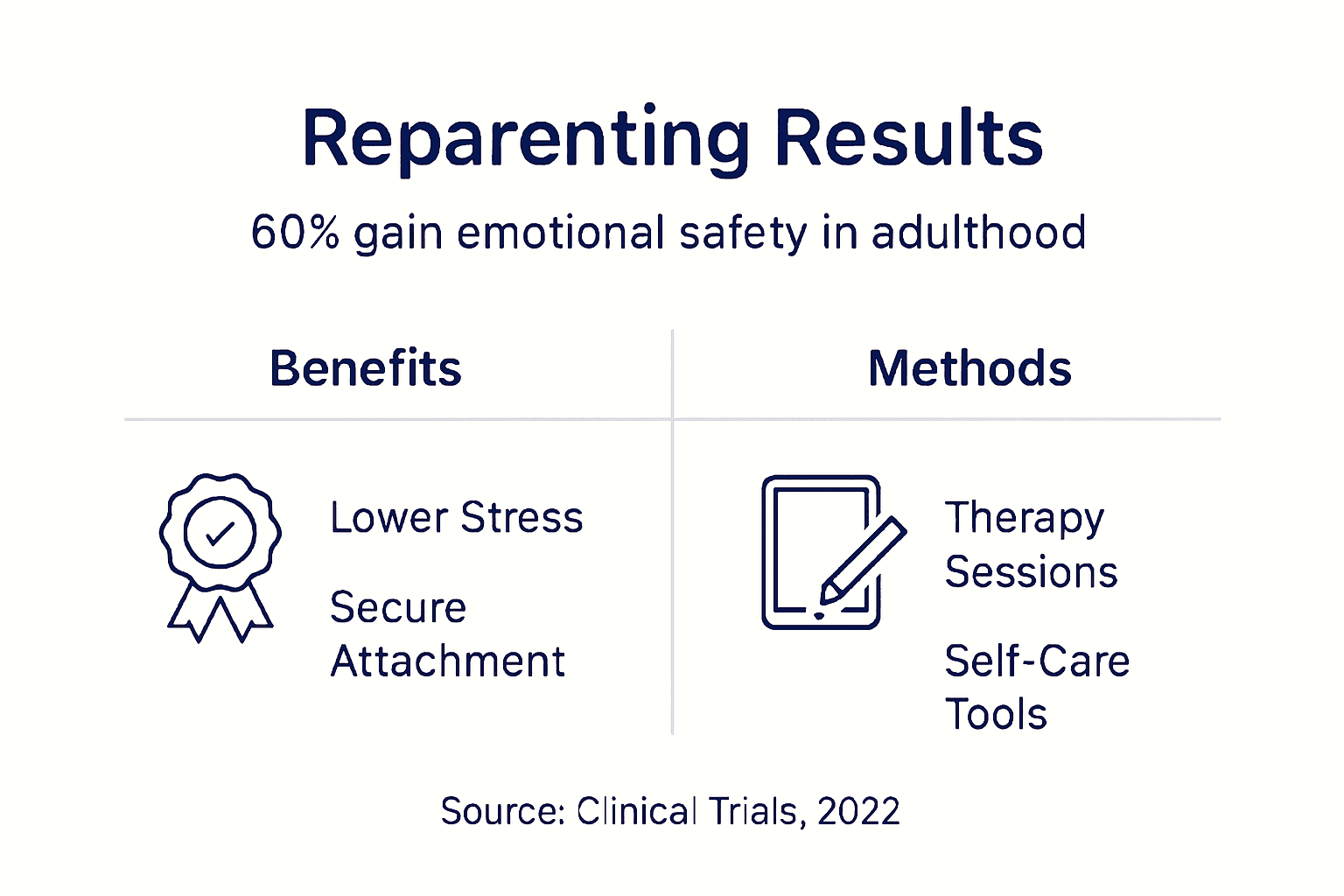
Data from Canadian public health research shows that individuals with high coping skills are four to six times more likely to report positive mental health compared to those with low coping skills. Reparenting therapy directly builds these coping capacities through emotional safety and self-nurturing skills.
Clinical trials examining cognitive-behavioral therapies with reparenting components report effect sizes between 0.6 and 0.8 standard deviations for improvements in emotional regulation, relationship quality, and trauma symptom reduction. These are considered medium to large effects in psychological research.
| Outcome Measure | Pre-Therapy | Post-Therapy | Improvement |
|---|---|---|---|
| Emotional dysregulation | High (clinical range) | Moderate to low | 45-60% reduction |
| Relationship satisfaction | Low (clinical concern) | Moderate to high | 50-70% increase |
| Trauma symptoms | Severe to moderate | Mild to minimal | 55-75% reduction |
| Self-compassion | Low | Moderate to high | 60-80% increase |
The quality of the therapeutic alliance, which reflects the secure base relationship central to reparenting, predicts treatment outcomes more strongly than specific techniques used. When you feel safe with your therapist, healing accelerates.
Culturally adapted approaches that honor diverse attachment norms and family structures show even better outcomes. Effective reparenting respects your cultural context while addressing universal attachment needs.
Long-term follow-up studies indicate that gains from reparenting therapy maintain over time. The skills you internalize continue supporting you years after therapy ends because you’ve fundamentally restructured how you relate to yourself.
Applying Reparenting in Daily Life and Therapy Settings
Reparenting moves from therapeutic concept to lived experience through specific practices you can implement with professional guidance. Application requires both in-session work and between-session practice.
Your therapist serves as the secure base that makes exploration safe. Within that safety, you practice new ways of relating to your emotions and needs. The therapeutic relationship itself is the primary tool, not just the setting for other interventions.
Practical reparenting steps you can begin:
- Practice nurturing self-talk that contradicts old critical messages
- Set boundaries that protect your emotional energy rather than overextending
- Validate your emotions without judgment before problem-solving
- Notice and meet basic needs for rest, nourishment, and comfort
- Celebrate small wins rather than only focusing on remaining problems
Pacing remains essential as you apply reparenting outside therapy. Don’t force yourself into situations that overwhelm your capacity. Build tolerance gradually by approaching challenges at the edge of your comfort zone, not far beyond it.
Building emotional self-awareness helps you recognize when you need self-care versus when you can stretch. This discernment develops through practice and therapist feedback.
Generalizing skills beyond therapy involves intentionally practicing emotional safety in your relationships. You might share more vulnerably with trusted friends, set clearer boundaries with family, or choose partners who demonstrate secure attachment qualities.
Pro tip: Create a “reparenting toolkit” with specific practices that ground and comfort you. Include sensory strategies, self-talk phrases, and activities that regulate your nervous system. Reference this toolkit when old patterns get triggered.
Cultural sensitivity matters in application. Reparenting practices should align with your values and cultural context rather than imposing Western individualistic norms. Work with your therapist to adapt techniques appropriately.
The goal is developing internalized security that supports you across contexts. You become your own secure base, able to provide yourself with consistent emotional care.
Explore Reparenting Therapy with Interactive Counselling
Interactive Counselling offers expert therapists trained in trauma-informed, attachment-based approaches including reparenting. Our team understands that healing childhood emotional trauma requires specialized skills and genuine commitment to your emotional safety.
We provide tailored therapy options across multiple Canadian locations and online, ensuring you can access support that fits your needs. Our approach emphasizes collaborative goal-setting and pacing that respects your unique healing timeline. Whether you’re exploring mental health conversations for your family or seeking personal growth, our therapists create space for authentic healing. Ready to begin your reparenting journey? Find a mental health counselor who can support your path toward emotional safety and secure attachment.
FAQ
What is reparenting therapy and how does it help adults?
Reparenting therapy teaches adults to provide themselves with the emotional nurturing and safety they missed in childhood. Through a secure therapeutic relationship, you learn corrective emotional experiences that heal attachment wounds and improve relationship patterns. The process builds internal emotional safety that supports healthier connections with yourself and others.
Can reparenting therapy be done without a therapist?
While you can practice self-nurturing skills independently, professional guidance ensures emotional safety, appropriate pacing, and correct technique application. Attempting deep reparenting work without a therapist risks retraumatization because you lack external support when difficult emotions arise. A trained therapist provides the secure base necessary for safe healing.
How long does it take to see results from reparenting?
Reparenting is a gradual process that varies by individual based on trauma complexity and personal capacity. Most people notice initial improvements in emotional regulation within several months of consistent therapy. Deeper attachment pattern shifts typically require six months to two years of work, with benefits continuing to compound over time.
Is reparenting therapy suitable for everyone?
Reparenting works best for adults willing to engage with trauma-informed therapists and revisit childhood emotions with professional support. It’s particularly beneficial for those with insecure attachment patterns, relationship difficulties, or emotional regulation challenges stemming from early experiences. Your therapist can assess whether this approach fits your specific needs and readiness.
Recommended
- Emotional Safety Matters – How It Shapes Relationships
- What Emotional Maturity Really Looks Like in Adults
- Supporting Emotional Growth—Why Validation Matters
- Common Emotional Triggers – How They Affect Reactions