It often feels like there’s a war going on inside your head, doesn't it? On one side, you have a relentless voice that picks apart every mistake. On the other, a much quieter, gentler voice tries to chime in with a bit of support. The chasm between your inner critic and your inner coach is huge. One drags you down into a spiral of self-doubt, while the other helps you build resilience and grow. The good news is that you can change this dynamic. With the right support, you can learn to turn down the volume on that harsh inner voice and amplify the encouraging one. For more information, see our couples counselling.
"Therapy helps you identify the origins of your harsh inner critic and uses evidence-based strategies to intentionally cultivate a compassionate, supportive inner coach, fundamentally changing your relationship with yourself for the better."
Understanding the Two Voices in Your Head
Before we can start changing the conversation in your head, we first need to get clear on who is speaking. Think of it like identifying the two key players on a team.
Your inner critic is that harsh, demanding voice that fixates on your flaws and dismisses your achievements. It loves to speak in extremes, using words like "always" and "never." Its goal, believe it or not, is often to protect you from failure or embarrassment by keeping you from taking risks. It's a misguided security guard.
Then there’s your inner coach. This is the voice of reason and compassion. It’s the part of you that can acknowledge a struggle without judgment, celebrate the effort you put in, and see a setback as a chance to learn something new. This is the voice that builds you up and gives you the courage to keep going, especially when things get tough.
Simply learning to tell these two voices apart is a massive first step. The inner critic can be incredibly loud and convincing, but listening for your inner coach is a skill you can strengthen over time. You might notice your critic gets loudest when you’re stressed, tired, or trying something new—that’s its favourite time to show up.
Comparing Your Inner Critic and Inner Coach
Sometimes, seeing the differences laid out side-by-side can make it much easier to identify which voice is talking. This table provides a clear, at-a-glance comparison of the distinct characteristics, motivations, and impacts of the inner critic and the inner coach, helping you identify which voice is currently dominant in your thoughts.
| Characteristic | Inner Critic | Inner Coach |
|---|---|---|
| Primary Tone | Harsh, judgmental, and demanding. | Compassionate, supportive, and encouraging. |
| Motivation | Fear-based; aims to prevent failure and judgment. | Growth-oriented; aims to build resilience and confidence. |
| Focus | Past mistakes, perceived flaws, and weaknesses. | Present effort, strengths, and opportunities for learning. |
| Language Used | "You always mess up." "You're not good enough." | "You tried your best." "What can we learn from this?" |
| Impact on You | Increases anxiety, depression, and self-doubt. | Fosters self-esteem, motivation, and emotional well-being. |
Looking at this, you can start to see how a shift from one column to the other isn't just about feeling better in the moment—it’s about fundamentally changing how you navigate your life.
Understanding the Voices Within: An In-Depth Comparison
Learning to tell the difference between your inner critic and your inner coach is a bit like learning to distinguish between a storm cloud and a patch of blue sky. Both are powerful forces in your mind, but they shape your emotional landscape in profoundly different ways. The first step in changing that internal narrative is simply recognising who’s talking.
The inner critic almost always speaks from a place of fear. Its main job, as it sees it, is to protect you from potential failure, rejection, or embarrassment by pointing out every single flaw before anyone else gets the chance. It's that nagging voice whispering, "Don't even bother trying, you'll just mess it up," right when you're thinking about taking on a new challenge.
In contrast, the inner coach comes from a place of compassion and genuine encouragement. It’s there to support your growth, acknowledge the effort you’re putting in, and help you learn from experiences without drowning in shame. This is the voice that says, "This is tough, but you've got this. What's one small step we can take right now?"
Core Functions and Emotional Impact
The harsh self-talk from the inner critic often gets its fuel from common cognitive distortions—basically, skewed patterns of thinking that lock in unhelpful beliefs. This voice blows mistakes out of proportion, completely ignores your successes, and talks in black-and-white terms. The result? You’re left feeling anxious, defeated, and small. Over time, that constant barrage can seriously erode your self-esteem.
Your inner coach, on the other hand, is all about building resilience. It helps you see situations with more clarity and kindness, reframing a setback not as a total catastrophe, but as a chance to learn something valuable. This supportive dialogue builds your confidence and cultivates a real sense of inner safety and self-worth.
This chart offers a great visual breakdown of these two competing voices.
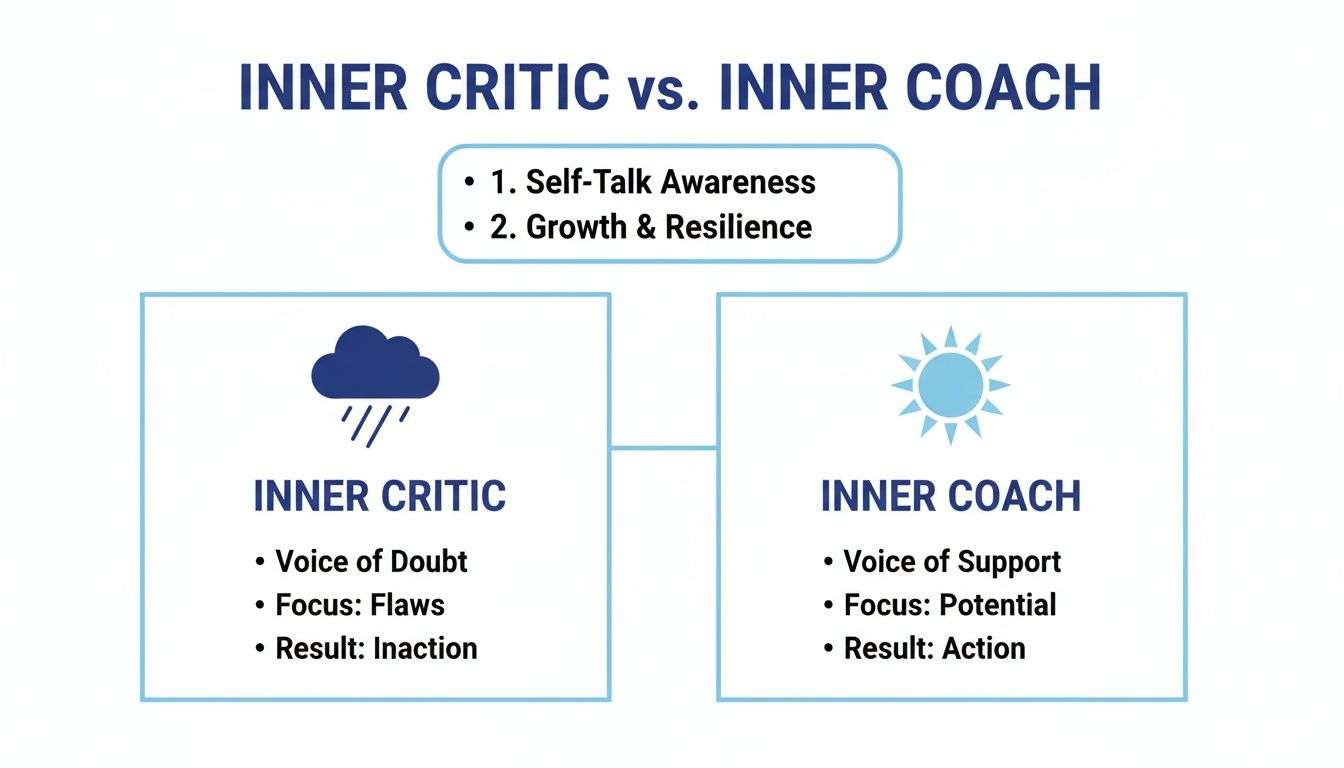
As you can see, the comparison really highlights how the critic keeps you stuck by focusing on past flaws, while the coach gently nudges you forward by focusing on your potential.
Real-World Scenarios Unpacked
To really get a feel for the inner critic vs inner coach dynamic, let’s look at how they might sound in a couple of common situations.
Scenario 1: You make a mistake at work.
- Inner Critic: "I can't believe I did that. I'm so incompetent. Everyone must think I'm a total fraud. I’ll probably get fired over this."
- Inner Coach: "Okay, that wasn't my best moment, but mistakes happen. What can I actually learn from this? I'll own it and figure out how to make it right."
Scenario 2: You're going through a tough life change, like a breakup.
- Inner Critic: "This is all my fault. I'll be alone forever. There must be something fundamentally wrong with me that I keep pushing people away."
- Inner Coach: "This hurts so much right now, and that's okay. I need to be kind to myself. This is an ending, but it’s also a chance to rediscover what I truly need."
The difference isn't just in the words themselves, but in the feeling they leave you with. The critic churns up shame and keeps you frozen, while the coach inspires self-compassion and action. If that harsh inner critic sounds painfully familiar, you are far from alone.
Learning to identify which voice is speaking is a foundational skill we work on in counselling. It creates just enough space between you and your thoughts, giving you the power to choose which one you listen to and which one you simply let pass by. This awareness is where the real work of changing your inner world begins.
How Therapy Helps You Cultivate Your Inner Coach
Therapy offers a dedicated, safe space to do the work of shifting your internal dialogue. It’s not about trying to silence your inner critic. Instead, it’s about understanding where that voice came from and learning practical, proven skills to nurture a more supportive inner coach. With a therapist's guidance, you can move from just noticing these two voices to actively reshaping the conversation inside your head.
The process often starts with a bit of detective work: where did your inner critic even come from? This voice didn't just show up one day; it’s usually a reflection of past experiences—maybe childhood criticism, deeply stressful events, or unresolved trauma.
In a supportive counselling environment, you can explore these roots without judgment. A therapist can help you see that the critic, as harsh as it sounds, often started with a misguided attempt to protect you. Realising this can be the first step toward approaching that critical voice with curiosity instead of fear.
The Role of Evidence-Based Therapies
Therapists draw from a toolkit of well-researched methods to help dial down the critic and turn up the volume on the coach. Each approach offers a unique way to start rewiring those deeply ingrained thinking patterns.
Here are a few highly effective therapies we often use:
Cognitive Behavioural Therapy (CBT): This is all about learning to spot, question, and reframe the automatic negative thoughts your inner critic throws at you. Your therapist helps you become an investigator of your own thoughts, looking for actual evidence to see if the critic's harsh statements hold any water.
Acceptance and Commitment Therapy (ACT): Rather than battling critical thoughts, ACT teaches you how to step back and "unhook" from them. You learn to observe your inner critic's commentary without getting tangled up in it, creating enough space so that its words lose their power over your choices.
Compassion-Focused Therapy (CFT): This approach directly targets self-criticism and shame by building up your capacity for self-compassion. You actively practice skills to soothe yourself and develop an inner voice that is warm and encouraging—the very definition of an inner coach.
These aren’t just abstract concepts. They are structured, practical strategies that have helped countless people find lasting relief.
From Understanding to Lasting Change
Therapy isn't just about talking about your inner critic; it's about giving you the tools to actively change your relationship with it. The goal is to help your inner coach become the default narrator of your life, not just a voice you hear on a good day. A therapist acts as your guide through this process. They help you spot the subtle ways the critic influences your daily life, whether it's causing you to procrastinate on a big project or avoid social gatherings.
This journey is really about learning to treat yourself with the same kindness and understanding you’d offer a close friend. You’ll practise acknowledging your struggles without judgment, celebrating your effort instead of obsessing over the outcome, and reminding yourself that making mistakes is simply part of being human.
Ultimately, the work you do in therapy helps you build a strong, resilient inner coach that can guide you through life's challenges with wisdom and self-compassion. This shift doesn’t just make you feel better—it fundamentally changes how you relate to yourself and the world, opening the door to greater confidence and true emotional well-being.
Evidence-Based Therapeutic Approaches to Rewire Your Thinking
So, you can tell the difference between your inner critic and your inner coach. That's a huge first step. The next logical question is, how do I actually get the coach to show up more often? This is where therapy comes in, offering a clear roadmap—not just talk, but structured tools to actively rewire the neural pathways that have kept your inner critic in the driver's seat for so long.
A therapist uses a variety of proven methods to help you do more than just fight back against that critical voice. It’s about understanding where it came from with a sense of compassion. The goal isn't to crush or banish this part of you, but to completely change your relationship with it.

Unpacking Different Therapeutic Models
Several therapeutic models are incredibly effective for dealing with a harsh inner critic. Each one gives you a unique way to look at your internal world and offers different strategies for making real, lasting change. Let's break down a few key approaches right here.
Internal Family Systems (IFS): IFS therapy sees your mind as a family of different "parts." From this perspective, your inner critic is a protective part, one that adopted a harsh role to keep you safe from things like failure or judgment. Instead of trying to silence it, IFS teaches you to get curious and compassionate, asking this part what it’s so afraid of. This process helps redirect its protective energy into something much healthier and more supportive.
Eye Movement Desensitization and Reprocessing (EMDR): A relentless inner critic is often powered by unresolved trauma or painful memories from the past. EMDR is a powerful therapy specifically designed to help your brain properly process these stuck memories. By working through the experiences that give the critic its ammunition, EMDR can dramatically turn down the volume on negative self-talk, letting a more compassionate voice come through naturally.
Cognitive and Compassion-Based Strategies
Other therapies take a more direct approach, focusing on your thought patterns and your ability to be kind to yourself. When you're looking for ways therapy can help strengthen your inner coach, finding a CBT therapist can be a game-changer for challenging and reframing those negative thought loops.
These methods give you the practical, day-to-day skills you need to build up your inner coach.
Cognitive Behavioural Therapy (CBT): This approach is all about spotting the automatic negative thoughts your inner critic throws at you and questioning them with cold, hard evidence. You learn to identify cognitive distortions—like all-or-nothing thinking or jumping to the worst-case scenario—and consciously rework them into thoughts that are more balanced and realistic.
Compassion-Focused Therapy (CFT): CFT goes right to the heart of the matter: the feelings of shame and self-criticism your inner critic feeds on. It gives you practical skills to develop self-compassion, like soothing breathing exercises and guided visualizations. The aim is to activate your brain's self-soothing system, which is a powerful antidote to the threat-based response triggered by your inner critic.
Picking the right therapy often comes down to your personal history and what feels like the right fit for you. A skilled therapist can help you figure out which method—or combination of methods—will best support you on your journey to a kinder inner world.
Practical Exercises to Begin Shifting Your Inner Voice Today
While working with a therapist offers a structured, supportive path for deep-seated change, you can begin shifting the conversation in your head right now. These practices are all about building awareness, creating some healthy distance from your inner critic, and consciously cultivating your inner coach.
Think of these as powerful first steps, not a replacement for professional guidance. They are simple, practical ways to start relating to yourself with a bit more kindness and compassion in your day-to-day life.

Exercise 1: Name Your Critic
One of the quickest ways to strip your inner critic of its power is to externalise it. It sounds simple, but giving that harsh voice a name—maybe something a little silly like "The Judge" or "The General"—instantly creates separation. It’s a powerful reminder that this critical voice isn't you; it's just one part of your internal experience.
The next time that voice pipes up, try thinking, "Ah, there's The Judge again with its usual complaints." This simple act of naming it transforms the critic from an all-powerful truth-teller into a predictable, and frankly, much less intimidating, character.
Exercise 2: Fact-Check the Critic
Your inner critic loves to speak in absolutes and worst-case scenarios. A fantastic way to push back is to treat its claims like a detective would: by looking for the cold, hard evidence. This is a core skill you can develop further using a thought record, a go-to tool in Cognitive Behavioural Therapy.
When the critic says, "You always mess things up," put it on trial:
- Is this 100% true? Can I think of even one time I didn't mess things up?
- What's a more balanced perspective? "I made a mistake this time, but I've also succeeded at plenty of other things."
- What would I tell a friend? "Everyone makes mistakes. That's how we learn and grow."
By questioning the critic's dramatic statements, you weaken its credibility. You begin to see its commentary not as fact, but as a collection of distorted, fear-based opinions that you don't have to accept as reality.
Exercise 3: Take a Self-Compassion Break
In those moments of intense self-criticism or emotional pain, this simple, three-step exercise can bring immediate comfort and shift your internal state. It’s about giving yourself the kindness you need, right when you need it most.
- Acknowledge the Pain: Simply say to yourself, "This is a moment of suffering," or "This really hurts." This validates your experience without judgment.
- Recognise Common Humanity: Remind yourself, "Suffering is a part of life," or "Everyone struggles like this sometimes." This small step helps you feel less isolated in your pain.
- Offer Yourself Kindness: Gently place a hand over your heart and say, "May I be kind to myself in this moment," or "May I give myself the compassion I need."
This practice directly counters the critic’s harshness with warmth and understanding, actively strengthening the voice of your inner coach.
By weaving these small exercises into your day, you begin the powerful process of rewiring your internal dialogue. You’re not just passively listening to an inner critic vs. inner coach battle; you are actively choosing to cultivate a kinder, more supportive relationship with yourself, one thought at a time.
When to Seek Professional Support for Your Inner Critic
These exercises are powerful first steps. They can help you start noticing that harsh inner voice and begin practicing a kinder way of talking to yourself. But sometimes, the inner critic is more like a relentless bully than a nagging voice. When it’s so loud and deeply ingrained, trying to challenge it on your own can feel like whispering in a hurricane. Knowing when it’s time to call in for backup is a huge act of self-care.
Reaching out for professional help isn't a sign of weakness. It's a sign of strength. It means you recognize the burden is too heavy to carry alone and you deserve real, compassionate support to lighten the load.
Signs It Might Be Time for Counselling
If that critical voice feels less like an occasional annoyance and more like a constant tormentor, it might be time to connect with a therapist. Here are a few clear signs that professional guidance could be the key to quieting the noise.
You might notice your inner critic is causing serious harm if:
- You're constantly anxious or depressed: The critic's non-stop negativity feeds feelings of hopelessness, anxiety, or depression that get in the way of your daily life.
- Your relationships or work are suffering: You find yourself backing away from opportunities, pushing people away, or struggling at work because that voice of self-doubt is just too loud.
- It’s tied to past trauma: Your self-criticism feels deeply connected to traumatic experiences from your past. Trying to challenge it brings up overwhelming emotions or flashbacks.
- You just feel stuck: You’ve tried self-help strategies, but you’re still caught in a cycle of negative self-talk and can't see a way out by yourself.
A registered therapist offers a safe, non-judgmental space to explore the roots of your inner critic without fear. Think of it as a dedicated partnership focused on helping you heal and build the skills for lasting change.
What to Expect from Therapy
When you start counselling, the first step is building a trusting relationship where you feel truly seen and heard. Your therapist will work with you to gently untangle the patterns that have kept your inner critic in the driver's seat for so long.
The process often involves exploring where that critic came from and understanding its original (though misguided) purpose—it was likely trying to protect you in some way. Using proven methods, you'll learn concrete strategies to question distorted thoughts, process the pain underneath, and actively nurture a more compassionate inner coach.
You're not just venting about the problem; you're building a practical toolkit for a new way of living. Seeking therapy is an investment in your well-being. It’s a commitment to learning how to go through life with a supportive guide in your head instead of a harsh judge. With the right support, you can absolutely shift this internal dynamic and find more resilience, confidence, and peace.
Frequently Asked Questions
It’s completely normal to have more questions as you start to think about what this means for you. Here are a few common ones we hear, answered with warmth and understanding.
Is it possible to completely silence my inner critic?
That’s a question a lot of people ask, and it comes from a very understandable place—wanting the harshness to just stop. The goal in therapy, however, isn't about total silence. It's more about changing the dynamic. Think of your inner critic less as an enemy to destroy and more as a misguided part of you that’s trying to protect you, even if it’s going about it in a clumsy, painful way. Through therapy, we work on turning down its volume so its voice fades into the background, allowing your compassionate inner coach to become the one you hear most clearly.
How can I support someone struggling with a harsh inner critic?
It's incredibly tough watching someone you care about beat themselves up. One of the best things you can do is simply listen without trying to "fix" it. Let them know you hear them and that what they’re feeling is valid. Gently reminding them of their strengths or times you've seen them succeed can also offer a different perspective to counter the negative story they're telling themselves. And, if their struggle feels overwhelming, gently suggesting they talk to a professional can be the most supportive step of all.
How long does it take to build a strong inner coach?
This is a journey, not a race, and everyone’s timeline is unique. It really depends on how long that critical voice has been running the show and how consistently you're able to practise new, kinder ways of talking to yourself. Some people feel a real shift within a few weeks of starting counselling, while for others, it might be a process of several months. The most important thing is to be patient with yourself. Every single time you choose a compassionate thought over a critical one, you're building that inner coach’s strength.
If you feel ready to explore this further, learning more about how counselling works can be a gentle and empowering next step. Remember, you don't have to navigate this alone. Taking the time to understand your inner world is a profound act of self-care, and support is available whenever you’re ready.
Clinically Reviewed By
Amy Mosset, MCP, RCC-S
Amy Mosset is a Master Practitioner in Clinical Counselling, Clinical Supervisor, and the owner of Interactive Counselling. She provides trauma-informed, evidence-based care and clinical supervision to registered therapists, with a focus on ethical practice, client safety, and high-quality therapeutic outcomes.