Your first EMDR therapy session in Vernon is usually a gentle, collaborative starting point. It's mainly about building safety, understanding your history, and preparing you for the therapy, not diving into deep trauma work right away. For more information, see our Vernon trauma counselling.
If you're reading this, there's a good chance you're holding a mix of hope and nerves. Maybe you've heard EMDR can help with trauma, anxiety, or the after-effects of a car accident. Maybe you're wondering whether your first appointment will feel intense, awkward, or overwhelming. Those questions make sense. Starting any therapy can feel vulnerable, and EMDR can sound especially mysterious when you haven't experienced it before. For more information, see our counselling in Vernon.
"The first EMDR session in Vernon is typically a calm, preparatory meeting where you and your therapist focus on safety, history, and readiness rather than immediate trauma processing." For more information, see our trauma counselling.
Taking the First Step Towards EMDR in Vernon
Many people look up First EMDR therapy session Vernon what to expect because they want one simple answer to a very human worry: Will I be okay in that room? Usually, yes. The first appointment is designed to help you settle in, ask questions, and get a feel for whether the process feels safe enough for you.
You might be someone who has been carrying stress in your body for a long time. Or maybe something more recent has shaken your sense of safety. In Vernon, that can include everyday life pressures, grief, relationship strain, or recovery after a motor vehicle accident. Whatever brought you here, it doesn't have to be “bad enough” to deserve support.
A first EMDR session often feels more like a careful conversation than what people imagine from films or social media. You won't be pushed to share every detail. You won't be expected to perform your pain. A good therapist will pay close attention to how you're feeling, how quickly you want to go, and what helps you stay grounded.
You're allowed to be unsure, emotional, quiet, talkative, sceptical, or relieved. None of that means you're doing therapy “wrong.”
Think of the first session as meeting a guide before starting a difficult hike. You're not climbing the mountain on day one. You're checking the map, talking about the path, making sure your shoes fit, and noticing what helps you feel steady.
That slower beginning matters. Trauma work goes best when your nervous system has enough support, and when you understand what's happening as you go. A strong start isn't dramatic. It's organised, respectful, and paced around your capacity.
A Gentle Introduction to Understanding EMDR Therapy
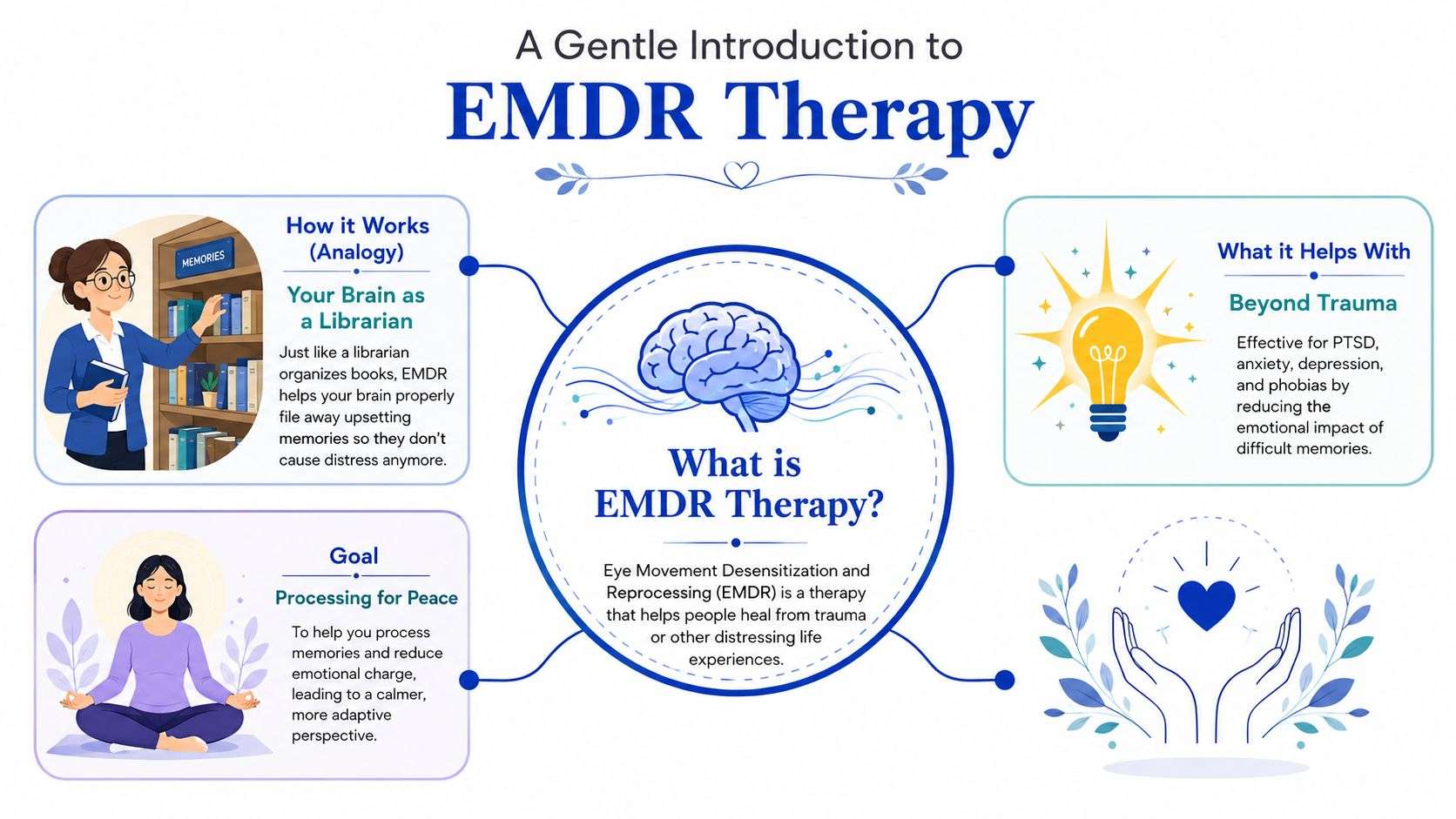
EMDR stands for Eye Movement Desensitization and Reprocessing. The name can sound technical, but the basic idea is simpler than it seems. EMDR helps the brain process upsetting experiences that still feel stuck.
Some memories fade into the background over time. Others don't. They can keep showing up as panic, shame, jumpiness, nightmares, body tension, or a sense that the past is still too close. EMDR is a structured way of helping the brain do the kind of sorting and updating that didn't happen fully when the distressing event occurred.
A simple way to picture it
A helpful analogy is to think of your brain like a librarian.
When life is going smoothly, the librarian files books where they belong. You can still find them, but they aren't falling off shelves or blocking the doorway. After a traumatic or distressing experience, some books don't get shelved properly. They end up in a messy pile on the floor. Every time you walk past, you trip over them.
EMDR helps your brain return to that pile and sort it. The memory doesn't disappear. It just becomes stored in a way that feels less raw, less immediate, and less disruptive.
What EMDR is and what it isn't
People often worry that EMDR is hypnosis. It isn't. You stay aware and in control. You're not put under, and you're not made to say anything you don't want to say.
It's also not traditional talk therapy in the usual sense. You may talk during EMDR, especially in the early stages, but the work isn't only about explaining your story out loud. It's about helping the brain and body process distress in a different way.
Here's what people often find helpful to know:
- It's structured: EMDR follows a clear process rather than wandering aimlessly.
- It's collaborative: You and your therapist make decisions together.
- It respects pacing: Readiness matters more than speed.
- It can support more than trauma: Distress connected to anxiety, fear, grief, or other difficult experiences may also be explored when clinically appropriate.
Some people also benefit from broader supports alongside therapy. For example, community-based options like personal growth programs can complement healing by giving people additional places to build reflection, coping, and connection.
Why this approach can feel different
The most reassuring part of EMDR for many clients is that it doesn't ask you to relive everything at full intensity without support. The process is meant to help your nervous system stay anchored in the present while difficult material is approached carefully.
Practical rule: If a therapy approach is right for you, you should feel informed and supported, not rushed or cornered.
That's why the first session matters so much. Before any deeper work happens, your therapist needs to understand you, not just your symptoms.
Your First Session A Step-by-Step Walkthrough
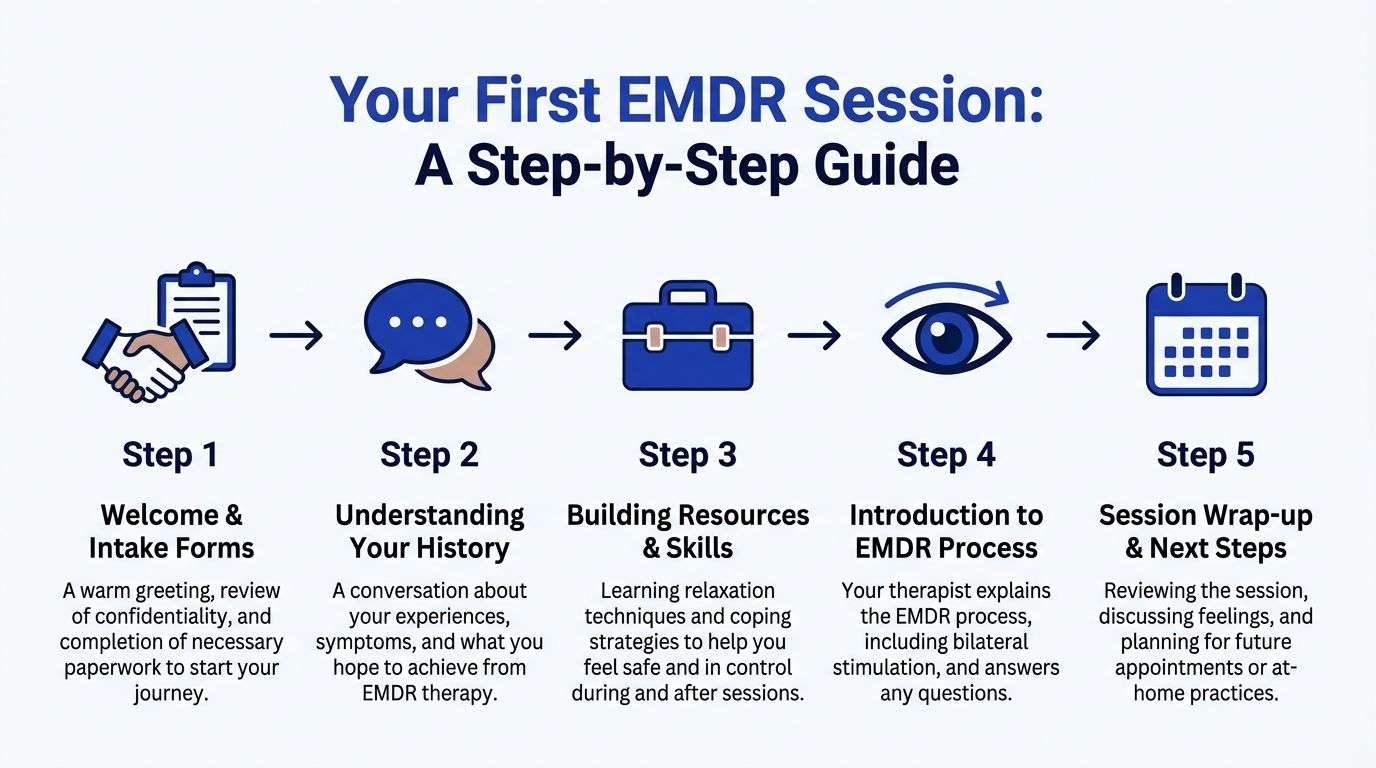
The first appointment usually has a rhythm to it. Knowing that rhythm can make the whole experience feel less unknown.
When you first arrive
The opening minutes are often quieter and more practical than people expect. You may review forms, confidentiality, consent, and a few basics about how therapy works. If you're meeting virtually, your therapist may also check that your space feels private enough and that the connection is working well.
This first contact tells you a lot. You're noticing whether the therapist feels steady, clear, and respectful. They're noticing what helps you feel comfortable and what seems to raise your stress.
Talking about what brings you in
After the paperwork side is handled, the therapist will usually ask what led you to seek EMDR now. You might talk about symptoms, specific events, patterns you've noticed, or the feeling that something from the past still hasn't settled.
You don't need to give a perfect summary. You don't need to have the “right” words. If all you can say is, “I don't feel like myself,” that's a valid place to begin.
A therapist may ask about:
- Current struggles: sleep problems, intrusive memories, anxiety, shutdown, irritability, or feeling on edge
- Relevant history: major stressors, losses, accidents, relationships, or earlier experiences that still feel important
- Supports in your life: trusted people, routines, coping tools, and what helps when things feel hard
- Your hopes for therapy: what would feel different if treatment were helping
Learning how EMDR works
Once your therapist understands more about your situation, they'll often explain the EMDR process in plain language. This is your chance to ask the questions people sometimes feel embarrassed to ask.
You can ask things like:
- Will I have to say everything out loud?
- What if I get emotional?
- What if I freeze or go blank?
- What if I'm not ready?
Those are thoughtful questions, not difficult ones.
If you like having something practical to do before your appointment, this guide on practical steps for first therapy can help you organise thoughts and reduce some of the uncertainty that comes with starting.
Early preparation instead of deep processing
This is the part that surprises many people. In a first session, your therapist often won't move straight into processing a major trauma memory. Instead, they'll focus on whether you have enough stability and support to begin safely.
That may include a brief introduction to bilateral stimulation, which is the side-to-side element used in EMDR. Depending on the setting, this might involve eye movements, tapping, or alternating sounds. In an early session, it may be introduced gently just to see what feels comfortable for you.
Here's a simple overview:
| Part of the session | What it often feels like |
|---|---|
| Welcome and orientation | Settling in, getting your bearings |
| History and goals | Being heard without pressure |
| EMDR explanation | Getting clarity about the process |
| Grounding or resourcing | Practising ways to feel steadier |
| Wrap-up | Leaving with a sense of what comes next |
Wrapping up and leaving the session
Near the end, the therapist will usually help you come back to the present if the conversation touched anything tender. You may review what stood out, what felt manageable, and what would help next time.
A good first session often ends with more clarity than intensity.
You might leave feeling relieved. You might also feel tired, thoughtful, or emotionally stirred. None of those reactions automatically mean something went wrong. The key question is whether you felt respected, informed, and safe enough to continue.
Building Your Foundation of Safety and Control
The most important part of early EMDR work is not bravery. It's stabilisation.
If a therapist starts trauma processing before you have enough grounding and internal support, the work can feel too activating. That's why the beginning of EMDR puts so much emphasis on safety, choice, and pacing. This is not a delay. It is part of the treatment.

What resourcing can look like
In EMDR, people often hear the word resourcing. It means building tools that help you stay anchored when emotions rise.
Those tools may include:
- A calm place exercise: You imagine a place that feels soothing, steady, or protective. It might be a lake, a quiet room, a hiking trail, or a completely imagined setting.
- Grounding skills: Naming what you see, feel, and hear in the present moment so your body remembers that you're here now.
- Breathing and pacing: Slowing things down on purpose instead of pushing through.
- Containment imagery: Mentally placing distressing material in a container until you're ready to return to it with support.
Some people worry these exercises are childish or fake. They're not. They're practical ways to help the nervous system recognise safety.
You are not trapped in the process
One fear comes up again and again: What if it starts and I can't stop? In well-paced EMDR, you stay in charge. You can pause, slow down, or stop. You can tell the therapist something feels too much. You can decide that today is for preparation only.
That sense of control matters because trauma often involves some kind of overwhelm, helplessness, or loss of choice. Good trauma therapy does the opposite. It restores choice.
If you ever feel pushed past your limits, that's not something to ignore. Your sense of safety is central to the work.
Safety first is not a small thing
People sometimes feel impatient and think, “I just want to get to the core work.” But this is the core work. Learning what helps your body settle, what cues signal overload, and what support you need is part of healing.
A strong foundation makes later sessions more manageable. It also helps you trust yourself more, because you begin to notice, “I can feel something difficult and still come back.”
What EMDR Might Feel Like and Common Concerns
The first session can feel many different ways at once. You might be nervous and hopeful. Curious and guarded. Calm at first, then unexpectedly emotional when someone asks a simple caring question. All of that falls within a normal range.
Some people feel a little shaky before the appointment, then more settled once the conversation begins. Others stay tense the whole time because new situations are hard. If that's you, it doesn't mean you're resistant. It may just mean your system is trying to protect you.
Common reactions people worry about
A few concerns come up often:
- “What if I cry?” Then you cry. Tears are welcome in therapy. They're not a failure or a problem to apologise for.
- “What if nothing happens?” That's okay too. Not everyone has a big emotional response in the first session.
- “What if I go blank?” Many people do when they're anxious or talking about difficult experiences. A skilled therapist knows how to slow down and help.
- “What if I don't click with the therapist?” Feeling safe with the person matters. It's reasonable to notice whether the fit feels right.
The relationship itself is part of the healing environment. Many people seeking EMDR also want care grounded in trauma-informed counselling approaches because they want a process that respects consent, pacing, and the impact of the nervous system.
What your body might notice
You may notice small physical responses during or after the session, such as tiredness, tight shoulders, a heavy feeling, or a sense of relief. Some people feel more talkative after being heard. Others want quiet.
There is no single correct first-session experience. The goal isn't to feel a certain way. The goal is to begin safely.
What matters most is not whether the session felt dramatic. It's whether it felt contained enough for your system to stay with it.
Practical Details for EMDR Sessions in Vernon
Logistics matter more than people sometimes admit. When the practical side feels manageable, it's easier to take the first step.
In Vernon, people often want to know whether they have to attend in person, whether virtual support is possible, and whether counselling may be available after a motor vehicle accident. In many cases, there are flexible options depending on your needs and comfort level.

Common format options
You may be able to access support in different ways:
- In-person sessions: Helpful if you feel more grounded in a therapy office or want a dedicated space outside home.
- Secure virtual sessions: Useful if travel, childcare, work, pain, or privacy concerns make home-based care more realistic.
- Phone sessions: Sometimes preferred when video feels like too much, or when visual contact isn't necessary for that stage of care.
Questions around ICBC and access
If you're seeking support after a motor vehicle accident, counselling may be available through ICBC. People in Vernon often look for this specifically because trauma after an accident can show up in ways that are emotional, physical, and very confusing. A therapist can usually help clarify whether EMDR or another trauma-focused approach fits your situation.
Scheduling also matters. Many clients need therapy times that work around jobs, school pickups, medical appointments, or energy levels. When you're reaching out, it's okay to ask practical questions early. Ease of access is part of what makes therapy sustainable.
A few useful things to ask when booking:
- Session format: in-person, virtual, or phone
- Availability: daytime, evening, or weekend options
- Experience area: trauma, PTSD, anxiety, accident recovery
- Administrative details: paperwork, consent, and any referral requirements
Getting those basics sorted can make the process feel much less abstract.
Frequently Asked Questions About Starting EMDR
How is EMDR different from just talking about my trauma?
Traditional talk therapy often focuses on understanding, insight, and emotional expression through conversation. EMDR includes conversation, but it also uses a structured process to help distressing memories feel less stuck. You're not merely recounting the past. You're helping your brain relate to it differently.
Do I have to share every detail of the memory?
Usually, no. Many people fear they'll need to describe painful experiences in full detail. EMDR doesn't always require that. Your therapist needs enough information to understand what you're working with, but you're not forced into a graphic retelling if that isn't clinically needed or feels unsafe.
What if I get too emotional during the session?
That's something therapists who use EMDR are trained to watch for carefully. If emotions rise too fast, the session can slow down. Grounding, resourcing, and present-moment orientation are part of helping you stay within a manageable range. Becoming emotional doesn't mean the session has gone off track.
What if I can't be hypnotised or I have trouble focusing?
That's okay, because EMDR is not hypnosis. You don't need a special kind of mind or perfect focus to benefit from the preparation phase. Many people with busy thoughts, anxiety, or scepticism still find the process approachable once it's explained clearly.
What should I do after my first session?
Try to keep the rest of your day gentle if you can. Drink water, eat something nourishing, and avoid packing your schedule too tightly. You might want quiet, a walk, journalling, or time with a safe person. Notice what your body asks for. If your therapist gave you grounding tools, practise them while you're calm so they're easier to use later.
If you're considering EMDR and want a calm place to begin, Interactive Counselling offers trauma-informed support for people navigating anxiety, trauma, grief, relationship stress, and recovery after motor vehicle accidents. You can learn more about their counselling services, available formats, and approach to care when you're ready.
Clinically Reviewed By
Amy Mosset, MCP, RCC-S
Amy Mosset is a Master Practitioner in Clinical Counselling, Clinical Supervisor, and the owner of Interactive Counselling. She provides trauma-informed, evidence-based care and clinical supervision to registered therapists, with a focus on ethical practice, client safety, and high-quality therapeutic outcomes.