Over half of Canadian adults report feeling overwhelmed by anxiety at some point, highlighting the growing need for effective coping strategies. If you are searching for more than temporary relief, building emotional awareness can lay the foundation for lasting well-being. This introduction explores how deepening your understanding of emotions can help you manage stress, foster meaningful growth, and transform your therapy experience into lasting change. For more information, see our anxiety counselling.
Table of Contents
- Defining Emotional Awareness And Well-Being
- How Emotional Awareness Shapes Mental Health
- Types And Signs Of Emotional Awareness Levels
- Emotional Awareness In Canadian Therapy Contexts
- Barriers To Cultivating Emotional Awareness
- Practical Strategies For Personal Growth
Key Takeaways
| Point | Details |
|---|---|
| Emotional Awareness | Understanding and managing emotions are crucial for overall well-being and resilience. |
| Mental Health Connection | Emotional awareness enhances coping strategies and helps maintain mental balance during challenges. |
| Levels of Awareness | Cultivating higher emotional awareness improves emotional vocabulary and enhances interpersonal relationships. |
| Barriers to Growth | Maladaptive beliefs and communication challenges are significant obstacles to developing emotional awareness. |
Defining Emotional Awareness and Well-Being
Emotional awareness represents a profound understanding of our internal psychological landscape, encompassing the ability to recognize, comprehend, and constructively engage with our feelings. Psychological wellness research suggests this capacity extends beyond simply identifying emotions, involving a holistic approach to mind, body, and spirit integration.
At its core, emotional awareness involves three critical dimensions: emotional recognition, emotional understanding, and emotional management. These dimensions enable individuals to decode complex emotional signals, interpret their underlying meanings, and respond with intentional strategies rather than reactive impulses. Comprehensive studies on emotional intelligence demonstrate that developing these skills significantly contributes to psychological resilience and overall life satisfaction.
Well-being, in this context, transcends the traditional medical model of merely avoiding illness. It represents a dynamic state of psychological, emotional, and social equilibrium where individuals can effectively navigate life’s challenges, maintain meaningful relationships, and experience a sense of personal growth. The interconnection between emotional awareness and well-being suggests that understanding our emotional terrain is not just beneficial but essential for living a fulfilling life.
Pro tip: Begin cultivating emotional awareness by dedicating 10 minutes daily to quiet reflection, systematically tracking your emotional states without judgment or immediate interpretation.
How Emotional Awareness Shapes Mental Health
Mental health is fundamentally shaped by our capacity to understand and navigate emotional experiences. Coping mechanisms among Canadian populations reveal that emotional awareness directly influences psychological resilience and overall well-being.
Emotional awareness acts as a critical protective factor in mental health by enabling individuals to recognize, process, and respond to complex psychological states. Canadian university student research demonstrates that students who develop strong emotional intelligence skills are better equipped to manage academic stressors, reduce anxiety, and maintain psychological balance during challenging life transitions.

The transformative power of emotional awareness lies in its ability to convert potentially overwhelming emotional experiences into opportunities for personal growth and self-understanding. By developing skills to decode emotional signals, individuals can interrupt negative psychological patterns, cultivate healthier coping strategies, and build sustainable mental resilience. This process involves learning to observe emotions without immediate judgment, understanding their underlying sources, and choosing constructive responses that support psychological well-being.
Pro tip: Practice emotional tracking by keeping a daily journal that documents your emotional states, noting triggers, intensity, and potential underlying causes without self-criticism.
Types and Signs of Emotional Awareness Levels
Emotional awareness exists on a nuanced spectrum, with individuals demonstrating varying capacities for recognizing and processing their internal emotional experiences. Validated psychological research identifies distinct levels of emotional awareness that range from basic recognition to complex emotional understanding.
Lower levels of emotional awareness are characterized by limited emotional vocabulary and difficulty distinguishing between different emotional states. Individuals at this stage might struggle to articulate feelings beyond simple descriptors like “good” or “bad”. Mindfulness research on emotional clarity suggests these individuals often experience emotions as overwhelming or confusing, with minimal insight into their underlying origins or potential meanings.
Higher levels of emotional awareness represent a sophisticated capacity for emotional intelligence. These individuals can not only identify complex emotional states but also understand their interconnections, triggers, and potential psychological implications. They demonstrate an ability to observe emotions with curiosity and compassion, recognizing emotions as informative signals rather than threats. This advanced emotional awareness enables more nuanced self-regulation, improved interpersonal relationships, and greater psychological resilience.
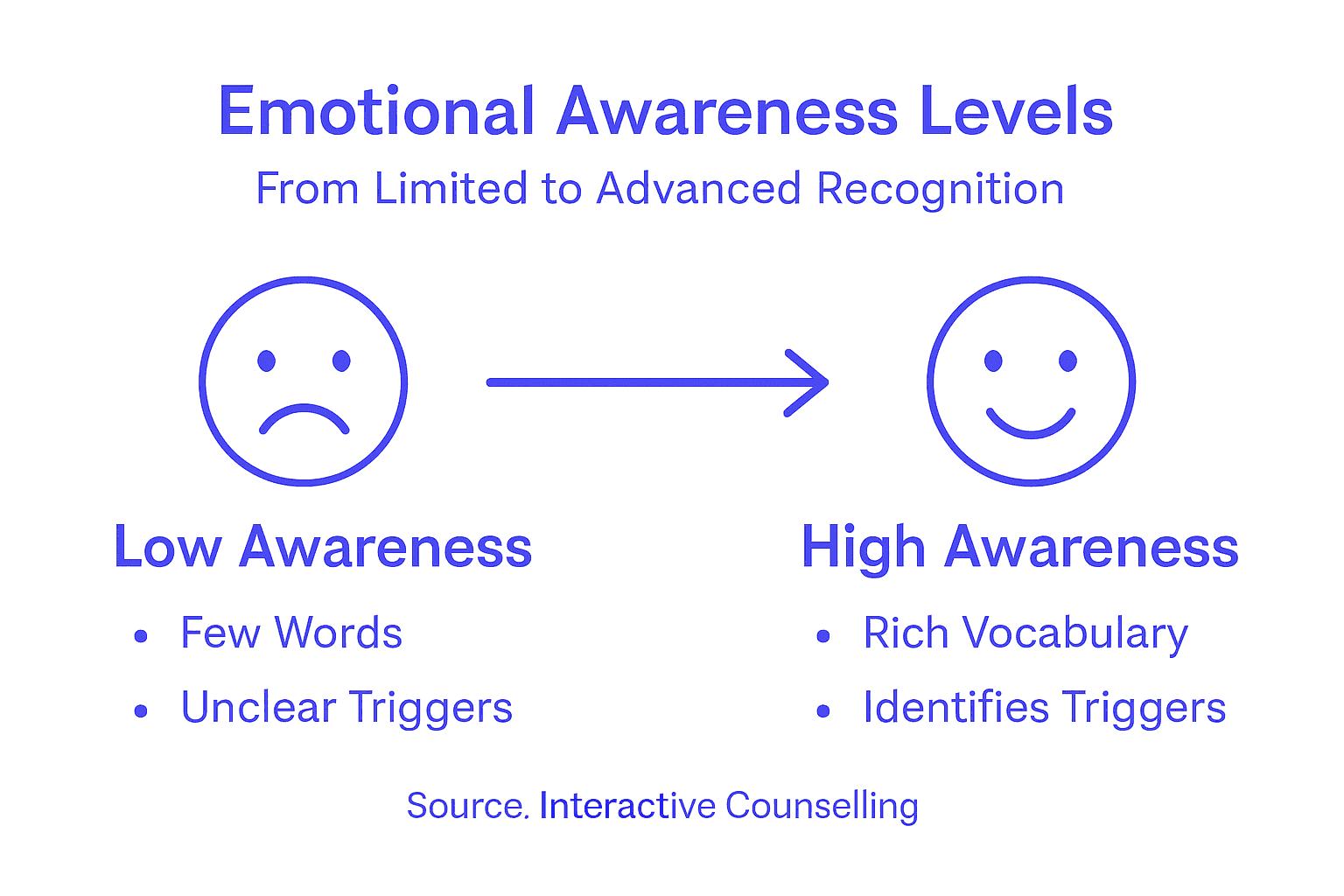
The following table summarizes key differences between lower and higher levels of emotional awareness for easier understanding:
| Level of Awareness | Emotional Vocabulary | Ability to Identify Triggers | Response Patterns |
|---|---|---|---|
| Lower | Limited, general terms | Difficulty recognizing causes | Often reactive or avoidant |
| Higher | Rich, specific language | Clearly understands emotional roots | Intentional, adaptive actions |
Pro tip: Create a daily emotion tracking system using a simple journal or mobile app, rating emotional intensity and noting potential triggers to gradually enhance your emotional awareness.
Emotional Awareness in Canadian Therapy Contexts
Canadian mental health therapy uniquely emphasizes emotional awareness as a critical therapeutic approach, recognizing the diverse psychological landscapes of individuals across different regions and professional backgrounds. This approach goes beyond traditional counselling models by integrating culturally sensitive strategies that acknowledge the unique stressors and emotional experiences specific to Canadian communities.
Therapists in Canada approach emotional awareness as a holistic skill set, helping clients develop nuanced emotional intelligence that supports mental health and personal resilience. The therapeutic process focuses on creating safe, non-judgmental environments where individuals can explore their emotional experiences, learn to articulate complex feelings, and develop strategies for emotional regulation. This method is particularly effective in addressing the psychological challenges faced by diverse populations, including urban professionals, rural communities, and specific demographic groups.
The Canadian therapeutic context recognizes emotional awareness as more than a therapeutic technique—it is a fundamental life skill essential for navigating personal relationships, professional challenges, and individual well-being. By teaching clients to recognize, understand, and constructively engage with their emotions, therapists help individuals develop a more profound sense of self-understanding and emotional flexibility. This approach empowers individuals to transform emotional challenges into opportunities for personal growth and psychological healing.
Pro tip: During therapy sessions, practice describing your emotions with increasing specificity, moving from broad terms like “stressed” to more nuanced descriptions that reveal the underlying emotional landscape.
Barriers to Cultivating Emotional Awareness
Psychological research highlights complex barriers that impede individuals’ ability to develop emotional awareness. These barriers are multifaceted, encompassing psychological, cultural, and personal dimensions that can significantly obstruct emotional understanding and growth.
One primary barrier stems from maladaptive emotional beliefs, where individuals develop misconceptions about emotions that limit their capacity for awareness. Implicit beliefs about emotion controllability can create psychological resistance, causing people to suppress or invalidate their emotional experiences rather than understanding them constructively. Such beliefs often emerge from familial patterns, cultural conditioning, and past traumatic experiences that teach individuals to view emotions as weakness or something to be controlled rather than understood.
Communication challenges and emotional vulnerability also present significant obstacles to emotional awareness. Many individuals lack the linguistic and interpersonal skills required to articulate complex emotional states, leading to emotional repression or misinterpretation. Social conditioning, particularly in cultures that prioritize stoicism or emotional restraint, can further complicate the process of developing genuine emotional intelligence. These systemic barriers create environments where emotional exploration feels unsafe or uncomfortable, preventing individuals from developing the nuanced self-understanding necessary for psychological well-being.
Below is a comparison of common barriers to emotional awareness and their typical impacts:
| Barrier Type | Common Source | Impact on Awareness |
|---|---|---|
| Maladaptive emotional beliefs | Family or cultural norms | Suppression of true feelings |
| Communication challenges | Lack of emotional language | Difficulty expressing emotions |
| Social conditioning | Societal expectations | Avoidance of emotional topics |
Pro tip: Create a weekly emotional reflection practice where you document your feelings without judgment, gradually building your emotional vocabulary and self-awareness.
Practical Strategies for Personal Growth
Mindfulness meditation techniques offer powerful pathways to developing emotional awareness and personal growth. By cultivating a nonjudgmental approach to observing internal emotional landscapes, individuals can gradually build deeper self-understanding and emotional intelligence.
Effective personal growth strategies encompass multiple interconnected dimensions of emotional development. Emotional intelligence development approaches emphasize the importance of integrating practices like active listening, structured self-reflection, and resilience-building exercises. These strategies help individuals transform emotional experiences from potential sources of distress into opportunities for learning and personal transformation.
Practical implementation of these strategies requires consistent, intentional practice. Key approaches include maintaining a daily emotional journal, engaging in mindful breathing exercises, participating in regular self-assessment, and developing empathy through active listening. By systematically expanding emotional vocabulary, learning to recognize subtle emotional shifts, and practicing non-reactive observation, individuals can progressively enhance their emotional awareness and build more robust psychological resilience.
Pro tip: Dedicate 10 minutes daily to a structured emotional reflection practice, using prompts that encourage curious and compassionate self-exploration.
Take Control of Your Emotional Well-Being Today
Understanding your emotions is the essential first step toward improved mental health and lasting well-being. If you find it difficult to identify, express, or manage your feelings, you are not alone. Many people face challenges such as limited emotional vocabulary, reactive responses, or barriers rooted in past experiences as highlighted in the article “Emotional Awareness First Step to Well-Being.” Developing emotional awareness can transform overwhelming feelings into opportunities for growth and resilience.
At Interactive Counselling, we specialize in helping Canadians across Kelowna, Vernon, Grande Prairie, Penticton, and nationwide online to build these critical skills through personalized therapy. Our licensed therapists provide compassionate, non-judgmental support tailored to your unique emotional landscape. Whether you are dealing with anxiety, grief, relationship stresses, or parenting challenges, you can take the next step toward emotional clarity and self-understanding with us.
Explore our flexible therapy options including in-person, phone, and online sessions designed to fit your schedule. Start your journey to emotional awareness and mental wellness now by visiting Interactive Counselling to book an appointment. Unlock the power of understanding your emotions and create a more balanced and fulfilling life today.
Frequently Asked Questions
What is emotional awareness?
Emotional awareness is the ability to recognize, understand, and constructively engage with our feelings, contributing to psychological resilience and overall well-being.
How does emotional awareness influence mental health?
Emotional awareness directly influences mental health by enabling individuals to process their emotions effectively, reducing anxiety, and improving coping strategies during challenging situations.
What are the levels of emotional awareness?
Emotional awareness exists on a spectrum, ranging from lower levels characterized by limited emotional vocabulary to higher levels where individuals can identify complex emotional states and their interconnections.
What strategies can help improve emotional awareness?
Effective strategies to improve emotional awareness include maintaining a daily emotional journal, practicing mindfulness techniques, engaging in structured self-reflection, and improving empathy through active listening.
Recommended
- Why Self-Awareness Matters for Emotional Wellness
- Therapy and Emotional Patterns: Building Self-Awareness
- Supporting Emotional Growth—Why Validation Matters
- Emotional Regulation: Building Resilience in Everyday Life