If you’ve found your way here, it's likely because you're struggling with the heavy weight of a relentless inner critic. First, please know you aren't alone in this, and it is absolutely not a sign of weakness. It's simply a sign that it’s time to seek help—especially when constant self-criticism and anxiety start running the show, impacting your work, relationships, and overall well-being right here in Vernon. For more information, see our Vernon anxiety counselling.
"It's time to get help for constant self-criticism and anxiety in Vernon when the internal battle starts to get in the way of living a peaceful, fulfilling life, affecting your relationships, work, and overall well-being." For more information, see our counselling in Vernon.
The Vicious Cycle of Self-Criticism and Anxiety
Most of us hear from a harsh inner voice from time to time. But when that voice becomes a constant, deafening presence, it can feel like you're permanently on trial inside your own mind. This internal monologue isn't just unpleasant; it's often the very fuel that keeps a powerful and exhausting cycle of anxiety going. For more information, see our anxiety counselling.
Think of it this way: self-criticism is the spark, and anxiety is the wildfire.
A single critical thought—"I completely messed up that presentation"—can instantly ignite feelings of worry and dread. Anxiety then pours gasoline on that spark, whispering, "What if they all think I'm incompetent? What if I get fired?" This creates a destructive feedback loop where the more anxious you feel, the more "evidence" your inner critic seems to find of your supposed failures.
How One Feeds the Other
This connection isn't just a coincidence; for many, it's a deeply ingrained and automatic pattern. Constant self-criticism keeps your mind and body on high alert, triggering your nervous system as if you were facing a real, physical threat.
Here’s how they work together:
- Self-Criticism: Fixates on past mistakes or perceived flaws, stirring up feelings of shame and inadequacy.
- Anxiety: Takes those feelings and projects them onto the future, creating a storm of worry about what could go wrong next.
It's a cycle that can leave you feeling completely trapped, as if there's no escape from the relentless commentary in your own head. For a deeper dive into this dynamic, you can read more about the relationship between your inner critic and anxiety.
The diagram below maps out this exhausting loop, showing exactly how self-criticism triggers anxiety, which then drives a desperate need for control that—more often than not—leads right back to more criticism.
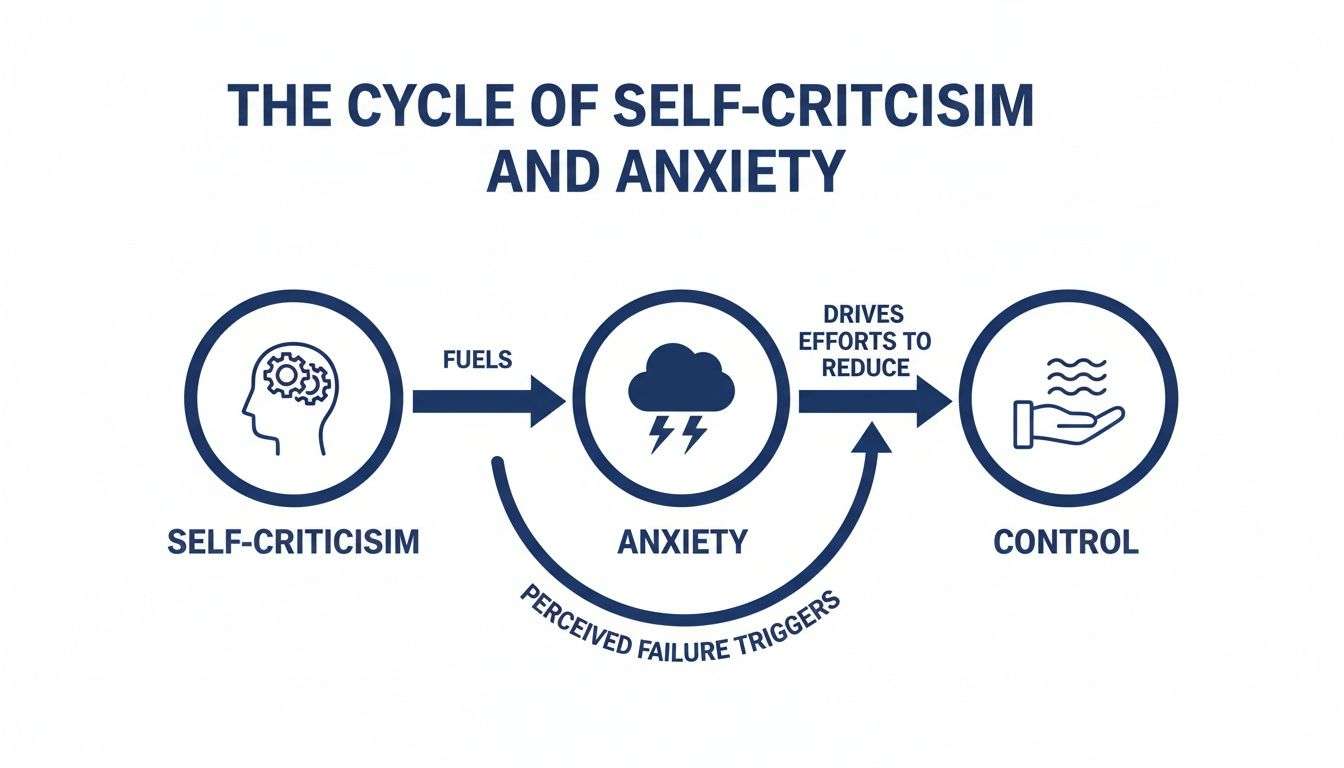
As the visual shows, the intense effort to control the anxiety often fuels even more self-judgment when things don't go perfectly, and the loop starts all over again. Simply understanding this pattern is the crucial first step toward finally breaking free.
Recognizing Your Inner Critic at Work

We all have moments of self-doubt. But constant self-criticism is something else entirely—it's like having a relentless heckler living inside your head, narrating your every move. This voice often gets loudest in professional settings, where it can twist achievements into sources of anxiety and minor missteps into proof of utter failure.
Learning to spot its patterns is the very first step toward turning down the volume and reclaiming your confidence.
Instead of a textbook definition, let's look at what this inner critic actually sounds like. It’s that nagging thought that you aren't really qualified for your role, despite years of evidence to the contrary. It’s the perfectionism that makes even starting a simple task feel overwhelming because the outcome might fall short of flawless.
Often, this experience is tied to profound feelings of inadequacy at work. You might know it as imposter syndrome—that persistent belief that your successes are just lucky breaks and you’re only moments away from being exposed as a fraud.
Common Thought Patterns to Notice
This harsh inner dialogue usually follows a predictable script. The trick is to start noticing these thoughts as they pop up, not to judge them, but just to see them for what they are: a habit, not a fact.
Here are a few classic lines from the inner critic's playbook:
- Dismissing Praise: A manager compliments your report, but your first thought is, "They’re just being polite," or "Anyone could have done that."
- All-or-Nothing Thinking: A project has one tiny flaw, and you immediately label the whole thing a complete failure. There's no middle ground for "good enough."
- Catastrophizing: You spot a typo in an email you just sent to a client and spiral into thinking, "That's it, I've ruined the relationship and my professional reputation."
- Using "Should" Statements: Your mind is filled with judgments like, "I should have known the answer to that question," or "I should be much further in my career by now."
These aren't just passing thoughts; they kick off real emotional and physical reactions. You might feel a constant, low-grade hum of anxiety in your chest, a deep sense of frustration with yourself, or a wave of shame that makes you want to hide. Just acknowledging these feelings is a huge part of the process.
The goal isn't to shut down your inner critic overnight. It's about learning to see it as a separate voice—one that doesn't have to call the shots or define your worth.
Healthy Self-Reflection vs. Harmful Self-Criticism
It’s crucial to draw a line between this destructive inner critic and genuine, healthy self-reflection. One helps you grow and learn from your experiences; the other just keeps you stuck in a cycle of shame and anxiety. Understanding the difference is key to knowing when your internal monologue has crossed from helpful to hurtful.
This table breaks down the key differences to help you tell them apart.
| Characteristic | Healthy Self-Reflection | Harmful Self-Criticism |
|---|---|---|
| Focus | Behaviour-oriented ("I could have managed my time on that project better.") | Person-oriented ("I'm so lazy and completely disorganized.") |
| Tone | Curious and compassionate ("What could I do differently next time?") | Harsh, judgmental, and absolute ("I always mess things up.") |
| Outcome | Motivates growth and creative problem-solving | Leads to paralysis, shame, and anxiety |
| Perspective | Balanced and realistic, acknowledging both strengths and weaknesses | Overly negative, catastrophic, and dismissive of any positives |
Spotting these differences in your own thoughts can be a game-changer. When you realize the voice you're hearing is the harsh critic, not the constructive coach, you can start to question its authority.
When Is It Time to Seek Support in Vernon?

Knowing when to reach out for help is a deeply personal thing. There’s no universal signal or flashing red light. Often, the clearest sign is simply noticing that the constant internal battle has started to get in the way of living a peaceful, fulfilling life.
It's rarely a single, dramatic crisis that brings people to counselling. It's more often a quiet, slow burn—the gradual buildup of small struggles. The tipping point usually comes when that inner critic and the constant hum of anxiety are no longer just background noise. They're in the driver's seat, making your decisions for you, shrinking your world, and draining the colour from everyday life.
If this feels familiar, you’re far from alone. Here in our own community, these challenges are more common than you might think. For some context, you can read this local report on community well-being.
Gentle Nudges That It Might Be Time
Think of these less as red flags and more as gentle nudges from yourself, for yourself. They're quiet hints that a bit of extra support could make a world of difference. If a few of these resonate with you, it might be the right time to think about reaching out.
- Your relationships feel strained. Are you pulling away from friends, family, or your partner? Sometimes this happens because you feel unworthy of their time or are simply too drained from the internal fight to engage.
- Work or school is suffering. Procrastination can take over when it's fuelled by a paralyzing fear of not being perfect. You might find yourself missing deadlines or ducking opportunities you’d normally jump at.
- Your body is keeping the score. Constant stress shows up physically. It can look like trouble sleeping, changes in appetite, frequent headaches, or a feeling of fatigue that never quite goes away.
- Joy feels out of reach. Do the hobbies and activities you once loved now feel like a chore? Or maybe you find it hard to feel genuinely happy, even when good things are happening around you.
Just recognizing these patterns is a huge, courageous first step. It's an act of self-awareness that truly opens the door to healing. Acknowledging you need support isn't a sign of weakness. It's a profound act of strength and a commitment to your own well-being.
From Awareness to Action
Seeing these signs in your own life can feel overwhelming, but try not to let that stop you. The goal isn't to judge yourself for struggling, but to meet yourself with kindness and curiosity. Even a simple thought like, "I'm noticing my anxiety is making it hard to connect with my friends," is an incredibly powerful start.
This kind of awareness gives you the power to decide what’s next. For many people, this is the moment when professional support becomes a clear, helpful path forward. Just learning about the kind of counselling available in your community can bring a huge sense of relief and hope.
At the end of the day, you are the expert on your own life. If your inner critic and anxiety are costing you peace, relationships, or joy, that’s more than enough reason to seek change. It is always the right time to choose a path toward feeling better.
Practical First Steps to Quieting Your Inner Critic
When you’re stuck in a loop of self-criticism and anxiety, just waiting for the storm to pass feels like an eternity. But here's the good news: you don't have to just wait it out. You can start taking back your peace of mind with small, manageable actions that break the cycle and give you some room to breathe.
These strategies aren't about flipping a switch and silencing your inner critic overnight. Think of it more like learning to turn down the volume, one compassionate step at a time.
Start with Mindful Awareness
The very first step is to simply notice when that critical voice shows up, without letting it drag you down. This is the heart of mindfulness—paying attention to what's happening right now, without judging it. When a critical thought pops into your head, try to see it for what it is: just a thought, not a hard fact.
This creates a tiny bit of space between you and the criticism, and that space is where your power is. You could even say to yourself, "Ah, there's that 'not good enough' story again." You're acknowledging it's there, but you're not automatically buying into it.
Practice Self-Compassion
Self-compassion is all about offering yourself the same kindness you would give to a good friend who is having a tough time. That inner critic is harsh and demanding, but self-compassion offers a gentle, supportive alternative.
So, instead of beating yourself up for a mistake, try asking yourself a few questions:
- What would I tell a friend if they were in this exact situation?
- What do I really need to hear right now to feel supported?
- How can I be a little kinder to myself in this moment?
This practice actively starts to rewire that old habit of self-criticism. Over time, it helps build a kinder, more resilient inner voice. It's a conscious choice to offer yourself support instead of judgment. Treating yourself with kindness isn't self-indulgent; it's a fundamental tool for building the emotional resilience needed to navigate anxiety and quiet a harsh inner critic.
Gently Question Your Thoughts
Critical thoughts often feel like absolute truths, don't they? But most of the time, they’re just old, unhelpful stories your brain has learned to repeat. You can start to loosen their grip by getting curious and gently questioning them.
A simple journaling exercise can be a great way to start:
- Write down the critical thought: For example, "I completely failed that task."
- Look for the evidence: Ask yourself, "Is that 100% true? Did nothing go right? What’s a more balanced way to look at this?"
- Offer a kinder alternative: You might reframe it as, "Part of that task was really challenging, but I handled other parts well. I'm learning as I go."
It's also worth remembering that our mental and physical well-being are deeply connected. Cognitive strategies are powerful, but sometimes physical therapies can make a huge difference. For instance, massage therapy can open up other avenues for managing the physical side of anxiety.
Finally, don't underestimate the power of sharing what you're feeling with a trusted friend or family member. Saying these critical thoughts out loud can often reveal just how exaggerated they are, and it reminds you that you aren’t alone in this. These first steps are about making progress, not achieving perfection.
How Professional Counselling Can Help You Break the Cycle
If you're thinking about therapy, you might feel a bit intimidated. It can seem like a mysterious process, and it's natural to wonder what actually happens behind closed doors. Let's pull back the curtain on that. At its core, professional counselling offers a safe, completely confidential space to explore the roots of your self-criticism and anxiety without any fear of judgment.
But it’s so much more than just talking about your problems. Think of it as an active, collaborative journey. You and your therapist become a team, working together to uncover the patterns holding you back and learning practical, proven skills to fundamentally change your relationship with yourself.
Building Your Mental and Emotional Toolkit
A huge part of counselling is learning how to rewire the thought patterns that keep you feeling stuck. One of the most effective and well-researched methods for this is Cognitive Behavioural Therapy (CBT). CBT is all about learning to spot, challenge, and reframe the automatic negative thoughts that fuel your inner critic.
For instance, instead of just accepting a thought like, "I always mess things up," as an undeniable fact, you'll learn to treat it like a hypothesis to be tested. You’ll work with your therapist to gently question it, look for real evidence, and find more balanced and compassionate ways of seeing the situation.
Other powerful approaches can also help you:
- Build emotional resilience so you can navigate life’s inevitable stressors with more ease.
- Cultivate self-compassion as a genuine, powerful alternative to self-criticism.
- Understand where your critical inner voice came from, which helps to lessen its power over you.
- Learn practical grounding techniques to manage anxiety right when it shows up.
This isn't about becoming a different person. It's about moving from being a passenger tossed around by your thoughts and emotions to confidently taking the driver's seat.
A Local Look at Well-being in Vernon
Here in Vernon, we can see how interconnected life's challenges are with mental health. You can discover more about Vernon's community health findings to see how these pieces often fit together.
professional counselling provides a supportive, non-judgmental space to begin untangling these threads. It’s about getting personalized, compassionate guidance that honours your unique story and helps you build a path toward lasting self-worth and inner peace.
Ultimately, therapy isn’t about “fixing” something broken in you. It's about gaining the tools and insight to understand your patterns, heal from past hurts, and build a kinder, more supportive relationship with the most important person in your life: yourself. It’s an investment in a future where you feel more resilient, in control, and at peace.
Finding Your Path Forward with Confidence
We've covered a lot of ground together—from spotting the signs of that relentless inner critic to exploring practical ways you can start to find relief. Remember, what you're going through isn't a sign of weakness; it's a part of the human experience. Reaching out is a sign of true strength.
The most important takeaway? The next step is simply the one that feels right for you. Trust that feeling.
Maybe that means trying one of the self-compassion exercises we talked about. Or perhaps it’s just bookmarking this page to look at later. Whatever it is, you're already moving forward. You deserve to find peace and feel comfortable in your own skin.
If you’re ready to learn more about how professional support could fit into your life, know that compassionate, expert help is available. Taking that first step—even just a small one—can be the start of building a calmer, more confident life.
We Hear You: Answering Your Questions About Counselling
Taking that first step toward getting professional support can feel like a big deal, and it's totally normal to have a lot of questions running through your mind. Feeling curious, and maybe even a little hesitant, is part of the process. We've put together some straightforward answers to the questions we hear most often from folks right here in Vernon who are thinking about counselling for self-criticism and anxiety.
Is It Normal to Feel Anxious About Starting Therapy?
Absolutely. In fact, it might be the most common feeling people have before their first session. Being nervous about opening up to someone new is completely understandable. Think of it this way: that feeling is a signal that you're about to step outside your comfort zone, and that's exactly where real growth and healing happen.
Keep in mind, counsellors are trained professionals who expect this. A therapist's number one job, especially at the beginning, is to create a safe, warm, and non-judgmental space where you can go at your own pace. No pressure.
What if I Don’t Know What to Talk About?
That’s another really common worry, so let us put your mind at ease: you don’t need to come in with a script or a perfectly organized list of problems. Your counsellor is skilled at guiding the conversation with thoughtful questions that help you explore what’s really on your mind, even if you can’t quite put it into words yourself.
The first session is just a chance for you to get to know your therapist and to see if it feels like a good fit. It’s much more about connection than it is about content.
Can Counselling Really Change a Lifelong Habit of Self-Criticism?
Yes, it really can. A habit of self-criticism can feel so deeply wired in after years—or even a lifetime—but therapy gives you proven, evidence-based tools to build a new, kinder inner voice. It’s a gradual process, of course. It involves unlearning those old, automatic thought patterns and mindfully practicing healthier ways of relating to yourself.
This is where you can dig in to understand where that critical voice came from, weaken its power over you, and build a lasting sense of self-worth. Change isn't just possible; it's something you deserve. You can read the full report about community well-being in Vernon to learn more about our community's health.
Clinically Reviewed By
Amy Mosset, MCP, RCC-S
Amy Mosset is a Master Practitioner in Clinical Counselling, Clinical Supervisor, and the owner of Interactive Counselling. She provides trauma-informed, evidence-based care and clinical supervision to registered therapists, with a focus on ethical practice, client safety, and high-quality therapeutic outcomes.