Feeling anxious in British Columbia can leave you trapped in cycles of worry and self-doubt. Anxiety itself is a normal reaction to stressful situations, but when it starts to interfere with friendships, work, or everyday comfort, it can feel confusing and overwhelming. Many people misunderstand their anxiety, believing it is a personal weakness, when in reality it often runs in families and has roots in genetics and environment. Understanding your unique anxiety patterns is the first step toward real, personalized therapy that truly fits your needs. For more information, see our anxiety counselling.
Table of Contents
- Core Anxiety Concepts And Misconceptions
- Types Of Anxiety And How Patterns Form
- How Persistent Anxiety Cycles Develop
- Factors That Make Anxiety Hard To Break
- Therapy Strategies To Shift Patterns
Key Takeaways
| Point | Details |
|---|---|
| Anxiety Is Normal | Acknowledge that anxiety is a common response to stress that can be manageable rather than inherently problematic. |
| Patterns of Anxiety | Recognising the specific patterns and triggers of your anxiety is key to breaking the cycle and regaining control. |
| Effective Management | Personalised therapeutic approaches like Cognitive Behavioural Therapy can effectively retrain your thought processes and behaviours. |
| Facing Fears Gradually | Gradual exposure to feared situations, supported by a therapist, helps diminish the fear associated with anxiety. |
Core Anxiety Concepts and Misconceptions
Anxiety isn’t your enemy. It’s actually a normal reaction to stressful situations that can increase focus and alertness when you need it most. The problem arises when this response becomes overwhelming, disproportionate, or interferes with your daily life—that’s when it shifts from helpful to harmful.
Many people misunderstand what anxiety actually is. You might think you’re broken or fundamentally flawed, but the reality is far different. Anxiety exists on a spectrum, and recognising where you fall is the first step toward managing it effectively.
What Makes Anxiety Persist
Anxiety patterns repeat because your brain gets stuck in a loop. Your mind identifies a threat (real or imagined), your body responds with stress chemicals, and then your thoughts amplify the fear. This cycle reinforces itself over and over.
Here’s what keeps anxiety going:
- Avoidance: When you avoid situations that trigger anxiety, your brain learns those situations are actually dangerous. Why avoidance fuels anxiety becomes clear when you understand that facing fears (gradually) is how your nervous system learns they’re safe.
- Rumination: Replaying worries in your mind strengthens the neural pathways connected to those thoughts.
- Physical avoidance: Steering clear of people, places, or activities reinforces the anxiety cycle.
- Safety behaviours: Seeking reassurance or controlling situations feels protective but actually maintains the problem.
Anxiety patterns persist not because something is wrong with you, but because your brain is trying to protect you from perceived danger—even when that danger isn’t real.
Common Misconceptions About Anxiety
Misconception 1: Anxiety is a character flaw. You’re not weak for experiencing anxiety. It runs in families and affects people across all backgrounds, abilities, and ages. Genetics and environment both play roles.
Misconception 2: You should eliminate anxiety completely. Some anxiety is protective. The goal isn’t zero anxiety—it’s managing it so it doesn’t control your life.
Misconception 3: Anxiety attacks are dangerous. While they feel terrifying, panic attacks themselves aren’t medically dangerous. Understanding anxiety attack symptoms helps you recognise what’s happening and respond calmly.
Misconception 4: Thinking harder will solve it. Paradoxically, more thinking often makes anxiety worse. How thoughts link to emotions through cognitive patterns means you need to change your thinking patterns, not just think more intensely about the problem.
The Role of Your Thoughts
Your thoughts shape your emotions far more than events themselves. Two people experiencing the same situation interpret it completely differently based on what they believe about it. This is why cognitive therapy approaches address how thoughts fuel anxiety by teaching you to gather evidence and respond to troubling thoughts realistically.
When you’re anxious, your mind naturally searches for threats. It’s hypervigilant. Learning to evaluate your thoughts against actual evidence—rather than just believing them—interrupts the anxiety cycle at its source.
Pro tip: When anxious thoughts arise, ask yourself: “What evidence supports this thought? What evidence contradicts it?” This simple reality check helps your brain distinguish between real threats and false alarms.
Types of Anxiety and How Patterns Form
Anxiety isn’t one-size-fits-all. Different types of anxiety create different patterns, and understanding which one you’re experiencing helps you address it more effectively. The way your anxiety shows up matters because the triggers, symptoms, and solutions vary by type.
Each anxiety type follows its own logic. Your brain learns specific threat patterns and reinforces them through repetition. Recognising your particular pattern is the first step toward breaking it.
The Four Main Types of Anxiety
Generalised Anxiety Disorder (GAD) keeps you in constant worry mode. Your mind jumps from one “what if” scenario to another—work problems, health concerns, relationships, finances. The worry feels uncontrollable and exhausting.
Panic Disorder brings sudden, intense panic attacks that feel like emergencies even when no real danger exists. Your body floods with stress chemicals, your heart races, and you might feel like you’re dying or losing control. The fear of the next attack often becomes as problematic as the attacks themselves.

Social Anxiety Disorder makes social situations feel threatening. You worry intensely about being judged, embarrassed, or rejected. This can range from dreading public speaking to avoiding everyday conversations.
Phobia-Related Disorders involve intense fear of specific objects or situations. Heights, flying, animals, or blood might trigger overwhelming fear that feels completely irrational to others but absolutely real to you.
Each type disrupts daily life in distinct ways:
To clarify how four main anxiety types differ, here’s a comparative summary:
| Anxiety Type | Typical Triggers | Common Symptoms | Main Daily Impact |
|---|---|---|---|
| Generalised Anxiety | Everyday worries | Restlessness, fatigue | Ongoing worry drains energy |
| Panic Disorder | Unpredictable cues | Heart racing, dizziness | Avoidance of feared situations |
| Social Anxiety | Social interactions | Blushing, sweating | Isolation, missed opportunities |
| Phobia-Related Disorders | Specific objects/events | Rapid fear response | Restricted activities |
- GAD: Constant background worry that drains your energy
- Panic Disorder: Unpredictable attacks that make you avoid triggering situations
- Social Anxiety: Isolation and missed opportunities due to fear
- Phobias: Avoidance of specific triggers, limiting your freedom
How Patterns Form and Stick Around
Anxiety patterns develop through repetition and reinforcement. Your brain notices something that feels dangerous, your nervous system reacts, and you respond by either avoiding the situation or using safety behaviours. Each time this cycle repeats, the pattern strengthens.
Genetic and environmental factors shape how anxiety patterns develop over time. Some people are biologically more sensitive to threat signals. Others experienced trauma or learned anxiety from family members. Both paths lead to persistent patterns.
Patterns persist because they feel protective. Avoidance temporarily reduces anxiety, so your brain thinks it’s working. Safety behaviours (checking, reassurance-seeking, controlling situations) feel like they prevent disaster. But they actually teach your nervous system that the threat is real.
Anxiety patterns form because your brain is trying to keep you safe—but it’s working with incomplete information and old threat maps that no longer fit your actual life.
Why Your Pattern Feels Automatic
After weeks or months of repetition, your anxiety response becomes automatic. You don’t consciously decide to avoid social situations or ruminate about worst-case scenarios—it just happens. Your nervous system has learned this pattern so well that it fires without conscious input.
This is actually good news. If your brain learned the pattern, it can learn a new one. That’s where personalised therapy helps.
Pro tip: Start noticing your specific anxiety pattern without judgment. Does it focus on health, social situations, or catastrophic thinking? Does it involve panic attacks or constant worry? Identifying your particular pattern helps you recognise triggers early and respond differently before the full cycle activates.
How Persistent Anxiety Cycles Develop
Anxiety doesn’t just appear randomly. It develops through cycles that your brain learns to repeat automatically. Understanding how these cycles form is crucial because breaking them requires interrupting the pattern at the right point.
Each cycle starts with a trigger. That could be a situation, a thought, a physical sensation, or even the anticipation of anxiety itself. Once triggered, your nervous system activates, and the cycle begins its familiar progression.
The Four Phases of an Anxiety Cycle
Anxiety cycles follow a predictable pattern. When you understand each phase, you can identify where your cycle gets stuck.
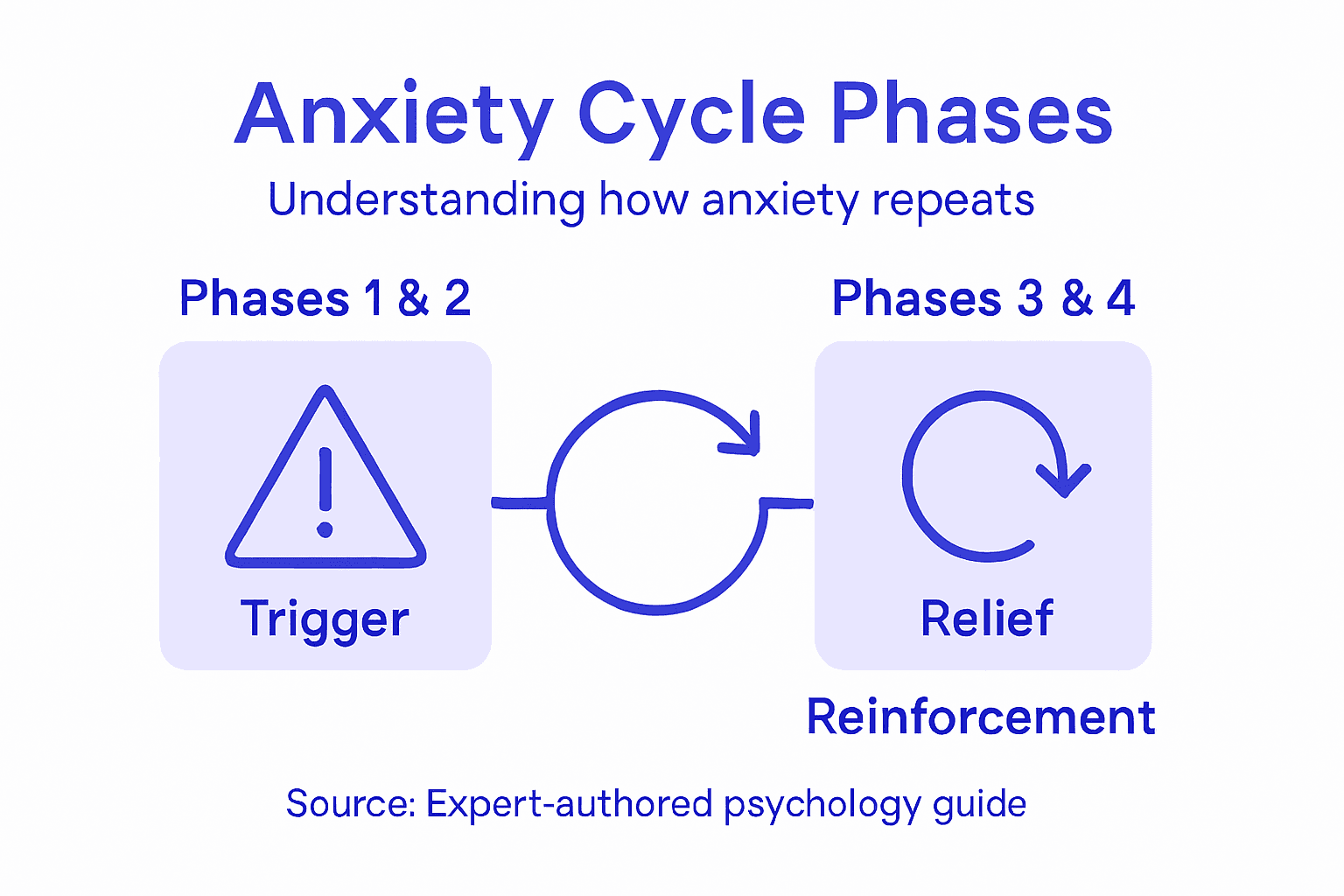
Phase 1: The Trigger. Something happens—real or imagined—that your brain interprets as threatening. This might be a social situation, a health thought, or a physical sensation like chest tightness.
Phase 2: The Anxiety Response. Your body activates. Your heart races, breathing quickens, muscles tense. Your mind floods with worry and catastrophic thoughts. This is the fight-flight-freeze response in action.
Phase 3: Short-Term Relief. Here’s where cycles get stuck. You do something to escape the anxiety—avoidance, reassurance-seeking, checking behaviours, distraction. The anxiety temporarily decreases.
Phase 4: Reinforcement. Your brain learns: “That escape strategy worked. I’ll use it again next time.” But this teaches your nervous system that the threat was real and that avoidance is the solution.
Here’s how persistent anxiety cycles can be interrupted at each phase:
| Cycle Phase | Usual Reaction | Effective Intervention |
|---|---|---|
| Trigger | Anticipatory worry | Mindful awareness, grounding |
| Anxiety Response | Physical symptoms | Slow breathing, supportive self-talk |
| Short-Term Relief | Avoidance or distraction | Gradual exposure, challenge avoidance |
| Reinforcement | Reliance on safety behaviours | Cognitive restructuring, therapy support |
Why Avoidance Strengthens the Cycle
Avoidance feels protective, but it’s the cycle’s fuel. When you skip the presentation to avoid social anxiety, attend that meeting remotely instead of in person, or check your health repeatedly, you get temporary relief. That relief is powerful enough to override logic.
The problem is avoidance behaviours reinforce anxiety by teaching your brain the threat is real. Your nervous system learns: “If we didn’t avoid that situation, something bad would have happened.” The fear grows stronger, and you feel more compelled to avoid next time.
This creates an escalating pattern. Over weeks and months, avoidance expands. Situations that once felt manageable now trigger intense anxiety. Your world shrinks.
How Unresolved Stress Keeps You Stuck
When stress cycles don’t complete properly, your body stays in heightened vigilance and repeated stress responses. You remain hyper-alert, scanning constantly for threats.
This explains why anxiety feels so exhausting. Your nervous system never fully relaxes. You’re stuck in a self-feeding loop:
- Heightened alert state
- Increased sensitivity to triggers
- More frequent anxiety activation
- More avoidance
- Stronger fear conditioning
The persistence of anxiety cycles depends not on the trigger itself, but on what happens after the anxiety activates—and what doesn’t happen when you avoid completing the cycle.
Breaking the Automatic Pattern
Your brain has learned these cycles through repetition. The good news: repetition is how change happens too. With support from a therapist, you can teach your nervous system that triggers aren’t actually dangerous and that facing situations (gradually) is safe.
Personalised therapy at Interactive Counselling focuses on interrupting your specific cycle. Rather than avoiding, you’ll learn to move through anxiety differently—tolerating discomfort temporarily while your brain gathers evidence that the threat isn’t real.
Pro tip: Notice which phase of your anxiety cycle is strongest for you. Do you get stuck in avoidance? Do you ruminate endlessly? Does your body stay activated for hours? Identifying your sticking point helps you know exactly where to intervene when anxiety activates.
Factors That Make Anxiety Hard to Break
Anxiety becomes stubborn when multiple biological, psychological, and environmental factors work together against you. Understanding these factors helps explain why willpower alone doesn’t work and why professional support makes such a difference.
Your nervous system isn’t broken—it’s stuck in a protective pattern. But several interconnected systems keep that pattern locked in place.
The Biological Factors
Your stress hormone system gets dysregulated. When anxiety persists, your body stays bathed in cortisol and adrenaline. These hormones were helpful when you faced actual danger, but continuous activation adversely affects your health and makes anxiety harder to break.
Genetic predisposition matters too. If anxiety runs in your family, your nervous system may be naturally more sensitive to threat signals. This doesn’t mean you’re destined to struggle forever—it just means your brain needs more retraining.
Your brain’s threat-detection system (the amygdala) becomes hypersensitive. It flags harmless situations as dangerous. Meanwhile, the prefrontal cortex responsible for logic and decision-making gets weakened by chronic anxiety, making it harder to talk yourself down.
The Psychological Traps
Worry loops are incredibly sticky. Once anxiety starts, your mind generates “what if” thoughts automatically. These thoughts feel real and important, so you ruminate about them, which strengthens the neural pathways connected to those worries.
Internal worry loops and negative thought patterns impair your brain’s executive control, making it difficult to interrupt the cycle through logic alone. Your brain literally becomes less able to regulate itself.
Misinterpretation of situations reinforces anxiety. You interpret neutral situations as threatening. A colleague’s silence becomes proof they’re upset with you. A chest sensation becomes evidence of a heart attack. These interpretations feel absolutely true, so you respond by avoiding or seeking reassurance.
These factors make anxiety persistent:
- Cognitive fatigue: Anxiety exhausts your brain, reducing your ability to think clearly
- Memory problems: Anxiety impairs concentration and memory formation
- Negative filtering: Your brain automatically focuses on threatening information while ignoring safety signals
- Catastrophic thinking: Your mind jumps to worst-case scenarios instantly
Why Intervention Matters
Anxiety doesn’t break on its own through avoidance. The longer you avoid situations, the stronger the anxiety becomes. Understanding anxiety disorder symptoms helps you recognise what you’re experiencing, but recognition alone doesn’t change the pattern.
The good news is real: anxiety is highly responsive to targeted therapy. Cognitive approaches work because they directly address the thought patterns and nervous system activation that maintain anxiety. Your brain can learn new patterns through structured, supported practice.
At Interactive Counselling, personalised therapy retrains your brain. You’ll work with a therapist who understands your specific anxiety pattern and helps you gradually face fears while your nervous system learns they’re actually safe.
Anxiety persists not because something is permanently wrong with you, but because your brain learned to protect you this way—and it needs new evidence that protection isn’t necessary.
Pro tip: When anxiety feels impossible to break, remember that your brain’s protective system is working too hard, not that you’re broken. This shift from “I’m broken” to “My brain needs retraining” makes getting help feel possible rather than hopeless.
Therapy Strategies to Shift Patterns
Therapy works because it directly targets the thought and behaviour cycles that keep anxiety locked in place. The right approach retrains your nervous system, teaches your brain to interpret situations differently, and builds concrete skills to interrupt patterns before they spiral.
There’s no single “best” therapy—what matters is finding an approach that fits your specific anxiety pattern and working with a therapist who understands your needs. At Interactive Counselling, we match you with personalised strategies that address your particular struggle.
Cognitive Behavioural Therapy (CBT)
CBT is the most researched and proven approach for anxiety. It directly addresses the connection between your thoughts, feelings, and behaviours. When you shift one element, the others change too.
Here’s how it works in practice: You identify the automatic thoughts that fuel your anxiety. Then you gather evidence to test whether those thoughts are actually true. Most anxious thoughts don’t hold up under scrutiny—your mind is catastrophising based on incomplete information.
Cognitive Behavioural Therapy modifies negative thinking and behavioural patterns sustaining anxiety by retraining both your nervous system and thought processes. You learn to catch catastrophic thinking early and respond with realistic thoughts instead.
CBT also targets behaviours. Instead of avoiding feared situations, you gradually face them in a structured, supported way. Your nervous system learns through repeated experience that the threat isn’t real.
Key CBT techniques include:
- Thought records: Writing down anxious thoughts, evidence for and against them, and more balanced alternatives
- Behavioural experiments: Deliberately testing anxious predictions to gather evidence they’re unfounded
- Exposure: Gradually facing feared situations to reduce fear through habituation
- Problem-solving: Building practical skills to handle actual challenges rather than imagining worst-case scenarios
Exposure Therapy and Gradual Facing
Exposure therapy involves gradually confronting the situations, objects, or thoughts you fear. This isn’t about forcing yourself into panic—it’s about strategic, supported practice that teaches your nervous system safety.
You start small. If social anxiety keeps you isolated, you might begin with lower-stakes interactions—ordering coffee, attending a small group. As your nervous system learns these situations are safe, you gradually move toward more challenging ones.
Exposure works because avoidance teaches your brain the threat is real. Approaching fears—slowly, with support—teaches your brain the opposite. The threat signal decreases.
Building Emotional Awareness and Self-Regulation
Therapy and emotional patterns work together to build self-awareness that helps you recognise anxiety early. When you notice anxiety starting, you can respond differently before the full cycle activates.
Therapists teach practical grounding and breathing techniques. These calm your nervous system quickly. Combined with cognitive work, they give you concrete tools for managing anxious moments in real time.
Shifting anxiety patterns requires both understanding why you think and feel the way you do, and practising new responses until they become automatic.
Working With a Therapist at Interactive Counselling
Your therapist will assess your specific pattern and recommend the best approach. Some people benefit most from CBT’s structured framework. Others need additional work exploring root causes or building emotional regulation skills.
The process typically involves learning skills in session, then practising them between sessions. Real change happens through repetition—your brain needs many experiences of safety to override years of threat conditioning.
Pro tip: When starting therapy, commit to at least 8-12 sessions before evaluating whether it’s working. Anxiety patterns that took months or years to form need time to shift. Real progress often feels gradual until suddenly you notice you’re handling situations that used to feel impossible.
Take Control of Persistent Anxiety Patterns Today
If you find yourself stuck in repetitive anxiety cycles, dealing with avoidance, rumination, or overwhelming worry, you are not alone. The article explores how these anxiety patterns persist because your brain is trying to protect you using outdated threat maps. Understanding this is the first step to breaking free from the exhausting loop that limits your daily life and peace of mind. At Interactive Counselling, our personalised therapy services focus on identifying your unique anxiety pattern and providing practical strategies like cognitive behavioural therapy and gradual exposure to help retrain your nervous system.
Don’t let anxiety control your life any longer. Discover compassionate, evidence-based support tailored to your specific needs. Visit General – Interactive Counselling to learn more about our services, and take the first step towards lasting change by booking an appointment through our main website. Facing anxiety is challenging but with the right guidance, relief is within reach.
Frequently Asked Questions
What are the main types of anxiety disorders?
The main types of anxiety disorders include Generalized Anxiety Disorder (GAD), Panic Disorder, Social Anxiety Disorder, and Phobia-Related Disorders. Each type presents unique triggers, symptoms, and impacts on daily life.
Why do anxiety patterns persist over time?
Anxiety patterns persist due to repetitive cycles of triggering, anxiety response, short-term relief through avoidance, and reinforcement of the perceived danger. The brain learns to treat certain situations as threats, reinforcing the anxiety response.
How does avoidance influence anxiety?
Avoidance feels protective and provides temporary relief from anxiety, but it strengthens the cycle by teaching the brain that the threatened situation is dangerous. This leads to increased sensitivity and a shrinking comfort zone over time.
What therapeutic strategies can help break anxiety patterns?
Therapeutic strategies include Cognitive Behavioural Therapy (CBT), exposure therapy, and building emotional awareness. These approaches focus on restructuring negative thought patterns, gradually facing fears, and practicing self-regulation techniques.
Recommended
- Why Avoidance Fuels Anxiety – Patterns and Solutions
- Cognitive Behavioral Therapy Exercises for Anxiety – Interactive Counselling
- How Emotional Patterns Shape Canadian Wellbeing
- Normal Worry vs. Anxiety Patterns – What Sets Them Apart