You might be reading this after searching late at night, during a lunch break, or in the small gap between work, parenting, commuting, and trying to hold yourself together. A lot of people want support but get stuck on the practical details. How will I fit therapy in? What if I live far from a therapist? What if I'm not even sure how online counselling works in Canada?
"Online counselling across Canada works by connecting you with a qualified therapist through secure video, phone, or other approved virtual formats, while following privacy and licensing rules that are meant to protect your care."
That option matters because the need is real. Statistics Canada reported that in 2022, over 5 million Canadians aged 15 and older met diagnostic criteria for a mood, anxiety, or substance use disorder, yet less than half received counselling services. For many people, virtual care has become one practical way to close that gap.
Online therapy isn't a lesser version of “real” therapy. It's still therapy. The setting is different, but the heart of it is the same: a confidential conversation, a structured process, and a relationship built on trust, safety, and care.
Your Path to Support Can Start from Home
Sometimes the hardest part of therapy is everything around therapy.
It's the drive across town after work. It's trying to book around school pick-up. It's living in a smaller community where options feel limited, or feeling too drained to sit in traffic when what you really need is support. For some people, the barrier is physical distance. For others, it's privacy, mobility, chronic stress, or not having enough energy left in the day.
Virtual counselling can ease some of that pressure. Instead of adding one more difficult task, it can let support meet you where you already are. That may be your kitchen table, your parked car during a break, a quiet office, or your bedroom with the door closed and headphones on.
What this can look like in real life
A university student might schedule a phone session between classes. A parent may log in for video counselling after the children are asleep. Someone recovering from an accident may choose virtual therapy because travel feels exhausting. A person in a rural area may finally have access to a therapist whose training fits their needs.
Those examples matter because they show something simple. Access affects care.
Online counselling often helps when the main obstacle isn't willingness. It's logistics.
Why many Canadians start here
For a first-time client, online therapy can feel more approachable than walking into an office. You don't have to deal with a waiting room, commute, parking, weather, or unfamiliar surroundings. You still get a dedicated clinical space, but it's delivered in a format that can fit daily life more gently.
That doesn't mean virtual care is right for every person or every situation. It does mean that if practical barriers have kept you from reaching out, there may be a workable path forward.
What Online Counselling in Canada Really Is
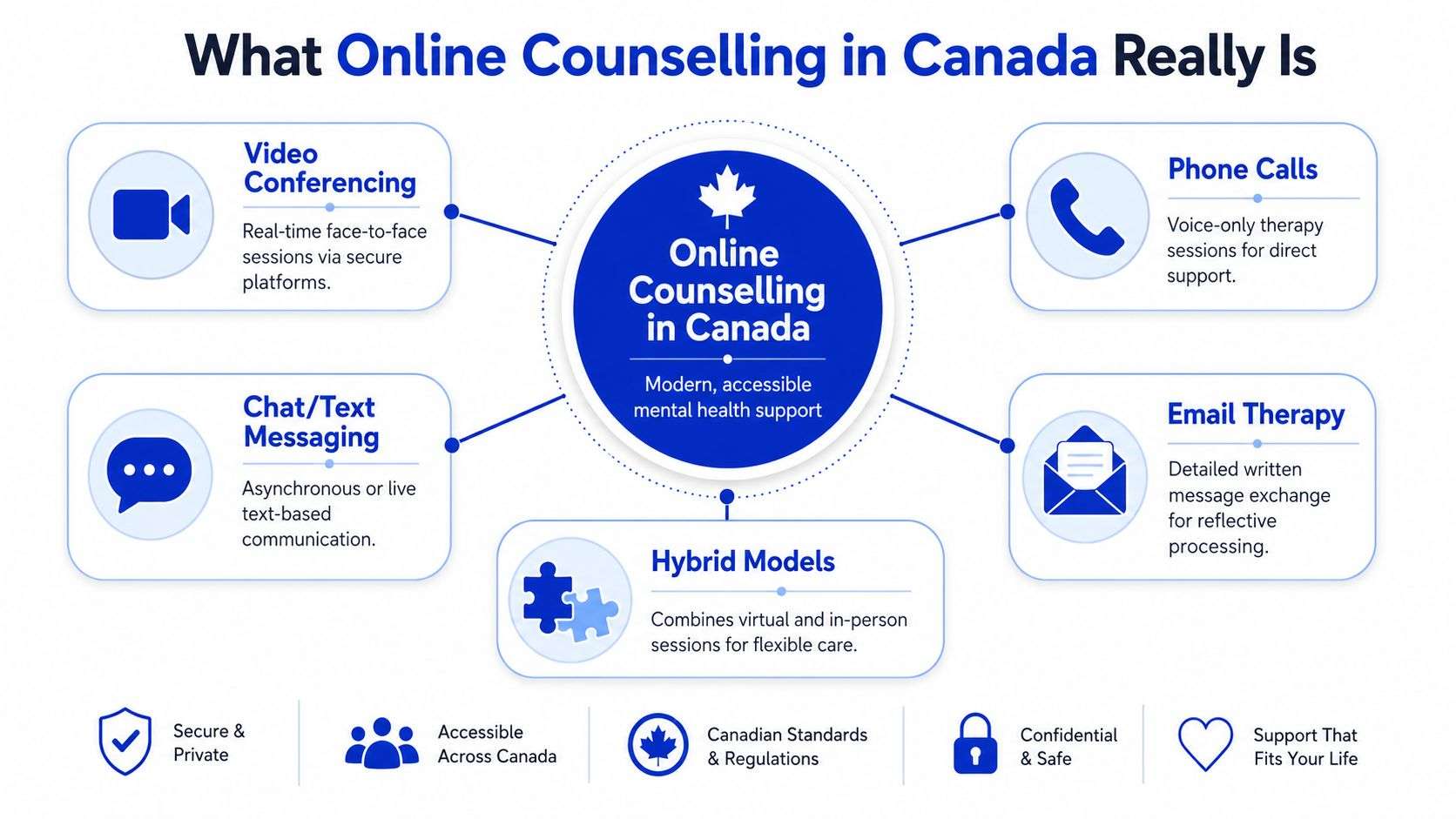
Online counselling in Canada includes more than video calls. At its core, it means mental health support delivered through communication technology, using a format that fits the client's needs, comfort level, and clinical situation.
Here's a simple way to think about it. Therapy is a meaningful conversation with structure and purpose. Virtual care gives therapists and clients several ways to have that conversation safely.
The main formats you may see
- Video sessions help when facial expression and face-to-face conversation feel important.
- Phone sessions can work well for people who want privacy, feel self-conscious on camera, or have limited internet.
- Live chat or text-based formats may suit some clients, depending on the service and the nature of support.
- Email-based communication can allow for reflection, though it isn't a fit for every situation.
- Hybrid care combines in-person and virtual sessions when that makes clinical sense.
Canadian guidance from the Canadian Association of Social Workers describes online counselling as being delivered through synchronous and asynchronous information and communication technologies, commonly including video, live chat, email, and telephone. The same guidance also says the best format should be chosen through a formal assessment of things like client risk, motivation, communication style, and comfort with technology before treatment begins.
Why format matters
One person may feel most connected through video. Another may speak more openly by phone because they don't have to look at themselves on screen. Someone with unstable internet may need a phone backup. These aren't small details. They shape how safe, comfortable, and workable therapy feels.
This is one reason professional virtual counselling is more than “just talking online.” A therapist should be thinking about whether the technology supports the care, not just whether the app opens.
Practical rule: The best virtual format is the one that supports privacy, connection, and the kind of therapy you need.
Is it actually effective
For many common concerns, yes. Canadian evidence syntheses and clinical guidance support the effectiveness of therapist-guided remote CBT, with moderate-certainty evidence showing little to no difference versus in-person CBT across a range of mental health disorders.
The important phrase there is therapist-guided. In other words, the quality of the clinical model matters. Structured care, regular sessions, guided exercises, and progress monitoring tend to matter more than whether you're sitting in an office or at home.
How a Virtual Therapy Session Actually Works
A lot of anxiety fades once the process feels familiar. Most virtual sessions are straightforward, and after one or two appointments, many people find the technology becomes the least important part of the experience.
Before the session
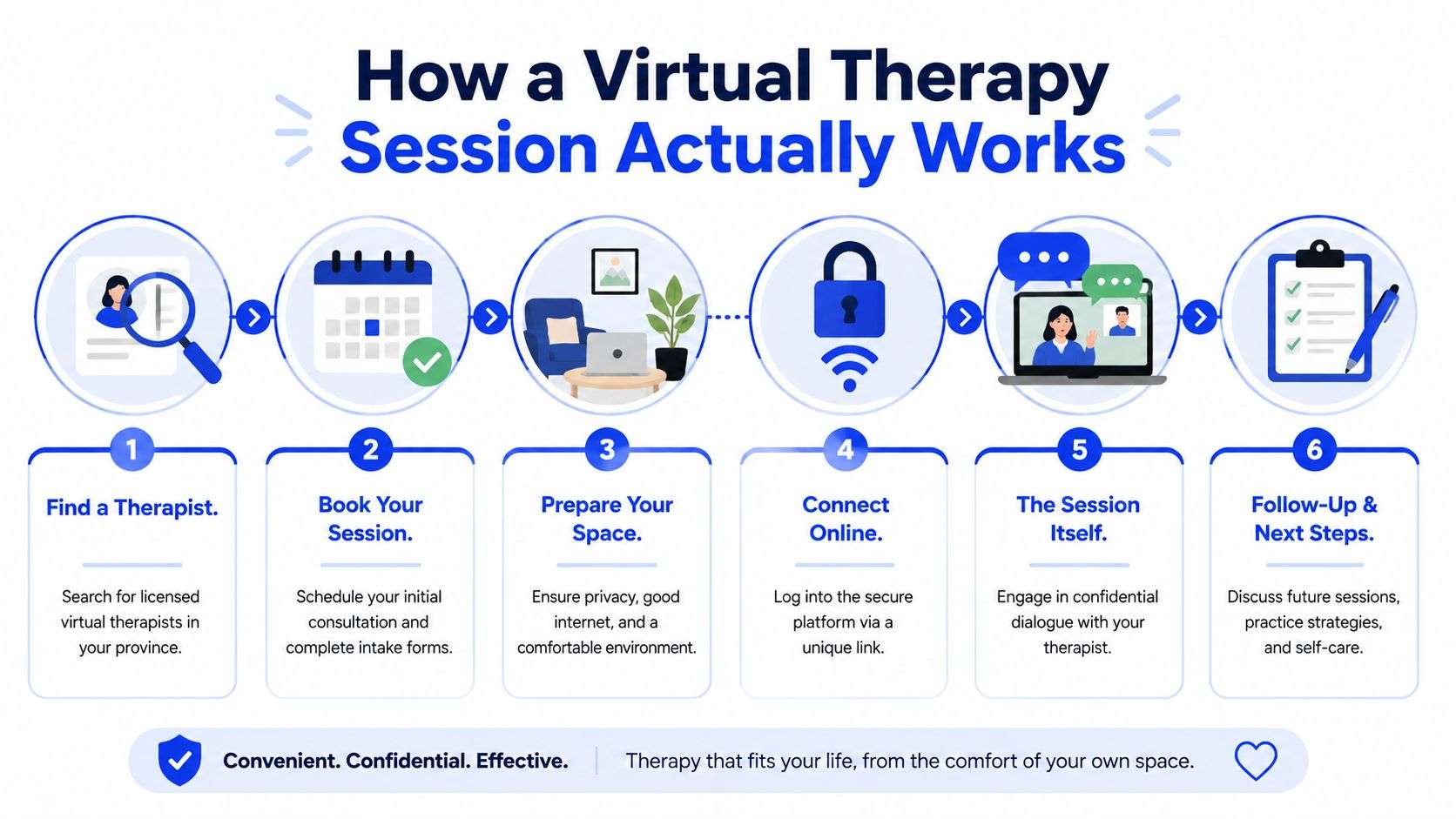
The process usually begins with booking. You'll often choose a time, share basic contact details, and complete intake forms. A therapist or practice may also ask where you live, what brings you to counselling, whether you've had therapy before, and whether there are any immediate safety concerns.
That location question can surprise people, but it matters. In Canada, therapists need to pay attention to the client's home province because licensing and privacy rules can vary.
You'll then receive instructions for the session. That often includes:
- A secure link to a protected video platform
- Simple consent forms that explain confidentiality, risks, and limits
- A backup plan such as switching to phone if video fails
- Practice details about cancellations, emergencies, and contacting your therapist
Getting set up
You don't need a perfect home office. You need a reasonably private space and a device that works.
Many clients use:
- a laptop at a desk
- a phone with headphones
- a tablet propped on a table
What helps most is reducing interruptions. Closing a door, muting notifications, and letting others know you need privacy can make a big difference.
If you're worried about “doing it right,” that's normal. Therapists who provide virtual care are used to helping clients settle in, troubleshoot, and adjust.
During the first session
The first few minutes are often practical. Your therapist may confirm your identity, location, and a phone number in case the connection drops. They may review confidentiality and explain what virtual care can and can't offer, especially if you're in distress or need crisis support.
Then the conversation begins much like in-person therapy does. You talk about what's been happening, what feels hard, what you hope will change, and what kind of support might help. The therapist asks questions, listens closely, and starts building an understanding of your situation.
A typical session might include:
Check-in
How you've been feeling, what feels most pressing, and what you want to focus on that day.Exploration
Looking at thoughts, emotions, patterns, relationships, or symptoms in more depth.Support and strategy
This could include coping tools, reflection, skill-building, or having a safe place to process.Wrap-up
Near the end, your therapist may summarise key themes, suggest something to notice between sessions, and confirm next steps.
What if the connection drops
This is common enough that ethical virtual care plans for it. You and your therapist should know in advance what happens if video freezes, audio cuts out, or the platform fails. Usually, the backup is simple: reconnect, switch devices, or continue by phone.
Good virtual care isn't based on everything going perfectly. It's based on having a clear plan when things don't.
Technology Privacy and Your Confidentiality
For many new clients, this is the biggest question: Is online therapy private?
It should be, if it's being offered properly. Canadian clinical guidance makes clear that safe virtual care requires more than a general consumer video app. It calls for end-to-end encryption, password protection, secure backup systems, and a formal assessment of whether the technology is appropriate for the client's situation, as outlined in Canadian guidance on online counselling practice.

What that means in plain language
Think of a secure virtual platform as the digital version of a private counselling room. In person, you'd expect a closed door, a confidential file, and professional boundaries. Online, you should expect the same level of care, just through different tools.
A secure setup usually includes:
- Protected access so only the right people can enter the session
- Encrypted communication so the conversation isn't easily exposed in transit
- Password-protected systems for notes, files, and clinician accounts
- Reliable backup procedures if the platform or device fails
- Clear consent information about how virtual care works
What clients can do on their end
Privacy is shared. Your therapist is responsible for the platform and professional safeguards. You can help by choosing the most private setting available to you.
That might mean:
- using headphones
- sitting in your car for a session if home is crowded
- turning off smart speakers nearby
- avoiding public Wi-Fi when possible
- checking who can overhear you
A good question to ask is, “What platform do you use, and how do you protect my information?”
That question isn't rude. It shows you're taking your care seriously.
Understanding Provincial Licensing for Therapists
This is one of the most important parts of online counselling in Canada, and one of the least explained.
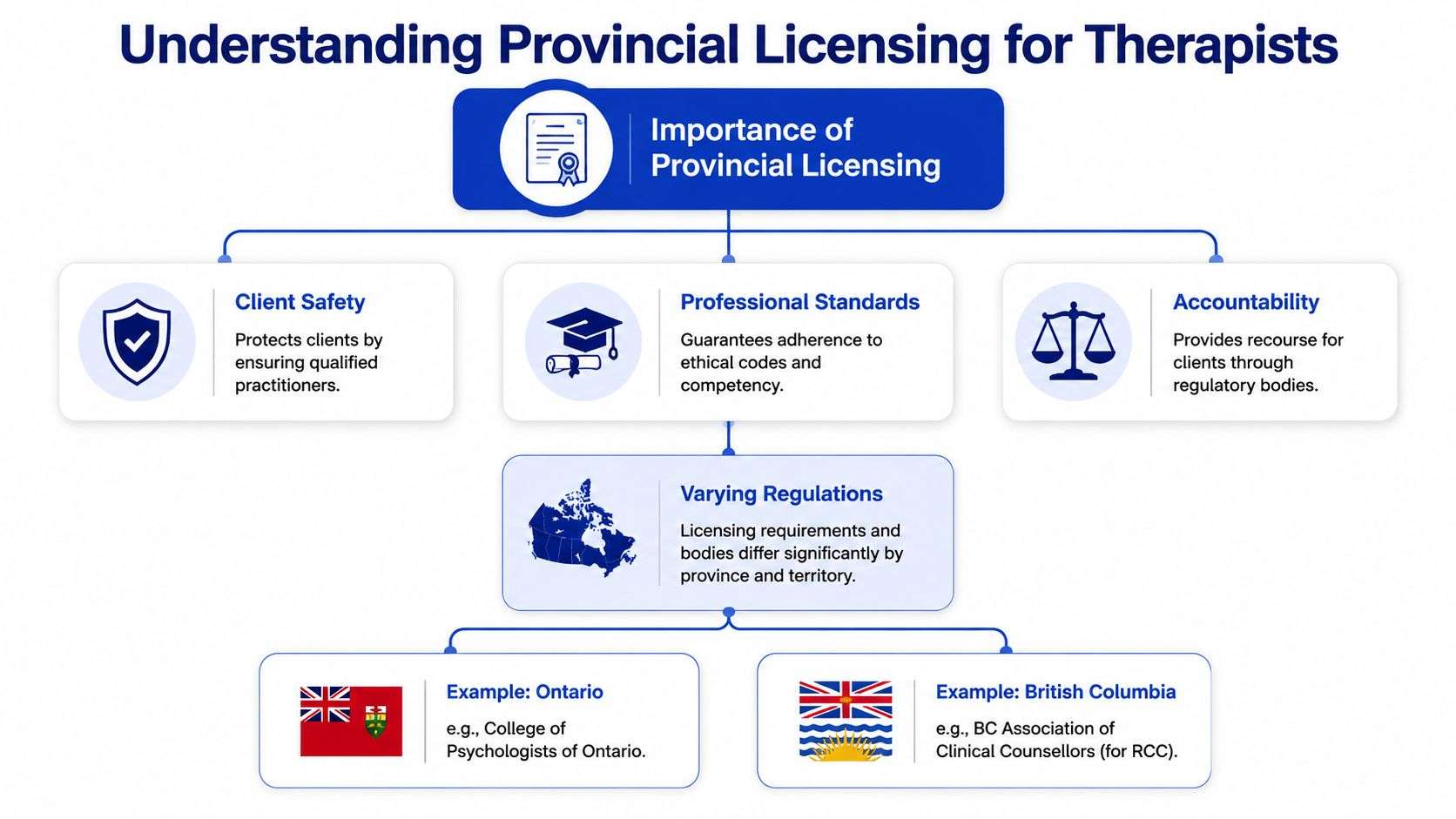
A therapist's ability to practise is often tied to the province where the client lives. That means virtual care isn't “online, so it works everywhere.” Canada has a fragmented regulatory system, and a therapist's credentials and data practices need to comply with the rules connected to the client's home province to support confidentiality and legal validity.
A simple way to understand it
Think of it a bit like professional driving rules. Even if someone is highly skilled, there are still jurisdiction-specific rules about where and how they can operate. Therapy regulation works in a similar way. The province isn't just a location detail. It shapes the standards, oversight, and accountability attached to your care.
Why this protects you
Provincial licensing or registration helps with three big things:
| Area | Why it matters to clients |
|---|---|
| Safety | It helps ensure the therapist has appropriate training and is allowed to practise. |
| Standards | It connects the therapist to ethical rules, competency expectations, and scope of practice. |
| Accountability | It gives clients a regulatory body or professional framework to turn to if concerns arise. |
If a therapist is working with clients across provinces, they need to understand where they are permitted to practise and how privacy obligations apply in those locations.
Where people often get confused
Many clients assume that if a website is available across Canada, every therapist on it can legally work with every Canadian client. That isn't always true.
Questions worth asking include:
- Which province are you licensed or registered in?
- Can you work with clients who live in my province?
- How is my information stored and protected?
- What happens if I travel or move during therapy?
Those questions become even more important when documentation, extended benefits, or claim-related services are involved.
If you're a therapist or practice owner trying to understand how websites can clearly communicate credentials and service areas, Solo AI Website Creator's guide offers a useful look at how therapy websites can present practical information in a client-friendly way.
The main point is simple. A good online therapy service should make it easy for you to understand who your therapist is, where they can legally practise, and how your information is handled.
Is Virtual Therapy the Right Choice for You
Online counselling can be an excellent fit. It can also be the wrong fit in some situations. The most helpful question isn't “Is virtual therapy good or bad?” It's “Does this format match what I need right now?”
Virtual therapy may fit well if
- You need flexibility because of work, caregiving, school, or health limitations.
- Travel is difficult because of distance, fatigue, mobility, weather, or time.
- You feel safer at home and open up more easily in familiar surroundings.
- You want more choice in finding a therapist whose background or approach suits you.
- You're comfortable with basic technology or at least willing to try.
In-person care may be better if
- You're in acute crisis and need immediate local or emergency support.
- You need intensive hands-on care that can't be managed well through a screen or phone.
- Privacy is hard to create in your living environment.
- Technology feels like a barrier rather than a support.
- You strongly prefer face-to-face presence and find screens disconnecting.
A balanced way to decide
Here's a simple comparison:
| Question | If yes, virtual may work well | If no, consider alternatives |
|---|---|---|
| Can you find a private place for sessions? | Likely manageable online | In-person may feel easier |
| Can you reliably use phone or video? | Virtual is more practical | Another format may be better |
| Are you seeking ongoing counselling rather than crisis support? | Virtual can be a good option | Urgent local care may be needed |
| Do you want therapy to fit around daily life? | Online can reduce barriers | Office-based care may still suit you |
One important clinical note matters here. Canadian guidance indicates that online counselling isn't appropriate for crisis support, which is why responsible services build in triage pathways and safety planning before treatment begins.
If you're unsure, that uncertainty itself is worth bringing up in an initial consultation. A thoughtful therapist won't push one format. They'll help determine whether it matches your needs.
Preparing for a Successful Online Session
You log in a few minutes before your appointment. The room is quiet, your phone is muted, and you know what to do if the video freezes. That kind of setup can make an online session feel much easier.
Preparing for virtual counselling is less about doing everything perfectly and more about removing small distractions before they pull your attention away. A good session often starts with a few simple choices that help you feel private, settled, and present.
A short preparation checklist
- Pick one private space where interruptions are less likely.
- Check your device and internet a little early so the first minutes are not spent fixing tech problems.
- Use headphones if other people are nearby or walls are thin.
- Keep water, tissues, or a comfort item nearby if that helps you stay grounded.
- Turn off notifications on your phone, computer, and watch.
- Keep a backup plan ready such as a phone number or alternate contact method if the platform stops working.
It can also help to write down two or three prompts before the session. A few words are enough. You might note, “what felt hardest this week,” “what I keep avoiding,” or “what I want help making sense of.”
That works like bringing a bookmark to a conversation. You do not need a script. You just need a place to begin.
Questions to ask before you book
A good match involves more than finding an open time slot. In Canada, it also helps to know whether the therapist can legally work with clients in your province and how their practice handles privacy, records, and online communication.
You might ask:
- What experience do you have with the concern I want help with?
- Are you licensed or registered to provide therapy in my province?
- Do you offer video, phone, or both?
- What platform do you use, and how do you protect privacy?
- How is consent handled for virtual care and record keeping?
- What happens if the connection drops or I decide the fit is not right?
These questions are not being difficult. They are part of informed consent. A clear answer helps you understand the care you are agreeing to, much like reading the label before taking a new medication.
The goal is not to perform well in therapy. The goal is to create enough quiet and privacy that you can arrive as yourself.
Common Questions About Online Counselling
You might be sitting on your couch after work, finally ready to book a session, and then a few practical questions show up all at once. Will insurance help cover this. What if video feels awkward. What if the therapist is kind, but not the right fit.
Those questions are normal. Asking them is part of making an informed choice, especially in Canada, where coverage rules, therapist titles, and provincial requirements can differ.
Is online counselling covered by insurance or extended benefits?
Sometimes yes, sometimes no. Coverage usually depends on two things: your specific benefits plan and the therapist's professional designation.
A simple way to check is to contact your insurer before booking and ask which regulated credentials they reimburse for virtual counselling. You can also ask whether they cover video sessions, phone sessions, or both. If your care is connected to a motor vehicle accident, workplace claim, or another third-party process, ask what paperwork they need and whether the provider must belong to a particular college or association.
What if I do not click with my therapist?
Fit matters in therapy. It is a bit like meeting with a tutor. Even if the tutor is skilled, the process may still feel off if the style does not suit how you learn.
You are allowed to say that. A good therapist should be able to talk with you about what is not working, adjust their approach when appropriate, or help you find someone who may be a better match. Changing therapists does not mean you failed. It means you are paying attention to what helps you feel safe enough to do honest work.
Can I do online counselling by phone instead of video?
Often, yes. Many therapists in Canada offer both formats, but they may recommend one over the other based on your needs, privacy, communication style, and safety planning.
Phone sessions can feel easier if you are overwhelmed by being on camera, have limited internet, or focus better without a screen. Video can help when facial expression and body language are important parts of the conversation. The best option is the one that supports clear communication and appropriate care.
What if I am nervous and do not know what to say?
That is one of the most common concerns. You do not need to arrive with a polished explanation of your life.
You can start small. “I have been feeling off lately.” “I am not sure why I booked, but I know something is not working.” “I do better when people ask me questions.” Those simple starting points give the therapist something real to respond to.
Silence is okay too.
What if I need urgent help right now?
Online counselling is usually meant for ongoing support, not immediate crisis response. If you are in immediate danger or feel unable to stay safe, contact 911 or a local crisis service right away.
If the situation feels urgent but not life-threatening, your province or territory may have local mental health crisis lines, urgent care options, or hospital-based services that can respond faster than a scheduled therapy appointment. This is also why therapists often ask for your location and an emergency contact at the start of virtual care. It helps them respond appropriately if a serious safety concern comes up during a session.
If you are considering support and want to learn more about virtual, phone, or in-person counselling options, Interactive Counselling offers services for individuals, couples, families, children, and youth across a range of concerns. You can review the information, ask questions about fit, and decide at your own pace.
Clinically Reviewed By
Amy Mosset, MCP, RCC-S
Amy Mosset is a Master Practitioner in Clinical Counselling, Clinical Supervisor, and the owner of Interactive Counselling. She provides trauma-informed, evidence-based care and clinical supervision to registered therapists, with a focus on ethical practice, client safety, and high-quality therapeutic outcomes.