
If you're a driven person—successful, always pushing for the next goal—you're in the right place. We see your hard work, and we celebrate what you’ve built. But we also know about the private battle that often comes with that success: the quiet, nagging feeling that no matter what you do, it's never quite good enough. For more information, see our anxiety counselling.
"High achievers struggle the most because their success is often tethered to a relentless inner critic and a deep-seated fear of failure, transforming healthy ambition into a cycle of anxiety and self-doubt."
The High Achiever's Paradox
This is the tricky part of being a high achiever, isn't it? The very same traits that drive you to succeed—your sharp eye for detail, your incredibly high standards—are the same ones that can give your inner critic so much power. It’s a tangled dynamic where your ambition gets mixed up with a fear of falling short, creating a loop that feels impossible to break.
This article isn't about pointing out a flaw. It's a compassionate guide to understanding this as a common, manageable pattern. You are not alone in this. So many of the most capable people we know feel exactly this way.
Understanding the Internal Conflict
When you dig into it, this struggle is really about the connection between your ambition and your sense of self-worth. For many high achievers, those two things become welded together. A project gets minor criticism, and it doesn't just feel like a learning moment—it feels like a final judgment on your entire ability. You miss a target, and it’s not just a bump in the road; it feels like a total personal failure.
This can create an internal world where:
- Success feels temporary. The high from hitting a goal fades almost immediately, replaced by the pressure to prove yourself all over again.
- Rest feels unproductive. Taking a break can bring on a wave of guilt, with that inner voice insisting you should be doing more, being more.
- Vulnerability feels dangerous. The thought of being seen as anything less than perfect can make it almost impossible to ask for help or admit you're overwhelmed.
The constant chase for an unattainable standard of perfection means you're set up to feel like you're falling short from the start. It’s a trap where the finish line keeps moving further away, no matter how fast you run.
Moving Toward a Healthier Path
Simply recognizing this pattern is the first, and most important, step toward making a change. It helps you see that nagging inner critic not as the voice of truth, but as a learned script—and you can absolutely learn to rewrite it.
Our goal here is to help you gently untangle your self-worth from your list of accomplishments. When you do that, you open the door to a more sustainable, peaceful way of living and working—one where your drive fuels you instead of draining you. Throughout this guide, we'll walk you through gentle, evidence-based strategies to quiet that critical voice and find your way back to a sense of inner balance.
The Unsettling Duet: Perfectionism and the Inner Critic
To really get a handle on why you might feel so stuck, it helps to understand the two key players in this internal struggle: perfectionism and its enforcer, the inner critic.
Imagine you have a supportive coach in your corner. This coach champions healthy ambition, encourages you to do your best, celebrates your effort regardless of the outcome, and helps you learn from mistakes. That's the voice of growth.
But perfectionism? That's not a coach—it's a cruel drill sergeant. It’s the voice screaming that anything less than flawless is an abject failure. It turns minor slip-ups into definitive proof of your inadequacy. This isn't about striving for excellence; it's about being terrified of not being good enough.
The Different Masks of Perfectionism
Perfectionism isn't a one-size-fits-all problem. You might be your own toughest critic, imposing impossibly high standards on yourself (self-directed perfectionism). But for many high achievers, the most damaging form is what we call socially prescribed perfectionism.
This is that constant, nagging feeling that everyone else—your boss, your family, your peers—has impossibly high expectations of you. You feel an overwhelming pressure to meet these standards to earn their approval and avoid being rejected. It’s absolutely suffocating.
This isn't just a feeling; it's a growing cultural issue. A study tracking Canadian university students from 1989 to 2016 found a significant increase in socially prescribed perfectionism. The pressure to appear perfect is on the rise.
This cycle, which we call the High Achiever's Paradox, shows how the very drive to succeed can end up feeding the inner critic and trapping you in a loop of anxiety.
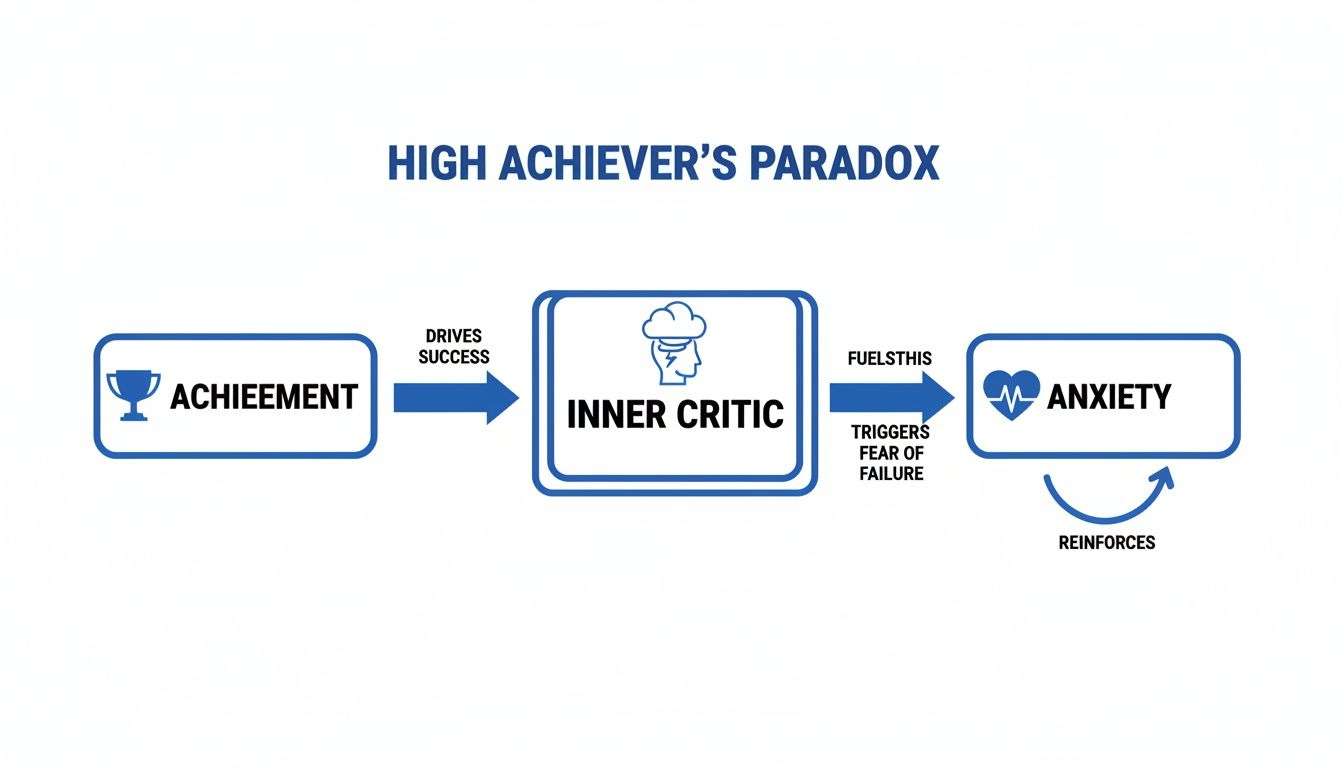
As you can see, the pursuit of achievement can activate that harsh inner critic, which then churns out anxiety. This anxiety just reinforces the belief that you must be flawless to feel safe and in control.
The Inner Critic: Perfectionism's Loudspeaker
If perfectionism is the rulebook filled with impossible standards, the inner critic is the ruthless enforcer making sure you never, ever forget them. It’s that voice in your head that highlights every flaw, brushes off every success as a fluke, and constantly reminds you how much better everyone else is doing.
This internal monologue doesn't just appear out of nowhere. It often has deep roots, usually forming in childhood or adolescence in environments where love and safety felt conditional. If you learned early on that praise only came after a perfect report card or a first-place trophy, your brain might have developed an inner critic as a defence mechanism to keep you performing and, therefore, "safe."
Your inner critic is not a reflection of your true worth. It’s an outdated survival strategy that no longer serves you. Its only real power is its ability to convince you that its harsh narrative is the truth.
The goal isn't to declare war on this voice—that often just makes it louder. The first, most crucial step is to simply recognize it for what it is: a pattern of thought, not an undeniable fact. Developing a better understanding of your internal world is key, and for some, looking into how to improve self-awareness can be a helpful place to start.
When you learn to observe this voice with curiosity instead of automatically believing it, you create space. In that space lies your power. It allows you to see the critic's harsh words not as commands to be followed, but as background noise. For more on this, our article exploring the relationship between the inner critic vs anxiety might be helpful. This separation loosens its grip, giving you the freedom to choose a kinder, more compassionate way of treating yourself.
Why High Achievers Are So Vulnerable to Perfectionism
If you're a driven, capable person who wrestles with perfectionism, you’ve probably wondered why it has such a tight grip on you. For so many high achievers, the connection is deeply personal because your identity gets tangled up with your accomplishments. Success stops being something you do and starts becoming who you are.
This fusion creates an incredibly high-stakes environment inside your own head. A missed deadline, a minor flaw in a project, or a piece of constructive feedback doesn't just feel like a simple mistake. To your inner critic, it feels like a fundamental failing of your character—all the "proof" it needs to argue that you aren't as smart, talented, or worthy as everyone thinks you are.
The Accomplishment and Identity Trap
This pattern often starts early in life for high achievers. Maybe you were the kid praised for getting top marks, excelling in sports, or always being the responsible one. Over time, your brain learns a simple but dangerous equation: Achievement = Worthiness and Safety. As long as you keep performing, you feel secure and valued.
This puts you on a treadmill, constantly chasing the next piece of validation. The moment you step off, even just to catch your breath, the inner critic starts whispering fear-based questions: What if you can't do it again? What if they find out you're not that great? This relentless internal pressure is exactly why so many outwardly successful people live with a constant, low-grade hum of anxiety.
Fertile Ground for Imposter Syndrome
This is the perfect breeding ground for Imposter Syndrome—that nagging, persistent feeling that all your successes are a fluke and you're just one wrong move away from being "found out." You could achieve something incredible, but your inner critic will be right there to dismiss it.
This internal tug-of-war often looks like:
- Discounting praise: When someone congratulates you, you might think, "They're just being nice," or, "It wasn't that big of a deal."
- Attributing success to luck: You might chalk up your accomplishments to external factors rather than your own skill and hard work.
- Fixating on flaws: You could deliver a presentation that is 99% successful, but you'll lose sleep over that one tiny mistake you made.
This isn't a sign of weakness; it’s a recognized psychological pattern. The inner critic magnifies small setbacks into overwhelming evidence of inadequacy, making you feel like a fraud despite a mountain of evidence to the contrary.
Think of the dedicated team leader who stays up all night agonizing over a single typo in a company-wide email. Or the loving parent who’s convinced that one imperfect holiday celebration has somehow failed their entire family. These aren't logical conclusions; they are the distorted narratives of a perfectionistic inner critic working overtime.
This struggle is far more common than you think, especially among people who appear flawless on the outside. Understanding this vulnerability is the first step toward validating your own experience and realizing you are not alone in this.
The Rising Tide of Perfectionistic Pressure
It's not just in your head—the pressure to be perfect is being amplified by our culture. Research shows that the quest for perfection has been steadily climbing for decades. A major study that tracked students across Canada, the U.S., and the U.K. found a significant increase in perfectionistic traits in less than 30 years. The findings noted that Canadian kids as young as middle-schoolers are already burning out from trying to be perfect in school, sports, and their social lives. This only strengthens the inner critic that high achievers so often carry into adulthood. You can learn more about how these impossible standards affect well-being by exploring insights from the Mayo Clinic Health System.
This cultural shift means the internal pressure you feel is constantly being reinforced by external expectations. It creates a tough environment where "good enough" rarely feels like a real option, and the inner critic’s demands for flawlessness seem not just reasonable, but necessary for survival. Recognizing this shared struggle can help reduce the sense of isolation and self-blame that perfectionism thrives on.
The Hidden Toll of Chasing Perfection
The constant pressure to be perfect isn’t just draining; it comes with a steep, hidden price tag that impacts your mental, emotional, and even physical health. This relentless pursuit, often driven by a harsh inner critic, slowly erodes your sense of peace and creates a baseline of chronic stress that can seep into every corner of your life.

This isn't about getting a few butterflies before a big presentation. It’s more like a constant, low-grade hum of worry that never really switches off. Your inner critic has convinced you that your worth is always on the line, turning every task, big or small, into a high-stakes performance where failure is not an option.
Over time, this constant state of high alert leads to some serious fallout, moving well beyond simple stress and into more complex territory.
The Pathways to Burnout and Anxiety
When your mind is perpetually scanning for potential flaws and mistakes, your nervous system gets stuck in overdrive. This is the perfect breeding ground for chronic anxiety. The fear of not being good enough morphs into a self-fulfilling prophecy, leaving you feeling perpetually overwhelmed, no matter how much you actually get done.
This sustained pressure is a direct route to burnout. And burnout is so much more than feeling tired—it's a state of profound emotional, physical, and mental exhaustion. For many high achievers, hitting that wall feels like a deep personal failure, which just adds fuel to the inner critic’s fire and makes the whole cycle that much harder to escape.
The mental and emotional costs often show up in very real ways, including:
- Chronic Anxiety: That persistent feeling of dread that something is about to go wrong, making it impossible to truly relax or enjoy your accomplishments.
- Decision Paralysis: The fear of making the "wrong" choice becomes so intense that you end up struggling to make any decision at all.
- Burnout: A state of total depletion where you feel cynical about your work, disconnected from others, and completely ineffective.
Perfectionism is rooted in the false belief that you can—and therefore should—be perfect. Since true perfection is an illusion, this mindset sets you up for a lifetime of frustration, self-blame, and the constant feeling that you're falling short.
The Procrastination Paradox
It sounds backward, doesn't it? But one of the most common side effects of perfectionism is procrastination. The pressure to deliver something flawless becomes so immense that the fear of not measuring up is paralyzing. So, instead of starting the task, you avoid it entirely.
Your inner critic whispers that if you can't do it perfectly, maybe it's better not to do it at all. This avoidance brings a fleeting sense of relief, but it ultimately creates even more stress as deadlines get closer. This only reinforces the critic’s harsh narrative that you're incapable or lazy.
Strained Relationships and Isolation
Those impossibly high standards you hold for yourself rarely stay neatly contained. They have a way of spilling over into your relationships with friends, family, and colleagues. You might catch yourself being overly critical of others or holding them to the same rigid expectations you place on your own shoulders.
This can create conflict and emotional distance, leaving you feeling misunderstood and alone. It's hard to build authentic connections when you're constantly evaluating yourself and everyone around you. The very drive you believe makes you valuable can end up pushing away the people you care about the most.
In fact, research from here in Canada has shown that these perfectionistic concerns—like a chronic fear of making mistakes—are a key predictor of depressive symptoms. The data reveals a significant link with depression, especially among high achievers whose inner critic demands nothing less than flawlessness.
Recognizing these hidden costs is the first, most crucial step. It helps you draw a clear line between the inner critic's demands and the real pain they cause, giving you the motivation you need to start forging a kinder, more sustainable path forward.
Proven Pathways to Tame the Inner Critic
Knowing you have an inner critic is one thing. Actually learning how to turn down the volume on its relentless monologue is something else entirely. The good news? You don't have to fight this battle on your own. There are gentle, effective, and well-researched therapeutic approaches that create a safe space to untangle these deep-rooted patterns and build a much kinder relationship with yourself.
Let's explore a few of these pathways. Think of them less as quick fixes and more as compassionate roadmaps. A registered counsellor can act as your guide, helping you navigate toward a more peaceful and productive way of being.
Cognitive Behavioural Therapy
Cognitive Behavioural Therapy (CBT) is a practical, hands-on approach that zooms in on the connection between your thoughts, feelings, and actions. When you're dealing with perfectionism, the inner critic’s thoughts often feel automatic and true, even when they’re distorted. CBT gives you the tools to become a gentle detective of your own mind.
A counsellor using a CBT approach might help you:
- Identify Distorted Thoughts: You’ll learn to spot the common mental traps that fuel perfectionism. This includes things like "all-or-nothing" thinking (if it’s not perfect, it’s a complete failure) or catastrophizing (assuming a small mistake will lead to a disastrous outcome).
- Challenge and Reframe: Once you can see these thoughts for what they are, you can start to question them. You’ll work on gently replacing that harsh, critical self-talk with more balanced, realistic, and genuinely compassionate perspectives.
This isn't about slapping on a layer of forced positivity. It’s about cultivating a more flexible and accurate way of seeing yourself and your efforts, which, over time, naturally quiets the critic's voice.
Acceptance and Commitment Therapy
Acceptance and Commitment Therapy (ACT) comes at it from a slightly different angle. Instead of trying to eliminate the inner critic, ACT teaches you how to change your relationship with it. The goal is to reduce its power so it no longer dictates your choices or holds you back from the life you want to live.
The core idea of ACT is that you can hear the critic’s noise without letting it drive the car. You can acknowledge the thought—"This isn't good enough"—and still choose to move forward in a direction that aligns with your personal values.
This is an incredibly freeing approach for high achievers who worry that letting go of perfectionism means losing their drive. ACT helps you connect with what truly matters to you—things like creativity, connection, or personal growth—and use those values as your motivation, rather than fear. A key part of this is learning to detach from mental chatter, and exploring effective mind body connection exercises can be a powerful first step on that journey.
Compassion-Focused Therapy
Compassion-Focused Therapy (CFT) goes straight to the heart of the matter. It directly counters the inner critic’s cruelty by helping you actively cultivate an inner voice of warmth, kindness, and support. For many perfectionists, the idea of self-compassion can feel a bit strange, or even undeserved. But it's a skill, and like any skill, it can be learned.
CFT helps you understand why your brain is wired to spot threats (a tendency the inner critic loves to exploit) and then teaches you how to deliberately activate your brain’s natural soothing systems. This might involve mindfulness or guided practices where you learn to talk to yourself with the same care you'd offer a good friend. It’s a direct antidote to the harshness of perfectionism.
If you want to dive deeper, you might find our guide on therapist-backed strategies to quiet your inner critic helpful.
Practical Steps to Embrace “Good Enough” Today
While therapy is incredibly powerful for creating deep, lasting change, you don’t have to wait to start shifting your mindset. Think of the strategies below not as more items for your to-do list, but as gentle invitations to practice a bit more self-kindness in your daily life.

Each of these is a small step toward quieting that harsh inner critic and reclaiming a sense of calm. They're designed to prove to you, through your own experience, that "good enough" isn't a cop-out—it’s actually a doorway to a more peaceful and joyful way of living.
Celebrate Progress Over Perfection
Your inner critic is obsessed with the finish line. It dismisses anything short of a flawless outcome as a complete failure. The best way to push back is to consciously acknowledge and celebrate your effort and progress, no matter what the final result looks like.
Did you finally start that task you’ve been putting off? That’s a win. Did you manage a tough conversation with a little more grace than last time? Celebrate it. When you shift your focus from the all-or-nothing result to the process itself, you start to starve the inner critic of its power.
Set Flexible Goals Instead of Rigid Ultimatums
Perfectionism has a way of turning goals into rigid, pass-fail ultimatums. Instead of falling into that trap, try setting flexible, value-driven intentions. It's like choosing a general direction on a compass rather than a single, distant pin on a map.
For instance, instead of a rigid rule like, "I absolutely must work out for one hour every single day," a more flexible intention would be, "I want to move my body in a way that feels good a few times this week." This approach builds in room for life’s inevitable curveballs and encourages self-compassion when things don’t go perfectly to plan.
"Your inner critic constantly narrates your every move, but you don't have to believe the story it's telling. Mindfulness teaches you to observe these thoughts as passing mental events, not as commands you must obey."
Practice Mindful Observation
Mindfulness is an absolute game-changer for dealing with perfectionism. At its core, it’s about paying attention to the present moment without slapping a judgment on it. The next time that critical voice pipes up, just try to notice it.
You might say to yourself, "Ah, there's that 'not good enough' story again." This simple act of observation creates a tiny but powerful gap between you and the thought. You begin to realise you are the one observing the thought, not the thought itself. In that small space, you’ll find your freedom.
Cultivate Self-Compassion
This might just be the most important step of all. Self-compassion is about treating yourself with the same warmth and understanding you’d offer a close friend who was having a hard time. Your inner critic speaks to you in ways you would never dream of speaking to someone you care about.
The next time you’re struggling, pause and ask yourself:
- What would I say to a friend who was in this exact situation?
- What does the kindest part of me really need to hear right now?
Learning to offer yourself this gentle support is a direct antidote to the harshness of perfectionism. Remember, it’s a practice, not a perfect performance. Every small attempt helps build a more supportive and caring inner world, offering a clear path to taming the inner critic that so many high achievers struggle with.
Your Questions on Perfectionism Answered
It makes perfect sense to have questions when you start exploring something this personal. Let's walk through some of the most common concerns we hear from high achievers about their inner critic and what it really means to let go of perfectionism.
If I Let Go of Perfectionism, Will I Lose My Drive?
This is, without a doubt, the number one fear. The worry is that if you ease up on yourself, your ambition will disappear and your standards will plummet.
But letting go of perfectionism isn't about giving up or becoming lazy. It’s about shifting how you’re motivated—moving away from a rigid, fear-based drive toward one that’s more flexible, compassionate, and frankly, sustainable.
People who learn to manage their perfectionism often become more productive and creative. When you’re not paralyzed by the fear of making a mistake, you’re free to take healthy risks, which is where real growth and innovation happen. It’s about achieving success that feels meaningful, not just stressful.
Is Perfectionism a Mental Health Disorder?
On its own, perfectionism isn't classified as a mental health disorder. Think of it more as a personality trait or a risk factor that can lie underneath other mental health challenges.
It's a significant feature in many conditions, including:
- Anxiety disorders
- Obsessive-compulsive disorder (OCD)
- Eating disorders
- Depression
The key is the level of distress it causes. When that inner critic and the constant push for flawlessness start to seriously disrupt your daily life, your relationships, or your sense of well-being, it's a clear sign that it’s time to seek professional support.
How Do I Know If I Need Counselling for My Perfectionism?
A good way to gauge this is to look at the impact it’s having on you. Are you constantly feeling anxious, overwhelmed, or like you’re on the edge of burnout? That's a significant sign.
Ask yourself if your fear of making mistakes is holding you back from trying new things. Perhaps you've noticed your relationships are strained because of the sky-high expectations you place on yourself and others. Another tell-tale sign is when you can't seem to actually enjoy your achievements—you just immediately move the goalpost. If this sounds familiar, learning more about supportive therapeutic options through counselling can offer some much-needed clarity. Therapy provides a safe, non-judgmental space to unpack these patterns and build healthier ways of relating to yourself and your goals.
Navigating the path away from perfectionism is a journey of self-compassion, not another task to get right. Each small step toward a kinder inner dialogue is a victory. It’s about gently releasing the need for flawlessness and embracing the freedom that comes with being human—imperfect, resilient, and whole.
Clinically Reviewed By
Amy Mosset, MCP, RCC-S
Amy Mosset is a Master Practitioner in Clinical Counselling, Clinical Supervisor, and the owner of Interactive Counselling. She provides trauma-informed, evidence-based care and clinical supervision to registered therapists, with a focus on ethical practice, client safety, and high-quality therapeutic outcomes.